BPO Consulting in Dubai & UAE | Strategic Outsourcing for GCC Brands
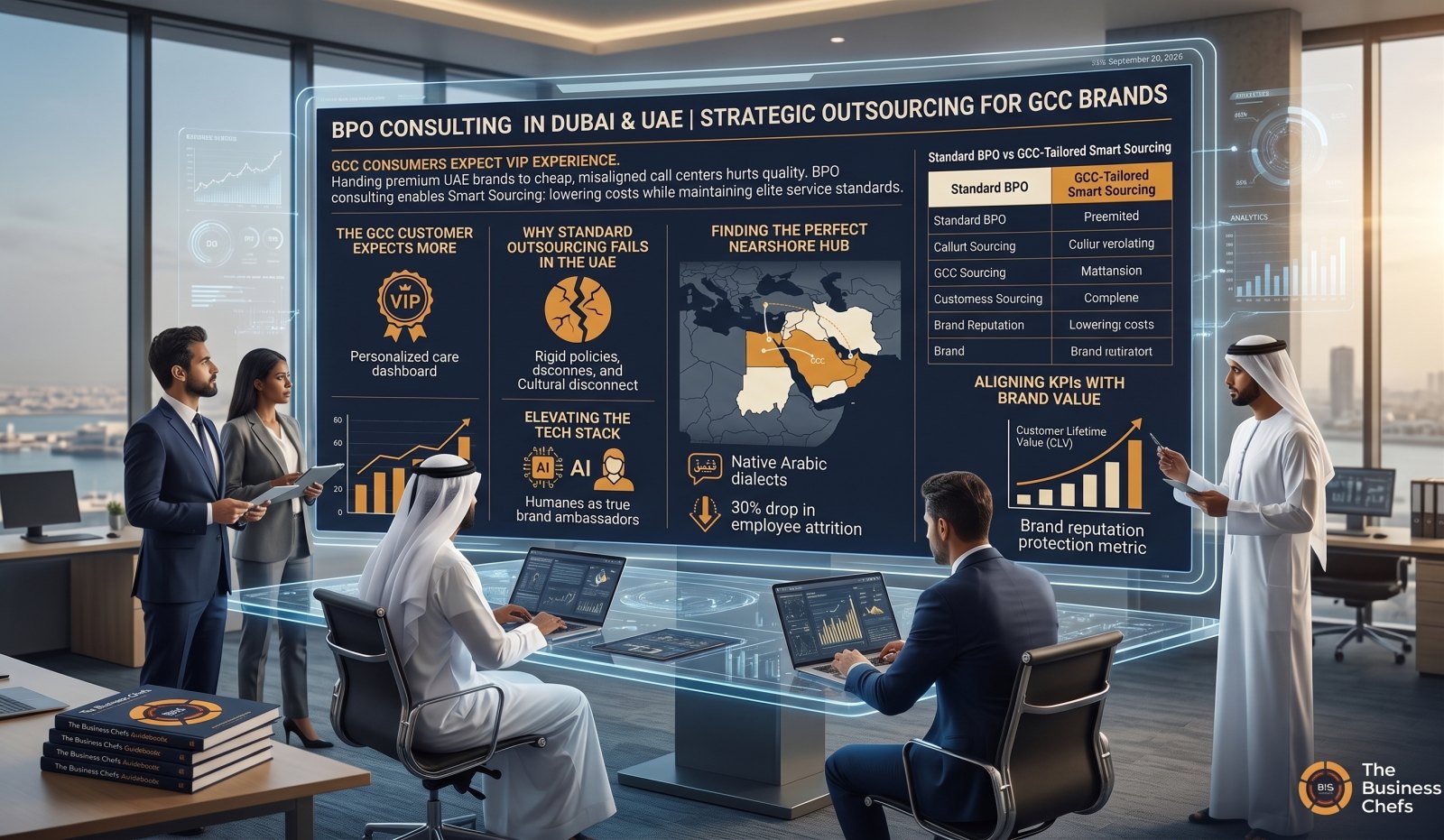
GCC consumers expect a VIP, highly personalized customer experience. You cannot take a premium UAE brand and hand its customer service to a cheap, misaligned offshore call center. Strategic BPO consulting helps GCC companies outsource smartly—lowering costs while maintaining the elite service standards their market demands.
The usual claim is that Gulf consumers expect VIP treatment. That is half right, and the half it gets wrong is expensive.
Expectations here are high, but they are not uniform. A private banking client in Abu Dhabi and a telecom subscriber topping up a prepaid line want different things from the same phone number. The first wants to reach someone who knows them. The second wants the problem solved in ninety seconds without speaking to anyone at all.
What is consistent across the region is that the cost of a poor interaction is high. Markets are small, competitive and well connected, switching is easy, and reputation travels fast. That is the real argument for getting service right, and it holds without any claims about luxury.
The practical implication is segmentation. Work out which of your contacts genuinely needs high-touch handling and which need to be fast, self-serve, or prevented entirely. Then design the sourcing around that, rather than buying premium handling for every contact or generic handling for all of them.
Where outsourcing goes wrong for GCC brands
Outsourcing does not fail here because vendors are careless. It fails in four specific, predictable ways.
The language mix is misread. A GCC customer base is rarely Arabic-only. In the UAE and Qatar, a large share of contacts arrives in English, Hindi, Urdu, Tagalog or Malayalam. Staffing an all-Arabic team is as much a mismatch as staffing a team with no Arabic at all. The answer starts with a breakdown of actual contact volume by language, which many brands have never produced.
Dialect is treated as a checkbox. Where Arabic voice does matter, "speaks Arabic" is not a specification. Gulf, Levantine, Egyptian and Maghrebi registers are not interchangeable, and formality carries weight with a Gulf caller in a way scripts do not capture.
Authority is not delegated. Most escalations in premium segments are not knowledge failures. They are permission failures: the agent knows what should happen and cannot authorize it. No amount of empathy training fixes a policy that requires three approvals for goodwill credit.
Contact drivers are never examined. If a billing rule or an app flow is generating the calls, moving the calls somewhere cheaper changes the cost per contact and nothing else.
The compliance question, which usually arrives too late
Data protection is the constraint most likely to overturn a sourcing decision after it has been made, and the one most often left to legal review at the end.
The UAE and Saudi Arabia both have national data protection regimes, and sectoral regulators add their own requirements for financial services, healthcare, telecoms and government-facing work. Free-zone entities such as DIFC and ADGM operate under their own frameworks. Depending on which of these applies to you, cross-border processing of customer data may be permitted with controls, permitted only to certain jurisdictions, or not permitted at all.
What this means in practice is that three questions belong at the start of the process, not the end:
1. Which regulator and which framework govern the data in each contact type?
2. Does anything in our own client contracts restrict where processing can happen?
3. What controls would make an offshore or nearshore arrangement compliant, and who pays for them?
A vendor who cannot discuss this specifically is telling you something. So is a consultant who presents a location recommendation before these answers exist.
What in-house actually costs in the UAE
Before comparing outsourcing options, most brands need a number they do not have: the fully loaded cost of the operation they already run. Salary is the smallest part of it.
The lines to build into that figure:
- Base salary, plus housing and transport allowances where they apply
- Visa, medical and residency costs, and their renewal cycle
- End-of-service gratuity accrual
- Office space and fit-out, or the per-desk cost if you allocate it
- Telephony, CRM and workforce management licenses per seat
- Recruitment and training cost per hire, multiplied by your actual attrition
- Supervisor, quality, workforce management and training headcount
- Management time spent running the operation, which is real even though nobody invoices for it
- Emiratization obligations under Nafis, where the entity is in scope
Divide the total by resolved contacts rather than by handled contacts. That single change usually moves the comparison more than any vendor’s rate card does, because it prices the repeat calls the current setup generates.
What the engagement looks like
We are practitioners rather than report writers, so the work is structured around decisions you have to make and things that have to be built.
Phase 1: Diagnose (3 to 4 weeks). Contact volume is broken down by language, channel and complexity. Fully loaded cost per resolved contact. Contact driver analysis showing which contacts your own processes are creating. A compliance map for each contact type. You end this phase with a baseline, whether or not you go further.
Phase 2: Design (2 to 3 weeks). The target operating model: what stays in-house, what moves, where it goes, and what gets automated or prevented. A KPI framework and governance rhythm. A business case comparing options on total cost of ownership over three years, including the option of changing nothing.
Phase 3: Execute. Vendor selection run against the framework, transition planning, and delivery oversight through stabilization. We can run the floor alongside your team during transition rather than handing over a document.
What we need from you. Access to contact data and cost lines, a sponsor who can make decisions, and willingness to act on the process findings. The work does not function as an external exercise conducted at arm’s length.
Standard outsourcing against a designed model
|
Standard offshore BPO |
GCC-tailored Smart Sourcing |
|
|
Staffing basis |
Seats filled against a headcount number |
Language and complexity mix taken from actual contact data |
|
Arabic |
Treated as one language |
Dialect and register specified per customer segment |
|
Agent authority |
Script adherence, escalate by rule |
Resolution authority defined and delegated |
|
Compliance |
Addressed at contracting |
Mapped per contact type before location is chosen |
|
Process |
Your SOPs, followed as given |
Contact drivers analyzed, fixes agreed before go-live |
|
Primary metrics |
Volume handled, Average Handle Time |
Resolution, repeat contacts, retention |
|
Cost basis |
Lowest hourly rate |
Lowest total cost per resolved contact |
Average Handle Time still belongs in the operation as a capacity planning input. What changes is that it stops being the thing agents are judged on.
How we are paid, and why it matters here
Any consultant who also introduces you to vendors has a potential conflict of interest, and you should ask about it directly, including with us.
Our advisory work is paid as a fee for the engagement, not as a commission on the vendor you select. If a referral or delivery arrangement exists with a provider under consideration, it gets disclosed before that provider enters the shortlist, and you keep the right to exclude them.
The reason this matters is structural. A recommendation is only worth having if the person making it has nothing riding on which way it goes. If a firm cannot explain its commercial relationships with the vendors it recommends, the recommendation is marketing.
When this is not the engagement you need
- You already know the answer. If the diagnosis is done and you simply need delivery capacity, go to vendors directly. Paying for a design phase to confirm what you know is waste.
- The operation is small. Below roughly ten to fifteen agents, the analysis costs more than it can return. Fix the obvious things first.
- The problem is upstream. If contacts are rising because of a product or policy issue, the fix sits with those teams. We will tell you that in the diagnose phase rather than sell you a sourcing program.
- There is no internal sponsor. Without someone who can approve process changes, the work produces a document and nothing else.
Frequently asked questions
Why do UAE companies outsource customer service?
Mainly cost structure and flexibility. In-house delivery in the UAE carries salary, visa, gratuity, office and licensing costs, and scaling up or down is slow. Outsourcing converts much of that into a variable cost. Whether it saves money in your case depends on volume, language mix and how much management overhead you keep.
Which country is best for GCC brands?
It depends on the contact type. Egypt and Jordan are strong for Arabic voice work and share the business day. Offshore locations such as India and the Philippines are often the better fit for English and South Asian language support and for back-office processing. Many GCC operations end up using more than one.
Will outsourcing hurt our customer experience?
It can, and it does when the staffing does not match the customer base or when agents lack authority to resolve. Neither is a consequence of outsourcing itself. Both are design decisions made before the contract is signed.
How long does the diagnose phase take?
Three to four weeks for a mid-sized operation, assuming reasonable access to contact and cost data. If the data does not exist in usable form, assembling it is part of the work.
Do you run the operation, or just advise?
Both are possible. Some clients want the design and then run it themselves. Others want us alongside them through transition and stabilization. The engagement is scoped to whichever you need.
Start with the baseline
Most of this decision resolves itself once two numbers exist: what your current operation costs per resolved contact, and what your contacts actually consist of by language and complexity.
Book a free 30-minute review. In one session we’ll help you:
- Work out the fully loaded cost of your current setup
- Break your contact volume down by language, channel and complexity
- Identify the compliance constraints that narrow your options before you shortlist anyone
No commitment and no pitch deck. If the right answer is to keep things as they are, we’ll say so.
Book Your Free Review → https://cal.com/thebusinesschefs/30min