Call Center Outsourcing Contract: 20 Clauses to Negotiate Before You Sign
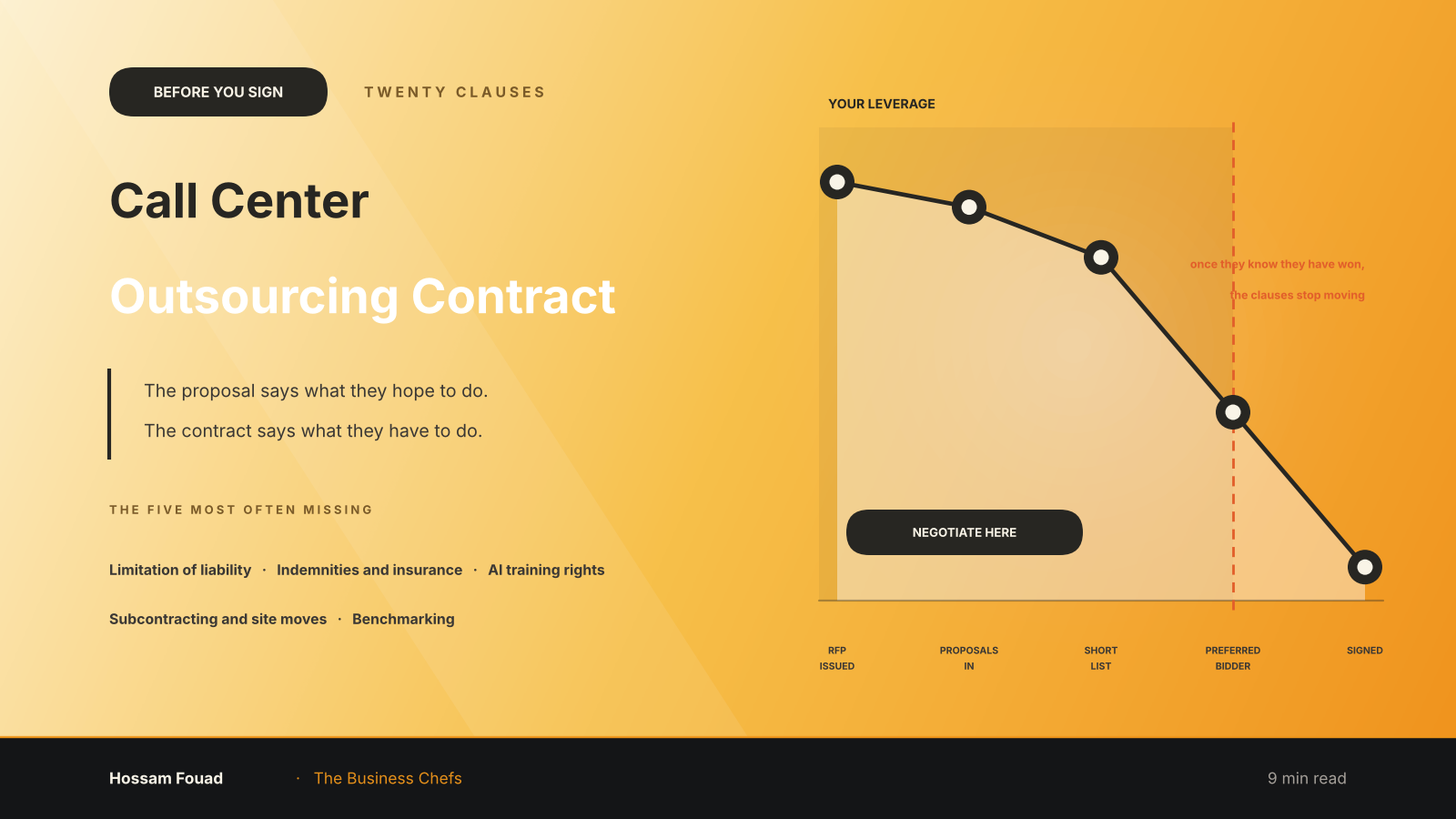
A call center outsourcing contract turns proposal promises into enforceable obligations. The 20 clauses that matter most cover scope and volume, outcome-based KPIs and service credits, pricing and indexation, automation and AI savings, staffing and localization, data protection and AI training rights on your conversations, limitation of liability and indemnities, governance and change control, and exit assistance with a defined duration and pre-agreed rates. Negotiate these before you announce a winner — leverage falls off a cliff the moment a provider knows they have won.
|
This article is general guidance, not legal advice. Have a lawyer qualified in your jurisdiction review any outsourcing agreement before you sign. The clauses below are the commercial and operational ones a buyer should be arguing about; the legal drafting is a separate job. |
|
Key takeaways
|
A call center outsourcing contract should define exactly what the provider delivers, how performance is measured and paid for, how your customers' data is protected, what happens when things go wrong, and what happens when the relationship ends. The proposal tells you what a provider hopes to do. The contract decides what they must do.
Why the contract matters more than the proposal
Proposals are written by sales teams. Contracts are enforced by lawyers. UK legal services firm Sprintlaw notes that one of the most common mistakes is relying on sales promises about quality, reporting or staffing that never make it into the written terms. If the proposal promised a named account manager, low attrition or weekly calibration sessions, those commitments belong in the contract or its schedules.
Timing matters as much as content. Your leverage is highest while several providers still believe they can win, and it collapses the moment one of them is told they have. Everything you care about should be agreed in principle before you announce a preferred bidder — which is why the contract conversation belongs inside the RFP process, not after it.
Scope and service
1. Scope and volume assumptions
Define the channels, languages, hours and processes in scope, plus the forecast volumes the price is based on. Agree with a tolerance band, for example plus or minus 10%, and what happens to price and staffing outside it.
2. Service levels and KPIs
List each KPI, its target, how it is calculated, how often it is reported and which system the data comes from. Ideally that is your own system, not the vendor's spreadsheet. Lead with outcome measures such as first contact resolution, customer satisfaction and quality, not only speed measures. Set targets per channel rather than one blended number. A blended target can be met by over-performing on the easy channel. Our guide to contact center KPIs explains which metrics belong in a contract and the measurement question behind each.
3. Service credits and earn-backs
Credits are price reductions when targets are missed. They should be large enough to matter, capped at a sensible share of monthly fees, and paired with earn-back or bonus terms if you want to reward over-performance.
Then read the sentence that follows them. Providers routinely draft credits as the "sole and exclusive remedy" for service level failures. Accept that wording and you have agreed that a credit worth 10% of one month's fee is your entire recovery for a month that may have cost you far more in lost customers and remediation. Either strike the sole remedy language, or accept it only for ordinary SLA misses while carving out the categories listed under clause 15.
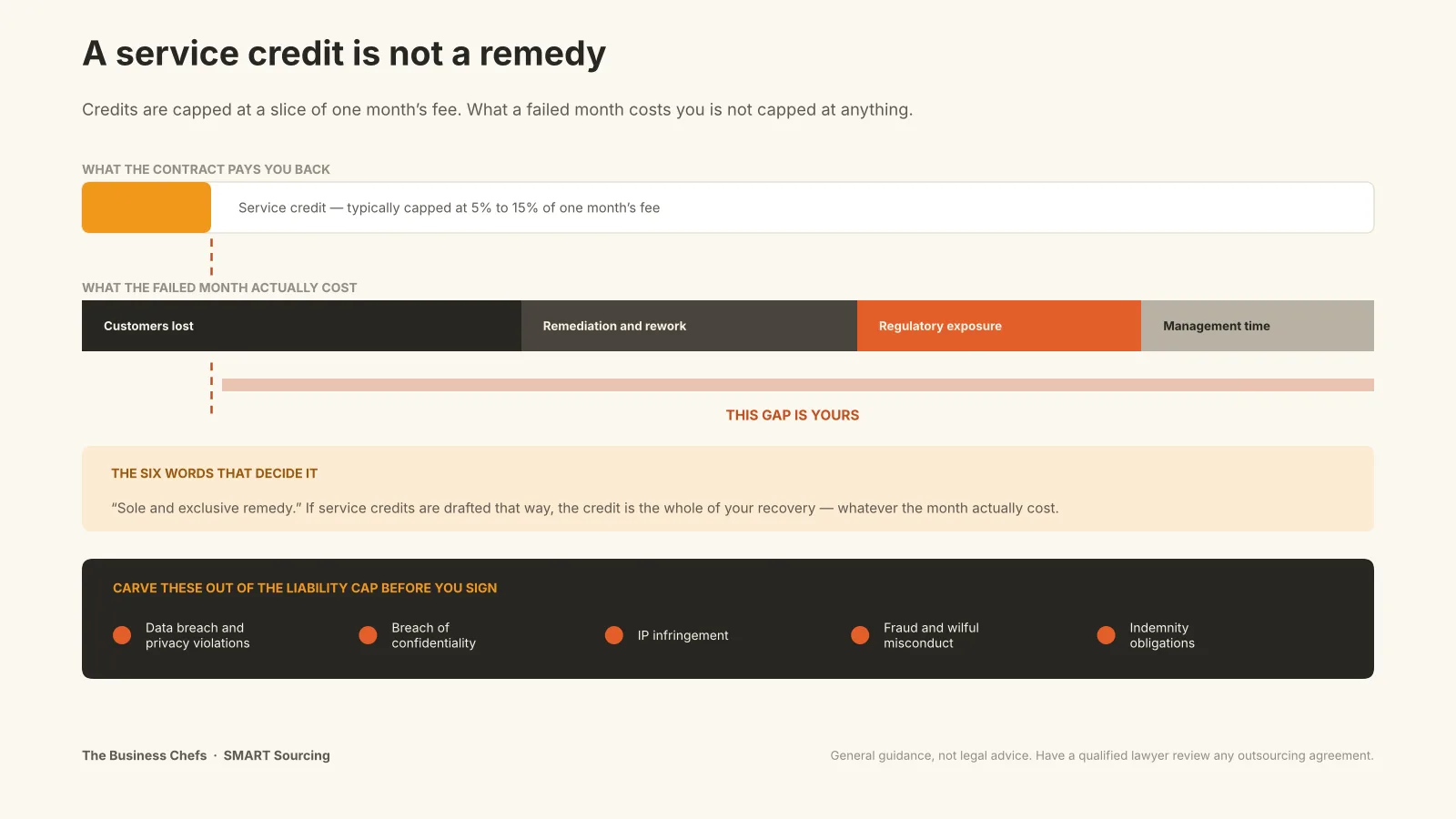
What a credit pays back, what a failed month costs, and the words that decide who carries the difference.
Commercial terms
4. Pricing model
Per hour, per FTE, per minute, per contact or per resolved contact. Each one rewards different behavior, and per-minute pricing in particular rewards shorter calls rather than solved problems. Require the provider to state the first contact resolution assumption behind any per-resolved-contact price, so the number can be compared and enforced. Our call center outsourcing cost guide compares the models in detail.
5. Indexation, currency and re-rating
State which currency the contract is priced in, how rates are indexed each year and what events trigger a re-rate. "Rates reviewed annually" with no formula is not a clause, it is an invitation. In markets with volatile currencies or fast wage growth, a defined formula protects both sides.
6. Automation and AI savings
A provider paid per hour or per contact loses revenue when automation removes contacts. Agree upfront whether you price on resolved contacts, share automation savings on a declining scale, or keep the automation layer on your own contract. Check this clause against your minimum volume commitment, because the two can contradict each other: a contract that shares automation savings while also guaranteeing minimum volume gives back with one hand and takes with the other. We explain the sequencing in how AI is changing contact center outsourcing.
7. Minimums, ramp-up and ramp-down
Spell out minimum volume or spend commitments, how quickly the provider must scale up for peaks, and how much notice you need to give to scale down. Ramp-down notice is the one buyers regret: ninety days is common, and ninety days of paying for seats you no longer need is a real number.
People
8. Staffing, attrition and key personnel
Name the key roles, such as account manager and operations lead, and require your approval before they change. Require monthly attrition and tenure reporting for your program specifically, minimum training hours and a maximum ratio of agents per supervisor. Program-level reporting matters: a provider's company-wide attrition figure tells you nothing about the team answering your calls.
9. Localization and labor compliance
If the work falls under national employment rules, the provider must warrant compliance for the full term, not just at signing. In Saudi Arabia, for example, customer service jobs inside the Kingdom have been subject to 100% localization since December 2022, including supervisory roles. Our article on Saudization and BPO covers the clauses that matter there. Make the warranty continuing and tie a failure to it to a termination right rather than a credit — a localization breach is a regulatory problem, not a service problem.
Data and risk
10. Data protection and security
Include a data processing agreement that states where data is stored and processed, who can access it, how breaches are reported and within what deadline, and which transfer mechanisms apply. Requirements differ by market: UK and EU buyers need a processor contract under the GDPR, and Saudi Arabia's Personal Data Protection Law has been fully enforceable since September 2024 with administrative fines reaching SAR 5 million and criminal exposure for unlawful disclosure of sensitive data.
11. AI training and secondary use of your data
This clause did not exist in most BPO contracts three years ago and belongs in everyone signed now. Can the provider use your call recordings, transcripts and chat logs to train or fine-tune models? Can they subprocess it? Does anything derived from your data — a tuned model, a classifier, an intent library — belong to them or to you?
The default in many vendor templates is a broad license to use "service data" for product improvement, which is wide enough to cover exactly this. Decide deliberately: prohibit it, permit it on anonymized data only, or permit it in exchange for something. What you should not do is leave it silent and discover the answer later.
12. Business continuity and disaster recovery
Require a tested continuity plan, a named fallback site, recovery time and recovery point targets, and the right to see test results. A plan nobody has rehearsed is a document, not a control.
13. Audit rights
Secure the right to audit performance data, quality scoring, staffing and compliance for your specific program, not just a company-wide certificate. Agree the practical terms at signature: how much notice, how often, who pays, and whether the right extends to subcontractors. An audit right that stops at the provider's front door is worth little when the work sits one tier down.
14. Subcontracting and site changes
Your contract is with a provider; your service may be delivered by someone else, somewhere else. Require written consent before any subcontracting, before your work moves to a different site or country, and before material offshore shifts in the delivery mix. Providers resist this because it constrains their capacity planning, which is precisely why it matters — an unconsented move can break your localization position, your data transfer basis and your language coverage in a single quarter.
Liability and remedy
These are the clauses most buyer checklists skip, including earlier versions of this one, and they decide what actually happens when something goes badly wrong.
15. Limitation of liability
The cap is usually expressed as a multiple of fees paid in the preceding twelve months. Whatever the number, the negotiation is about the carve-outs — the categories that sit outside the cap entirely. At minimum, argue for: data breach and privacy violations, breach of confidentiality, intellectual property infringement, fraud and willful misconduct, and the provider's indemnity obligations.
Also look for the exclusion of indirect and consequential loss. Standard, reasonable, and in a customer service contract it may exclude the one category of loss that actually materializes: lost customers. If "loss of revenue" and "loss of profit" are excluded without qualification, consider what remains recoverable after a three-day outage.
16. Indemnities and insurance
Indemnities shift defined risks to whoever is best placed to control them. Ask for indemnities covering data breach caused by the provider, IP infringement by the provider's tools, and employment claims from the provider's own staff. Then check they are backed: require evidence of professional indemnity and cyber liability cover at a level proportionate to the contract, with a right to see the certificate annually. An uninsured indemnity from a thinly capitalized delivery entity is a promise, not a protection system, which is also why it is worth knowing which legal entity is signing.
Governance and exit
17. Governance
Define the meeting rhythm — weekly operations reviews, monthly business reviews, quarterly business reviews — and an escalation path with named people and response times at each level. Name an internal owner on your side too. A governance clause with no owner inside your organization decays within two quarters.
18. Change control and the change rate card
Agree how changes to scope, processes or volumes are requested, priced and approved. The part most contracts omit: agree the rates for change requests at signature. Without a rate card, every change is priced by a provider who knows you have no alternative, and small changes become large invoices exactly as the risk predicts.
19. Benchmarking
On any contract longer than two years, include the right to benchmark rates against the market at a defined point — typically mid-term — using an agreed independent party, with an obligation on the provider to move toward market if they are materially above it. This is standard in large outsourcing deals and almost absent from mid-market contact center contracts, which is one reason mid-market buyers drift above market without noticing.
20. Term, termination, step-in and exit assistance
Set the term, renewal terms, and termination rights for poor performance and for convenience. Three things to add that are commonly missing:
- Step-in rights. In a sustained failure, the right to take over or direct the operation before terminating. Termination is a slow remedy for a fast problem.
- A duration for exit assistance. Typically, six to twelve months. "Reasonable assistance" with no period attached is unenforceable when you need it.
- Exit rates agreed at signature. You will be negotiating exit support with a provider you are leaving. Fix the rates while they still want the deal.
Exit assistance itself should cover knowledge transfer, parallel running, return of all data, recordings, knowledge base content and reports in a usable format, and certified deletion afterwards.
Clause checklist at a glance
| Clause | What to ask for | Red flag |
|---|---|---|
| Service levels | Outcome KPIs, per channel, measured in your systems | Speed-only targets, vendor-reported data |
| Service credits | Meaningful credits with a sensible cap | "Sole and exclusive remedy" left in |
| Limitation of liability | Carve-outs for breach, confidentiality, IP, fraud | A cap with no carve-outs, consequential loss excluded outright |
| Indemnities | Backed by evidenced insurance | Indemnity from a thinly capitalized entity |
| Pricing | A model that rewards resolution | Per-minute pricing with no quality measure |
| Indexation | Clear formula and re-rate triggers | "Rates reviewed annually" with no formula |
| AI savings | Agreed sharing, consistent with the minimum | Silence on automation |
| AI training rights | A deliberate position on secondary use | A broad "product improvement" license |
| Subcontracting | Consent before site, country or tier changes | Free right to move your work |
| Key personnel | Named roles and approval rights | No commitment to who runs your account |
| Data protection | Full DPA with breach deadlines | Vague "industry standard security" |
| Audit rights | Program-level access, extending to subcontractors | Certificates only |
| Change control | A rate card agreed at signature | Changes priced on request |
| Benchmarking | Mid-term right with an obligation to move | No benchmarking on a multi-year deal |
| Exit assistance | Defined duration and rates agreed upfront | No exit clause, or exit at vendor's rates |
Negotiation tips
- Negotiate before you announce a winner. Your leverage drops sharply once providers know they have won. Agree the contentious clauses in principle during the RFP, not after.
- Use pilot data, not proposal claims, to set targets and credits.
- Trade term length for better terms. A longer commitment can buy stronger credits, better pricing or a richer exit package — but pair any longer term with a benchmarking right.
- Check who holds the leverage. In tight labor markets, compliant capacity is scarce and terms may need to reflect that.
- Separate the lawyers' fight from yours. Liability caps and indemnities are their argument; measurement method, data source and the change rate card are yours, and nobody else in the room will fight for them.
If you are still choosing a provider, our guide on how to choose a BPO partner covers the selection side, and writing and scoring the RFP covers the process that should precede this one. The Business Chefs helps companies structure outsourcing contracts as part of our vendor selection service.
|
Reviewing a BPO contract right now? Get an independent view |
Conclusion
A strong call center outsourcing contract turns promises into obligations: outcome KPIs with real credits, a liability clause with the right carve-outs, a pricing model that rewards resolution, a deliberate position on AI and your data, and an exit plan with a duration and a price attached. Negotiate these before you announce a winner, while you still have leverage, and the contract becomes a tool for performance rather than a document in a drawer.
Frequently Asked Questions
What should a call center outsourcing contract include?
At minimum: scope and volume assumptions, KPIs and service levels, service credits, the pricing model, indexation, automation and AI savings, staffing and key personnel, localization warranties, data protection, AI training rights, business continuity, audit rights, subcontracting consent, limitation of liability, indemnities and insurance, governance, change control, benchmarking, and termination with exit assistance.
What are service credits in a BPO contract?
Service credits are price reductions the provider gives when it misses agreed targets. They should be large enough to change behavior and capped at a sensible share of monthly fees. The critical point is what sits next to them: if the contract calls the credit the sole and exclusive remedy, the credit is your entire recovery regardless of what the failure cost you.
Is a service credit the same as compensation?
No. A credit is a price adjustment, usually a single-digit percentage of one month's fee. Compensation for the loss a failure caused comes through the liability and indemnity clauses, which is why those two clauses matter more than any SLA in the document.
How long should a call center outsourcing contract be?
Two to three years is common, often with an initial pilot or probationary period and renewal options. Longer terms can buy better pricing but should come with strong performance termination rights, a mid-term benchmarking right and defined exit assistance.
Who owns the data in an outsourcing contract?
You should. The contract should state that all customer data, recordings, knowledge base content and reports belong to you, must be returned on exit in a usable format, and must be securely deleted afterwards. Deal with derived assets separately: a model tuned on your interactions is not obviously covered by a clause about "your data".
Can a provider use our customer conversations to train AI models?
Only if your contract allows it, and many vendor templates allow it by default through a broad license to use service data for product improvement. Take a deliberate position: prohibit it, permit it on anonymized data only, or permit it in exchange for commercial value. Also decide who owns anything derived from it.
What is exit assistance?
Exit assistance is the provider's obligation to help you move the work to another provider or back in-house when the contract ends. It typically covers knowledge transfer, parallel running, and the return of all data and documentation. Give it a defined duration, usually six to twelve months, and agree the rates at signature rather than when you are leaving.
|
About the author Hossam Fouad is the Managing Partner of The Business Chefs, a boutique BPO, customer experience and strategic sourcing consultancy. He advises enterprises in North America, the UK and the GCC on outsourcing strategy, partner selection and contact center performance, working hands-on with operations teams from assessment to execution. Reviewing a BPO contract right now? Book a free 30-minute discovery call for an independent view. No sales pitch, just practical next steps. |