Saudization and BPO: Impact on Contact Center Outsourcing
|
Key takeaways
|
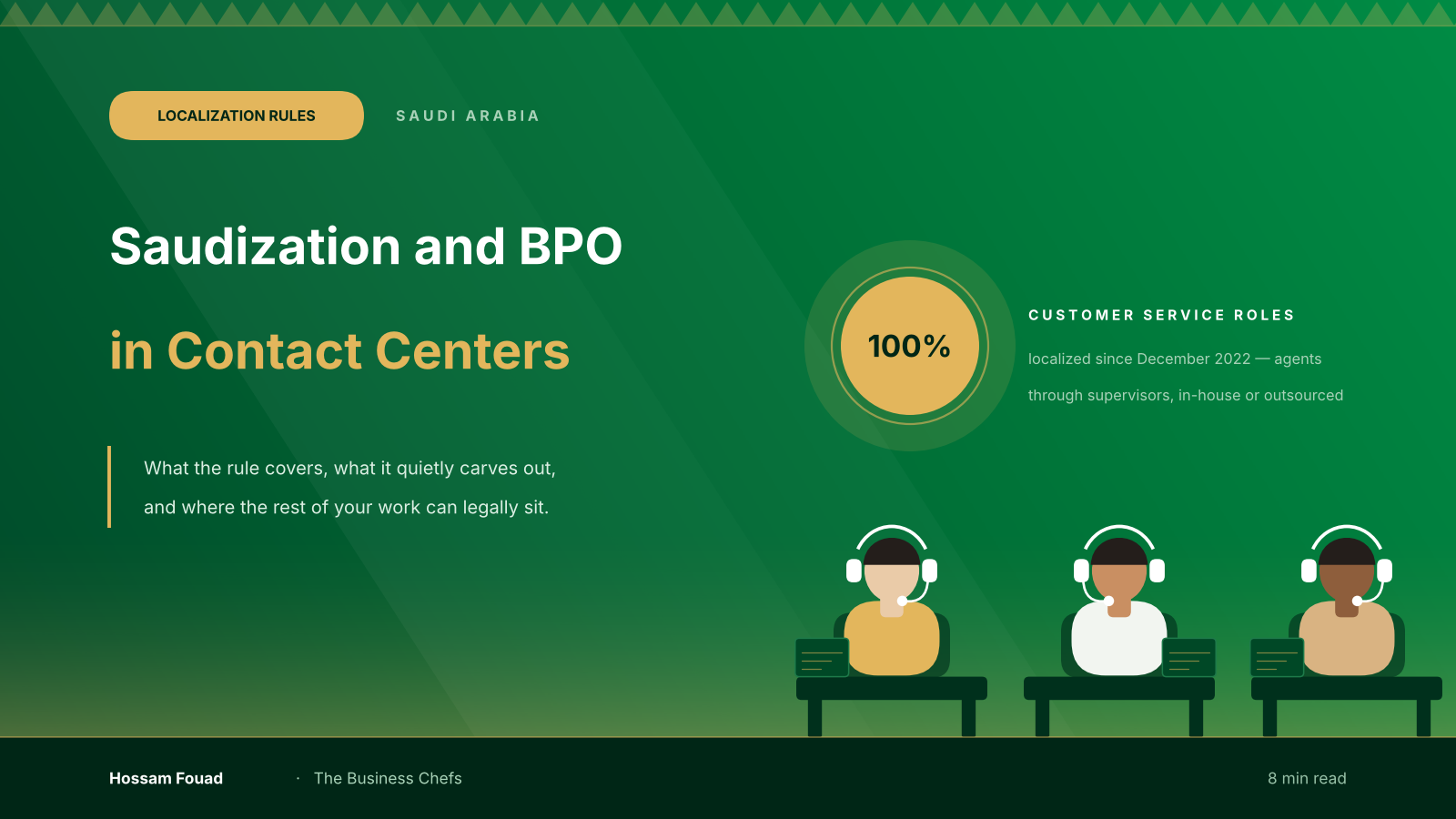
Saudization has turned customer service in Saudi Arabia into a fully localized function. Since December 2022, customer service jobs in the Kingdom must be filled by Saudi nationals, whether the company employs agents directly or outsources to a BPO provider. Combined with the Personal Data Protection Law, this means companies serving Saudi customers plan their contact center model around Saudi talent and in-Kingdom data handling first, and cost second — but the rule is narrower than most summaries suggest, and knowing exactly where its edges are is worth real money.
*This article is general information, not legal advice. Localization decisions and their interpretation change. Confirm current requirements with the Ministry of Human Resources and Social Development (HRSD), the Saudi Data and AI Authority (SDAIA) and your own legal counsel before you design a model around any of it.
What Saudization requires of contact centers
Saudization is the Saudi government’s policy of increasing the employment of Saudi nationals in the private sector. It runs mainly through Nitaqat, which classifies companies by the share of Saudis in their workforce, and through sector decisions that reserve particular professions for citizens.
Contact centers are among the most affected sectors, because customer service is one of the professions that has been fully localized. That applies to companies running in-house centers in the Kingdom and to every BPO provider serving them.
The rules arrived in two stages
2021 decision. HRSD decided to Saudize remote customer service jobs, whether through direct or indirect contracts. The decision explicitly covers service outsourcing agreements and applies to customer service delivered by phone, email, chat, social media and direct contact. Officials said the move aimed to create 20,000 jobs for Saudis.
December 2022 enforcement. HRSD announced the start of 100% localization of customer service jobs. It covers establishments that provide customer service as a main or supporting activity, or that outsource it to another party, and it includes leadership and supervisory positions.
What the rule actually covers, and what it carves out
This is where most published summaries stop and where the money is. HRSD published a procedural manual for the localization of remote customer service professions setting out the scope of Ministerial Decision No. 112203. Read closely, it is narrower than "all customer service".
The manual defines the scope as customer service professions under sub-group 42 of the Saudi Standard Occupational Classification, delivered remotely — by phone, email, chat, social media or other remote means — whether the work is contracted directly or through outsourcing. It then names several things it does not cover:
- Technical support and maintenance roles are excluded from the targeted professions.
- Face-to-face service is not covered. The decision addresses remote customer service.
- Non-Saudi workers operating inside an establishment’s own premises sit outside the stated scope.
- Establishments based outside the Kingdom that are not governed by the Saudi Labour Law are not addressed by the decision — which is the legal reason the offshore question becomes a data question rather than a labor one.
|
Do not design a sourcing model on these carve-outs without counsel. They come from a 2021 procedural manual, interpretations develop, and the boundary between "technical support" and "customer service" is exactly the kind of line a regulator may read differently from a vendor who wants your business. Confirm each one in writing before you rely on it. |
Deciding what can sit outside the Kingdom
Once you separate the labor question from the data question, the decision becomes simple enough to run process by process.
|
Work type |
Onshore in the Kingdom |
Nearshore or offshore |
|
Saudi-facing remote customer service |
Required, Saudi nationals through supervisors |
Raises PDPL and sector-rule questions; take legal advice |
|
Technical support and maintenance |
Possible |
Named as a carve-out in the manual; confirm before relying on it |
|
Back-office processing, no customer contact |
Possible |
Often possible, subject to data rules |
|
Customer service for other markets |
Possible |
Common (Egypt, Jordan, Philippines, India) |
|
IT support, analytics, quality assurance |
Possible |
Often possible, subject to data rules |
Most companies land on a hybrid: Saudi-facing service onshore with Saudi agents, and back-office or non-Saudi customer work nearshore or offshore. Our comparison of nearshore vs offshore outsourcing for GCC companies covers how to choose among the places the rest of the work can go.
The constraint nobody prices: Saudi talent supply
Full localization sets a requirement. It does not create the people to meet it, and that gap is the single most important commercial fact in this market.
Strategy& (PwC) put the GCC BPO workforce at roughly 50,000 to 70,000 professionals and expected that number could double within three to five years, against a regional market growing more than 10% a year. Hold that beside a rule saying every Saudi customer service seat must be filled by a Saudi national, and the arithmetic is uncomfortable: the growth has to come from one national talent pool that every provider in the Kingdom is recruiting from at the same time.
Two consequences follow, and neither is a vendor failing:
- Wage inflation is structural. When supply is constrained by law and demand is growing, rates rise. A three-year price agreed at today’s level carries real risk if nothing in the contract anticipates it.
- Attrition is the operating reality, not an exception. Agents who leave are replaced from the same contested pool, so your program spends a permanent share of its time on a learning curve.
What to do about it in a negotiation:
- Ask for Saudi national attrition over three years, not last quarter, and for average tenure on comparable programs.
- Ask how rates are indexed, what triggers a re-rate, and who absorbs wage movement between review points.
- Ask what the provider pays relative to market, and whether the rate they quoted you supports paying it.
- Treat a provider’s own training pipeline — university partnerships, HADAF programs such as Tamheer and Doroob — as a capability question, not a corporate social responsibility slide.
Why your vendor’s Nitaqat band is an operational question
Nitaqat classifies private companies by the percentage of Saudi nationals they employ, with benefits for compliant companies and restrictions for those below the required level. Most buyers treat the band as a compliance checkbox: confirm it is green, move on.
It is better understood as a staffing capability. A provider’s band affects its access to government services, including the ability to obtain and renew work visas for non-Saudi staff. That matters precisely because of the carve-outs above: the roles that are not localized — technical support, trainers, specialists, some management — are the ones your provider may need expatriate staff to fill. A band that slips does not only create a compliance problem for them. It creates a staffing problem for you.
So ask three questions rather than one:
1. What is your current Nitaqat classification, and what has it been over the last 24 months?
2. Which roles on our program would you expect to staff with non-Saudi employees, and what happens to those roles if your band changes?
3. What is your plan, with dates, if enforcement or a reclassification affects your ability to staff our account?
What to put in the contract
A compliance article that stops at "check their status" leaves the buyer carrying the risk. Your protection is contractual, and it belongs in the agreement rather than in a reassuring email. At minimum:
- A compliance warranty. The provider warrants compliance with HRSD localization requirements and the PDPL for the duration, not just at signature.
- A notification obligation. Written notice within a defined number of days of any change in Nitaqat classification, any enforcement contact, or any event that affects their ability to staff your program compliantly.
- Audit rights that bite. The right to verify Saudi staffing at agent and supervisor level on your account specifically — not to receive a company-wide certificate.
- Step-in and termination rights triggered by a compliance failure, with transition assistance at agreed rates so that leaving does not cost you more than staying.
- A data processing schedule naming where data is stored, who may access it, which transfer mechanism applies, and whether any AI tooling processes it.
- An explicit allocation of regulatory change risk. If the rules tighten mid-term and re-staffing is required, the contract should already say who pays.
Data residency and the PDPL
The Personal Data Protection Law took effect on 14 September 2023 and became fully enforceable on 14 September 2024. For outsourcing, three points matter:
- Transfers of personal data outside the Kingdom require appropriate safeguards, such as approved standard contractual clauses, unless the destination has been deemed adequate.
- A risk assessment is required in some transfer scenarios, including continuous or large-scale transfers of sensitive data.
- SDAIA enforces the law, and penalties can be significant.
The U.S. International Trade Administration notes that Saudi authorities are actively enforcing cross-border data transfer rules, which is driving demand for in-country hosting. When you evaluate a partner, ask exactly where your data will be stored, processed and accessed — including by any AI tooling, which is the route personal data most often leaves a jurisdiction without anyone noticing.
How providers have adapted, and what that means for your leverage
Strategy& observed that Saudization requirements led to increased outsourcing to Saudi-based BPO providers, as companies found it easier to buy compliant capacity than to build it. Scarce skilled nationals make outsourcing the easier path for some processes.
Leading providers have responded by building Saudi talent pipelines with universities and training programs, investing in retention because Saudi attrition now affects compliance as well as quality, opening centers outside Riyadh to reach new talent pools, and automating routine contacts so Saudi agents concentrate on complex work.
Now read that from the buyer’s side, which the usual version of this article does not. Regulation has concentrated demand onto a limited set of compliant providers. That is a seller’s market, and it changes how you should behave in one:
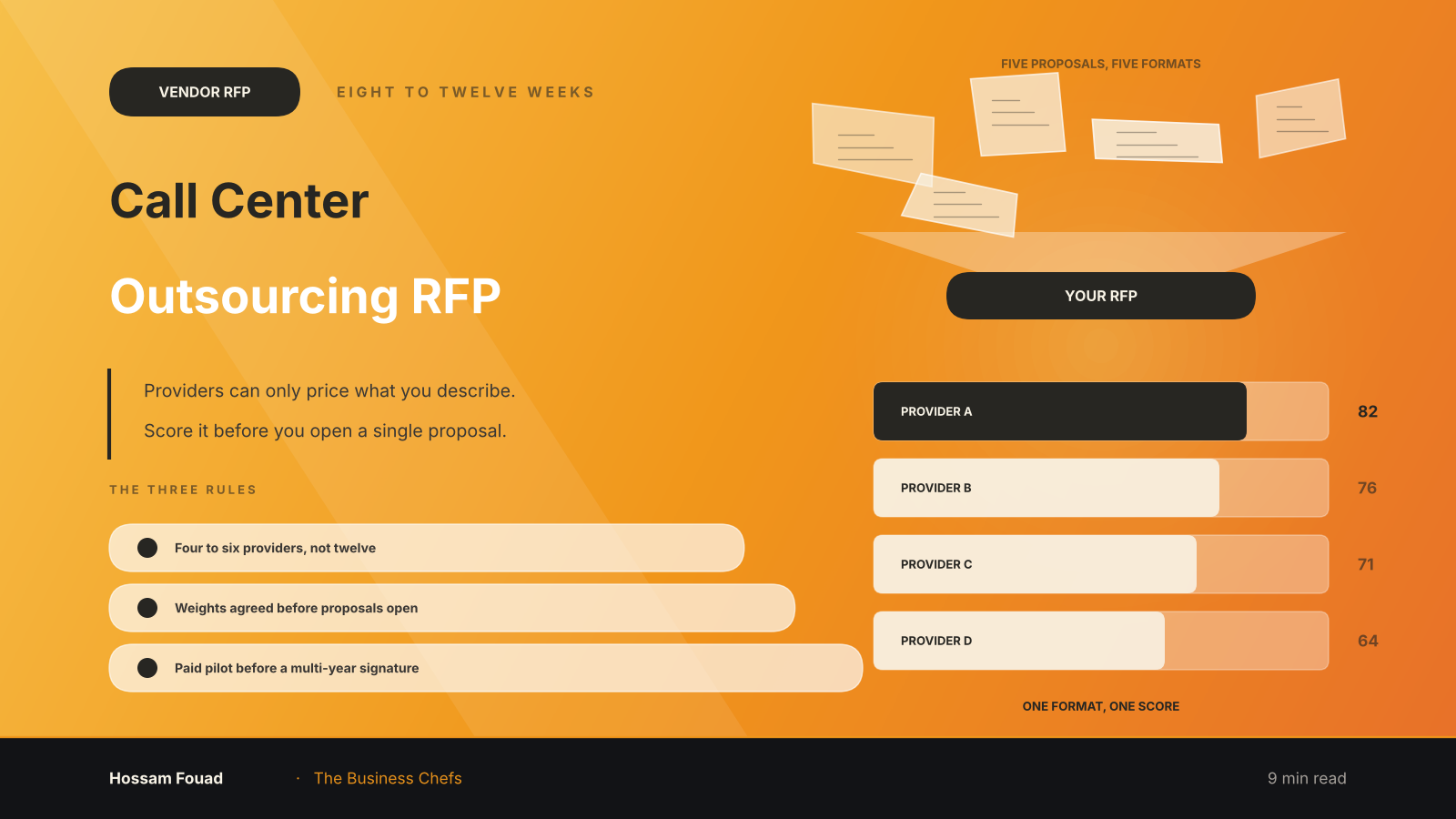
- Do not assume competitive tension exists simply because you ran an RFP. Confirm how many providers can genuinely staff your volume compliantly before you design the process around a shortlist of five.
- Start earlier than you would elsewhere. Compliant capacity is booked ahead, and urgency is expensive here.
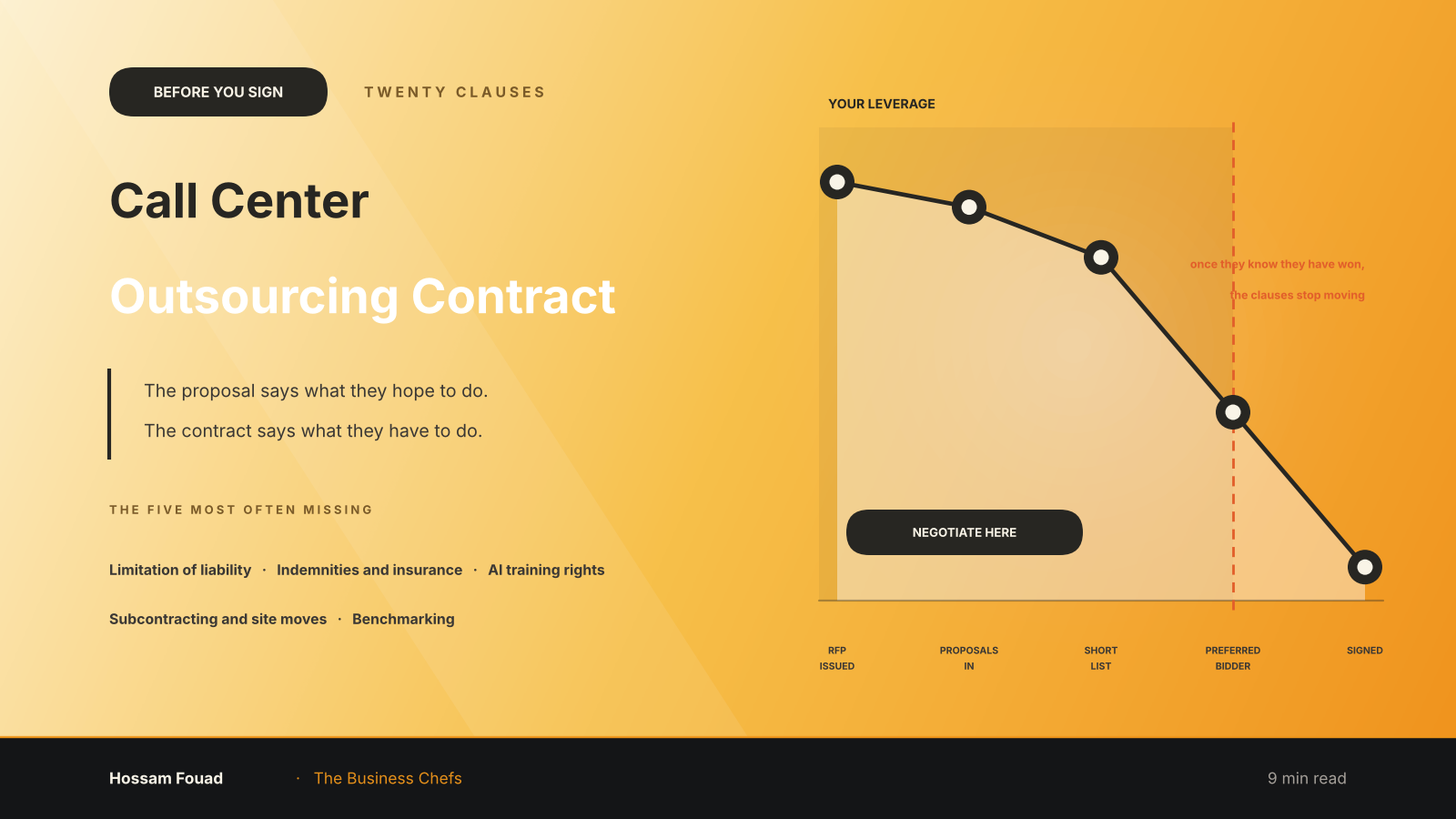
- Be careful with long lock-ins agreed at a moment when you have limited alternatives and look closely at any rate escalation clause.
Automation is part of the answer rather than an evasion of it, since it lets a constrained Saudi workforce carry more resolved contacts. We cover the sequencing in how AI is changing contact center outsourcing, and the economics in our cost guide.
The other half of the story: Vision 2030 demand
Saudization constrains supply. Vision 2030 is expanding demand at the same time, and the figures are worth stating rather than gesturing at.
Strategy& counted more than 100 privatization initiatives across 10 ministries under Vision 2030, with new entities such as Monsha’at and the companies created by the Public Investment Fund relying on third parties for support functions including procurement, HR and finance. It sized the GCC BPO market at $1.4 billion in 2021, growing at roughly 10.5% a year toward about $2.1 billion by 2025.
The most telling figure in that report is a ratio rather than a total: GCC BPO revenues equal about 0.1% of GDP, against roughly 0.4% in more developed markets. That gap is the headroom. It also explains why a constrained talent pool is the thing that decides how fast any of this can actually happen.
Growth sectors are the high-contact ones: government-to-resident services, healthcare, tourism and hospitality, financial services and telecoms.
*These projections run to 2025 and the report predates the current market.
Staying compliant while controlling cost
Compliance and cost efficiency are not opposite. The sequence matters:
4. Map your work by customer type, channel, data sensitivity and location before you talk to anyone.
5. Separate the labor question from the data question. Remote Saudi-facing customer service is settled. Everything else is a PDPL analysis.
6. Test the carve-outs with counsel rather than with a vendor and get the answer in writing.
7. Verify Nitaqat status and trajectory, and ask what the provider would do if it changed.
8. Document data flows and confirm transfer safeguards for anything leaving the Kingdom, AI tooling included.
9. Remove avoidable contacts through better processes and self-service before adding scarce Saudi headcount.
10. Raise first contact resolution, so each Saudi agent hour delivers more resolved issues. In a constrained labor market this is the highest-return lever you have.
11. Put the protections in the contract, not in the relationship.
12. Review quarterly with counsel, because localization decisions keep developing.
If you are selecting a vendor, our guide on how to choose a BPO partner in Saudi Arabia turns these points into a compliance gate and a weighted scorecard.
Conclusion
Saudization has made remote Saudi customer service a fully localized profession, and the PDPL has made data location a contract-level decision. Between those two facts sits more room than most summaries suggest — technical support, non-customer-facing processing, and service for other markets all remain placeable, subject to the data analysis and to advice you should get in writing.
The harder problem is not the rule. It is that a constrained national talent pool now sets the ceiling on quality, cost and growth for every operator in the Kingdom, yours included. The model that works combines Saudi talent onshore where it is required, eligible work placed where it makes commercial sense, contractual protection against the compliance risk you cannot control, and automation that lets every Saudi agent resolve more. We help companies design that through our SMART Sourcing approach.
Frequently asked questions
Is customer service in Saudi Arabia 100% Saudized?
Remote customer service is. Since December 2022, HRSD has enforced 100% localization of customer service jobs, covering establishments that provide customer service as a main or supporting activity or outsource it to another party, and including leadership and supervisory roles.
Does the rule cover every role in a contact center?
No, and this is widely misunderstood. HRSD’s procedural manual scopes the decision to customer service professions under occupational sub-group 42 delivered remotely, and names exclusions including technical support and maintenance roles. The boundary between technical support and customer service is interpretive, so confirm your reading with counsel before building a model on it.
Does Saudization apply to outsourcing companies?
Yes. The 2021 decision explicitly covers service outsourcing agreements, and the 2022 enforcement covers establishments that outsource customer service to another party. A BPO provider serving your Saudi customers from inside the Kingdom must use Saudi nationals, supervisors included.
Can foreign BPO providers serve Saudi customers from abroad?
The localization decision addresses jobs inside the Kingdom and does not govern establishments outside it that fall outside the Saudi Labor Law. But serving Saudi customers from abroad raises PDPL transfer requirements and possible sector-specific rules, so the question moves from labor law to data law rather than disappearing. Take legal advice before choosing that model.
What is Nitaqat, and why does my vendor’s band matter to me?
Nitaqat classifies private companies by the share of Saudi nationals they employ. The band affects access to government services including work visas, which determines whether your provider can staff the roles that are not localized. A band that slips is their compliance problem and your staffing problem.
How does the PDPL affect outsourcing?
Fully enforceable since 14 September 2024, it regulates how personal data is collected, processed and transferred. Transfers outside the Kingdom need appropriate safeguards, so contracts must specify where data is stored, who can access it, which transfer mechanism applies, and whether AI tooling touches it.
|
Need a Saudization-ready contact center model? Book a free 30-minute call with a senior practitioner. No sales pitch, just practical next steps. Talk to our team |
|
About the author Hossam Fouad is the Managing Partner of The Business Chefs, a boutique BPO, customer experience and strategic sourcing consultancy. He advises enterprises in North America, the UK and the GCC on outsourcing strategy, partner selection and contact center performance, working hands-on with operations teams from assessment to execution. |