Contact Center Assessment: What an Operational Review Covers, How It Works and What You Get
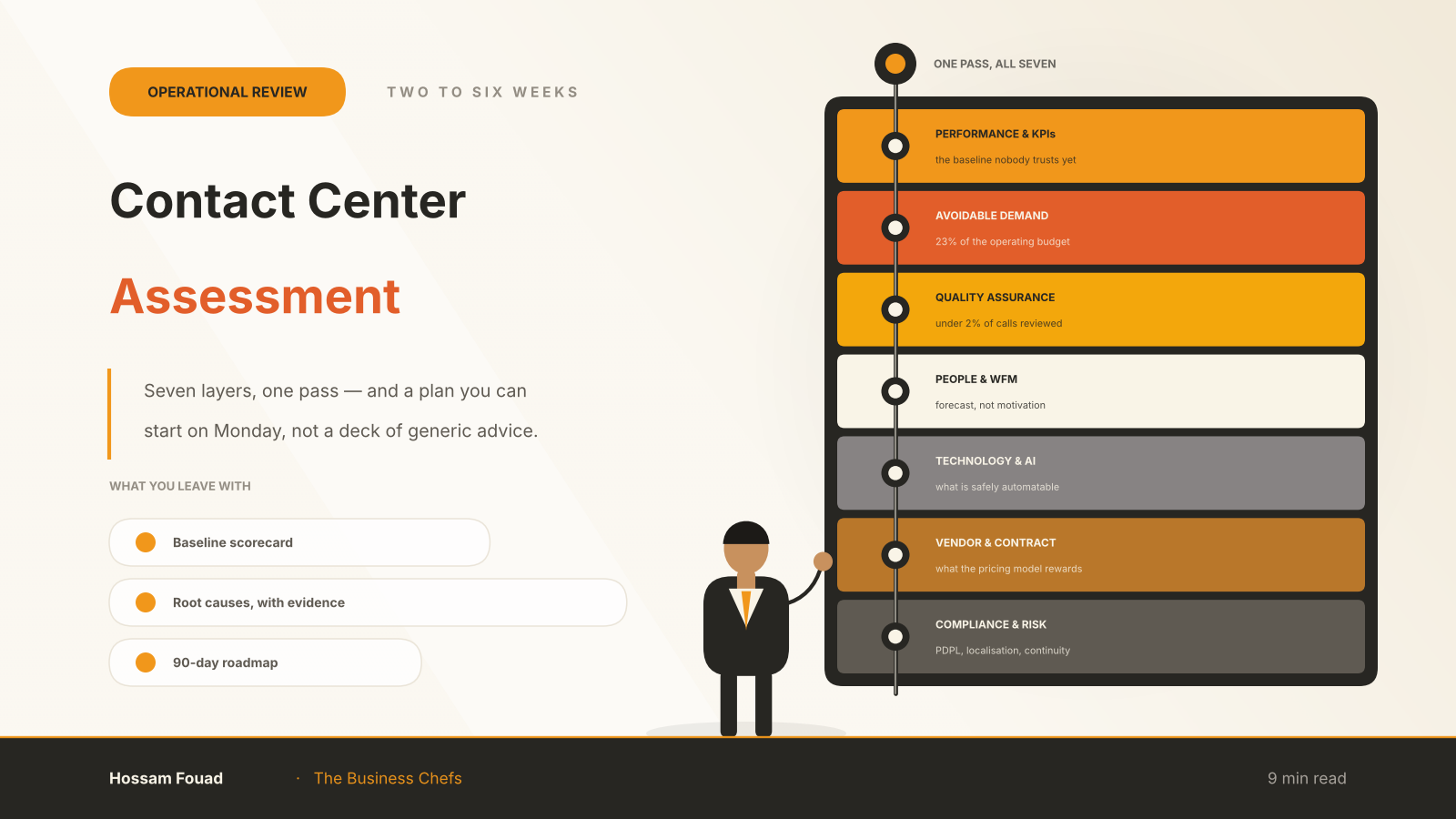
A contact center assessment is an independent operational review across KPIs, contact reasons, quality, people, technology, vendor management and compliance. It finds the root causes behind your numbers and ends with quick wins and a 90-day roadmap with named owners.
|
Key takeaways
|
A contact center assessment, also called a call center assessment, audit or operational review, is a structured, independent review of how your contact center performs. It measures where you stand on the metrics that drive cost and customer experience, finds the root causes behind those numbers, and turns them into a prioritized plan. Done well, it answers the three questions leadership actually asks: are we paying too much, are customers getting their problems solved, and what should we fix first?
One clarification before we start. This guide is about assessing how your operation performs. Pre-employment skills tests for agent candidates are often called call center assessments too, but they are a hiring tool for a different job, and they are not covered here.
When do you need a contact center assessment?
You do not need an assessment because the calendar says so. You need one when the numbers start telling a story nobody can explain. The most common triggers:
- Cost per contact is rising while volume stays flat.
- Customer satisfaction is falling, and complaints mention repeat contacts or transfers.
- Agent attrition is climbing and new hires never reach full speed.
- A BPO contract renewal is coming up and you have no independent view of the vendor’s performance.
- You are considering outsourcing, switching vendors or moving work to another country.
- You are about to invest in AI and want to know which contacts are genuinely automatable.
If a vendor change is on the table, read our guide on how to choose a BPO partner alongside this one, or see how our vendor selection service works.
And when you should not commission one
An article selling assessments should say when the fee buys you very little. Four cases:
- The decision is already made. If you have decided to switch vendors and only want the decision documented, you are buying cover, not analysis. That is a legitimate purchase, but do not pay assessment rates for it.
- Nobody internal will own the roadmap. Without a named owner who is still there in six months, an assessment produces a correct diagnosis and no change. Fix the ownership problem first.
- You already know the answer and it is a single, obvious fix. A knowledge base nobody has updated in two years does not need a four-week review. Fix it, then see what is left.
- You are mid-transition. Assessing an operation in the middle of a migration measures the migration, not the operation. Wait for it to stabilize, usually one to two months after go-live.
What a contact center assessment covers
A complete assessment looks at seven areas. Skipping any of them usually means fixing a symptom instead of a cause.
1. Performance and KPIs
The assessment starts by building a reliable baseline: first contact resolution (FCR), customer satisfaction (CSAT), average handle time (AHT), cost per resolved contact, attrition and schedule adherence. SQM Group reports that every 1% improvement in FCR reduces operating costs by about 1% and improves customer satisfaction by about 1%, with employee satisfaction moving about 2.5%.
Before any of that means anything, establish how each number is currently measured. FCR calculated from a customer survey, from repeat-contact analysis and from an agent disposition code will give you three different answers, and only one of them is scored by the person being measured. An assessment that baselines the number without first auditing the method is measuring the reporting, not the operation. Our guide to contact center KPIs that matter sets out each metric and the measurement question behind it.
2. Contact reasons and avoidable demand
Why are customers contacting you in the first place? A contact-reason analysis separates the contacts you want, such as sales and genuine questions, from the ones you created: status chasing, repeated contacts and failures elsewhere in the business. The same SQM research puts repeat calls at roughly 23% of the average contact center’s operating budget. This is usually where the biggest savings hide, and the framing matters: it is demand to remove, not cost to cut. Cutting cost against avoidable demand just makes the same volume worse.
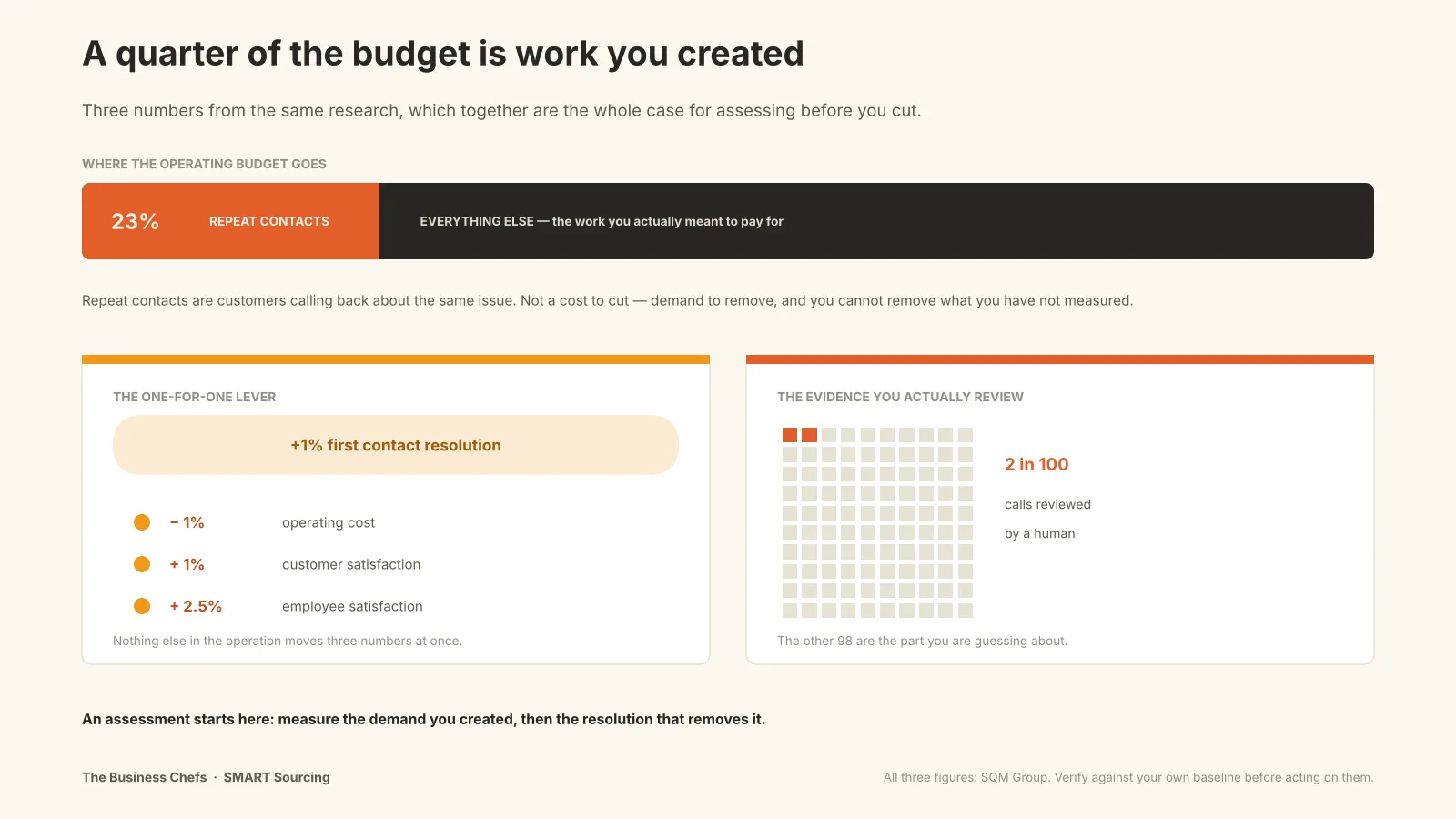
Three figures from the same research, which together are the case for assessing before you cut.
3. Quality assurance
Most quality programs review a tiny sample. SQM Group estimates that most call centers manually evaluate fewer than 2% of calls — a figure worth reading in context, since it appears on the page where they sell the software that fixes it. The assessment checks how calls are sampled, what the scorecard rewards, whether evaluators are calibrated, and, most importantly, whether quality is measured by resolution or by script compliance.
4. People, training and workforce management
Here the focus is the hiring profile, time to proficiency, coaching quality, forecasting accuracy, scheduling and occupancy, and the real drivers of attrition. A center that is always short-staffed on Mondays has a forecasting problem, not a motivation problem.
5. Technology and AI readiness
The assessment reviews the contact center platform, CRM integration, routing, knowledge base and reporting, then identifies which contacts could be automated safely. Gartner predicts that agentic AI will autonomously resolve 80% of common customer service issues without human intervention by 2029, with a 30% reduction in operational costs. Automation only pays off on top of a clean process and an accurate knowledge base — automating avoidable demand industrializes the thing you should have removed. We cover the sequencing in how AI is changing contact center outsourcing.
6. Vendor, contract and governance
For outsourced programs, the assessment reviews the SLAs, the pricing model, governance and data access. The pricing model matters more than most buyers realize: paying per agent hour rewards time spent, while paying per resolved contact rewards problems solved. Our call center outsourcing cost breakdown shows how quickly that difference reaches the bottom line.
7. Compliance and risk
Finally, the assessment checks data protection, local regulation and business continuity. Rules differ by market. Saudi Arabia’s Personal Data Protection Law has been fully enforceable since 14 September 2024, with administrative fines up to SAR 5 million, doubled for repeat offences, and up to two years’ imprisonment for unlawful disclosure of sensitive data.
One requirement catches contact centers specifically: controllers whose primary activity involves processing personal data must register on the National Data Governance Platform. A contact center’s primary activity is processing personal data, so this is not a general obligation you can assume someone else has handled. Customer service roles inside the Kingdom are also fully localized, as we explain in Saudization and BPO. Confirm your own position with counsel rather than with this article.
In-house vs outsourced: what changes in the assessment
|
Area |
In-house center |
Outsourced center |
|
Main question |
Are we running efficiently? |
Is our vendor delivering what we pay for? |
|
Data access |
Full |
Whatever the contract granted, which is usually less than you need |
|
Commercial review |
Internal cost model |
Pricing model, SLAs, penalties and exit terms |
|
Typical fixes |
Process, staffing and tools |
Contract terms, governance, a vendor improvement plan or a switch |
|
Biggest hidden risk |
Avoidable demand nobody measures |
SLAs that reward speed instead of resolution |
One practical warning on the outsourced column. If your contract does not already give you access to raw interaction data, call recordings and the vendor’s own quality scores, an assessment will be working from what the vendor chooses to show it. Check your data rights before you commission the work, not during it. If the rights are not there, the first finding of the assessment is that your next contract needs them.
How a contact center assessment works
A typical four-week assessment looks like this. A small, single-site program can move faster; a multi-country, multi-language operation takes longer.
1. Week 1, discovery and data: agree goals and scope, send the data request and interview key stakeholders.
2. Week 2, on the floor: listen to calls and chats, sit side by side with agents, join quality calibration and walk through key processes. For outsourced programs, this includes sessions with the vendor.
3. Week 3, analysis: run the contact-reason analysis, build the KPI baseline and cost per resolved contact, and test root causes against the evidence.
4. Week 4, findings and roadmap: deliver the scorecard, quick wins, 90-day plan and business case to leadership.
Most assessments take two to six weeks. What stretches the timeline is rarely the analysis. It is waiting for data, chasing contract documents, and getting time with the people who actually know why the process works the way it does.
What you should get at the end
A proper assessment produces decisions, not just observations. Expect:
- A baseline scorecard of the KPIs that matter, with the measurement method for each one stated.
- The root causes behind the numbers, with evidence.
- Quick wins you can implement within 30 days.
- A prioritized 90-day roadmap with named owners, not role titles.
- A business case that shows the expected impact, and what it assumes.
- For outsourced programs, a vendor scorecard and a clear recommendation: improve, renegotiate or switch.
If an assessment ends with generic advice you could have found in a blog post, it was not an assessment.
And what it cannot give you
- A forecast of vendor behavior under stress. An assessment is a point-in-time read. It can show you how a vendor performs now and what their contract allows them to do later; it cannot tell you how they will behave in a bad quarter.
- Certainty where your data is thin. If twelve months of contact-reason data does not exist, the contact-reason analysis is an estimate built from sampling. That should be stated on the page, not buried.
- Implementation. The roadmap is the start of the work, not the end of it. Most of the value is created in the 90 days after the report lands, by your people.
Who should run the assessment
The honest problem with this question is that most firms offering assessments also sell what the assessment might recommend: vendor selection, transition management, or delivery itself. A firm that earns on a vendor switch has a reason to find one. We sell vendor selection, so that applies here too.
That does not make the advice worthless, any more than a surgeon’s fee makes surgery unnecessary. It does mean you should test it. Three questions worth asking whoever you appoint:
1. Who paid you for your last five engagements? Not “are you independent” — everyone says yes. Ask about referral fees from providers and whether the firm has a delivery arm.
2. What would make you recommend we keep the current vendor and change nothing? A firm that cannot answer concretely is running a sales process.
3. Who will be on the floor — the people in this room, or an analyst I have not met? Get the names into the contract.
We set out the broader version of this test in what a BPO consultant does.
What data to prepare
You will save a week if you gather these before you start:
- Twelve months of contact volume by channel and contact reason.
- KPI reports for FCR, CSAT, AHT and attrition — and the definition behind each one.
- Cost data, from your internal budget or your vendor invoices.
- Quality forms and recent quality scores.
- An organization chart and staffing levels.
- Contracts and SLAs for any outsourced work, including the data access clauses.
- Sample recordings or transcripts, with customer data masked.
- A list of your contact center technology.
Do not wait for perfect data. Gaps in your data are a finding in themselves — and in our experience the gap tells you more than the report that was missing would have.
The findings that come up most often
- Avoidable volume: repeat contacts and status chasing that nobody owns.
- Quality that measures the wrong thing: scorecards built on script compliance instead of resolution.
- SLAs built on speed: answer time and handle time targets that push agents to end calls rather than solve problems.
- A knowledge base nobody trusts: so agents rely on memory and escalations.
- Hidden costs: attrition, rework and internal escalations that never appear on the invoice.
- A baseline nobody can reproduce: two teams calculating the same KPI differently, which makes every trend argument unwinnable.
How much does a contact center assessment cost?
It depends on scope, which is the answer every consultancy gives, so here is more structure than that.
What actually drives the fee: the number of sites, channels and languages; whether a vendor and contract review is in scope; how clean your baseline data is; whether a paid pilot or benchmarking exercise is included; and the seniority of the people doing the work. The last one is the largest multiplier and the least visible on a proposal — ask who is on the floor, not who is on the cover.
Ask for a fixed fee against a written scope. Day-rate assessments have no one accountable for finishing, and open-ended scope is where the disputes live. The scope document should name the sites, the channels, the number of interviews and the deliverables.
Judge the fee against the decision it informs, not against a day rate. An assessment typically sets the direction of a function for the next two to three years. On the arithmetic above, a single point of first contact resolution is worth about a point of operating cost, permanently — so the comparison worth making is the fee against a percentage of your annual run cost. One caveat worth stating plainly: that argument is made by consultancies about their own fees. Ask for the arithmetic rather than the assertion, including what it assumes about your baseline.
The Business Chefs runs contact center performance assessments for in-house and outsourced operations as part of our SMART Sourcing approach. If you are not sure whether you need a full assessment or a lighter review, say so on the call — the lighter review is often the right answer.
|
Want an independent view of your contact center? Book a free 30-minute discovery call |
Conclusion
A contact center assessment is the fastest way to replace opinions with evidence. It shows where your money goes, why customers come back, and which fixes will move the numbers first. Start with how your numbers are measured, then with the demand you created rather than the cost you spend, and the rest of the plan tends to write itself.
Whether your center is in-house or outsourced, the right assessment ends with a short list of decisions, named owners and a plan you can start on Monday.
Frequently Asked Questions
What is a contact center assessment?
A contact center assessment is an independent operational review of a contact center’s performance across KPIs, contact reasons, quality, people, technology, vendor management and compliance. It identifies root causes and ends with a prioritized improvement plan and a business case.
Is a contact center assessment the same as a call center skills test?
No. A contact center assessment reviews how the whole operation performs and what to fix. A call center skills test, often also called a call center assessment, is a pre-employment tool that screens agent candidates for skills such as communication and multitasking. They serve different goals and different buyers.
How long does a contact center assessment take?
Most assessments take two to six weeks. A single-site, single-language center can be assessed in about two weeks, while multi-country or multi-language operations, or programs that need a detailed vendor and contract review, take longer. The usual delay is data access, not analysis.
What is the difference between a contact center assessment and an audit?
An audit usually checks compliance against a standard, a contract or a set of rules. An assessment is broader: it measures performance, explains the root causes and recommends what to fix first. In practice, many companies use the two terms interchangeably.
Can you assess an outsourced call center or BPO vendor?
Yes. For outsourced programs, the assessment adds a review of the vendor’s performance data, the SLAs, the pricing model, governance and exit terms. It ends with a vendor scorecard and a recommendation to improve, renegotiate or switch. Check your contract’s data access rights first — without them the review works from what the vendor chooses to share.
Which KPIs does a contact center assessment review?
The core set is first contact resolution, customer satisfaction, average handle time, cost per resolved contact, quality scores, attrition and schedule adherence. First contact resolution matters most because it links customer satisfaction and operating cost — but only once you have established how it is being measured.
When should you not commission a contact center assessment?
When the decision is already made and you only want it documented, when no one internal will own the roadmap afterwards, when the problem is a single obvious fix, or when the operation is mid-transition. In the last case, wait one to two months after go-live so you are measuring the operation rather than the migration.
|
About the author Hossam Fouad is the Managing Partner of The Business Chefs, a boutique BPO, customer experience and strategic sourcing consultancy. He advises enterprises in North America, the UK and the GCC on outsourcing strategy, partner selection and contact center performance, working hands-on with operations teams from assessment to execution. Want an independent view of your contact center? Book a free 30-minute discovery call with a senior practitioner. No sales pitch, just practical next steps. |