Total Rewards Strategy in the GCC: What’s Changing in 2026
A total rewards strategy in the GCC is a deliberate plan for everything an employer offers to attract and keep talent: pay, benefits, well-being, career growth and recognition.
|
Key takeaways
|
A total rewards strategy in the GCC is a deliberate plan for everything an employer offers to attract and keep talent: pay, benefits, well-being, career growth and recognition. In 2026 it matters more than ever, because localization targets in Saudi Arabia and the UAE are increasing competition for national talent while expatriate professionals and frontline workers expect more than a competitive salary. Companies that still compete on pay alone are paying more and keeping less.
What is a total rewards strategy?
A total rewards strategy treats the employment offer as a complete value proposition rather than a salary figure. WorldatWork, the professional association whose model has been a standard for professional practice since 2000, defines total rewards as a strategic portfolio of commitments employers deploy to attract, retain and nurture a skilled, talented and engaged workforce.
In practice, a strategy answers three questions: what do we offer, to whom, and how do we communicate it so employees understand its full value? The third question is where most GCC employers lose money they have already spent.
The five pillars of total rewards
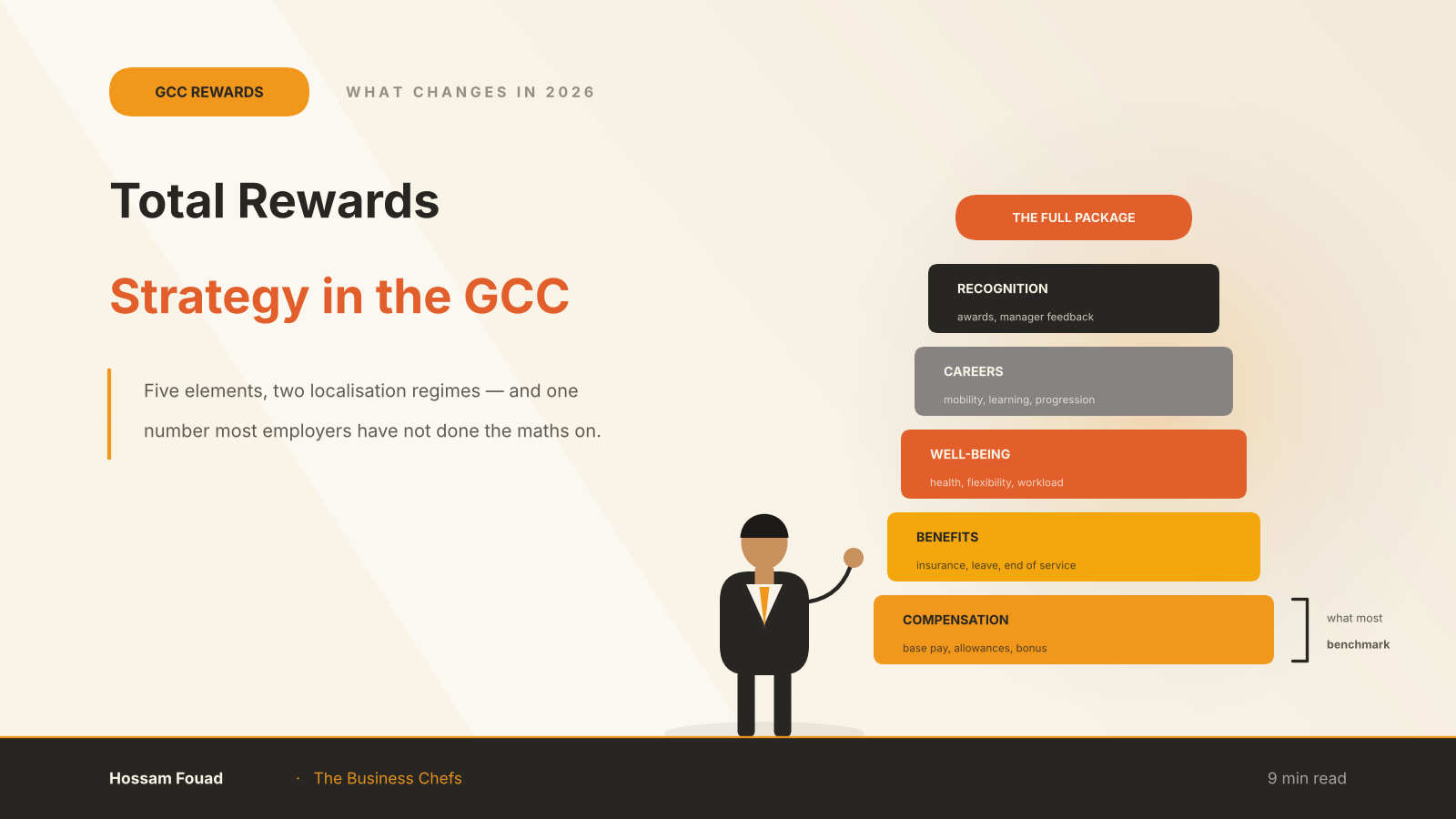
1. Compensation. Base pay, allowances, bonuses and incentives. In the GCC, allowances such as housing and transport often make up a large share of the package, which is exactly why base-pay-only benchmarking misleads.
2. Benefits. Health insurance, leave, retirement and end-of-service benefits, and family coverage, which carries particular weight for expatriates.
3. Well-being. Physical, mental and financial health support, flexible working and workload management.
4. Careers. Training, certifications, internal mobility and clear progression paths.
5. Recognition. Formal and informal ways of acknowledging contribution, from awards to manager feedback.
The elements work together. A strong career path can retain an employee who could earn slightly more elsewhere; weak recognition can drive out someone who is well paid. The common failure is not that an employer offers too little — it is that four of the five pillars are invisible to the people receiving them.
Why total rewards matters more than salary in the GCC
Three forces make the full package decisive in the Gulf today:
- Competition for talent. Fast-growing sectors in Saudi Arabia and the UAE are chasing the same skilled professionals, which pushes salaries up and makes pay increases alone an expensive retention tool.
- Changing expectations. Younger national and expatriate employees value flexibility, growth and purpose alongside pay.
- Cost of turnover. Every resignation brings recruitment, onboarding and lost productivity costs — and in localized roles it can also break a compliance position you have been building for a year.
That last point is the one that changes the arithmetic. In a localized role, losing a national employee is not only a replacement cost; it can move you back below target and restart a financial contribution. Turnover is especially costly in contact centers, where agent attrition directly affects quality and customer satisfaction. Our guide to contact center KPIs explains why attrition and employee satisfaction belong on every operations dashboard.
How Saudization and Emiratization are reshaping rewards
National workforce programs are now among the biggest drivers of rewards strategy in the region — and the UAE operates two tracks, not one. Most commentary describes only the first.
The UAE: two compliance tracks
Companies with 50 or more employees must increase the number of Emiratis in skilled jobs by 2% a year, split into 1% for each half of the year, with deadlines on 30 June and 31 December. From 1 July 2026, the Ministry of Human Resources and Emiratization applies a financial contribution of AED 10,000 a month — AED 120,000 a year — for each position not filled with an Emirati.
Companies with 20 to 49 employees in 14 selected economic sectors sit under a separate requirement: hire at least one Emirati in 2024 and a second in 2025, and retain them. MoHRE notifies the establishments it has selected, so an employer in this bracket may be in scope without having gone looking. Gulf News reports that non-compliance brings financial penalties and a downgrade in company classification.
As of 30 June 2025, more than 152,000 Emiratis were working in the private sector across 29,000 companies. There is an upside as well as a penalty: companies with strong results can join the Emiratization Partners Club, which offers up to 80% reductions on ministry service fees and priority access to government procurement.
Saudi Arabia: localized, with limits worth knowing
The Ministry of Human Resources and Social Development has fully localized some professions. Customer service jobs have been subject to 100% localization since December 2022, including leadership and supervisory positions, and the decision reaches establishments that provide customer service as a main or supporting activity as well as those that outsource it.
The word "fully" does carry limits that matter when you design roles and pay bands. The ministry’s own procedural manual carves out technical support and maintenance work, does not cover face-to-face service, and does not reach establishments outside the Kingdom that are not governed by Saudi Labor Law. We set out the detail in Saudization and BPO. Confirm your own scope with counsel before you build a structure on it.
For rewards leaders, this means:
- Retention of national talent is a compliance priority, not only an HR goal.
- Career paths for nationals need to be visible, credible and fast enough to compete.
- Pay equity and transparency matter more as mixed national and expatriate teams grow.
- "Fake" localization is a serious violation, not a grey area. Registering nationals who do not genuinely work in the role carries consequences well beyond the contribution you were avoiding.
The number most employers have not done the maths on
AED 120,000 a year, for each skilled position not filled with an Emirati. Almost every article on Emiratization reports that figure as a penalty to avoid. Very few treat it as what it actually is: a budget line you are already paying, denominated in exactly the same currency as a salary.
Once you put the contribution next to a real package, the question changes. It stops being "how do we avoid the contribution" and becomes "for this amount, what caliber of Emirati professional could we attract, develop and keep — and what would we have to add to the package to do it?" That is a rewards question, which is why it belongs to the rewards budget and not in a compliance footnote.
Two cautions on that calculation. It is per position and per month, so a role left open for part of a year costs proportionally, and a role filled late in a half-year period may not count toward that period’s target. And the contribution is the floor, not the ceiling: classification downgrades affect work permit costs and processing across the whole establishment, which is a cost most models leave out entirely.
The benefits change nobody is talking about
If the article’s title promises what is changing in 2026, the honest answer is not the Emiratization percentages, which have been stepping up for years. It is the way end-of-service benefits work.
The UAE’s alternative end-of-service benefits scheme, established by Cabinet Resolution No. 96 of 2023, lets private sector employers replace the traditional end-of-service gratuity with monthly contributions into an approved investment fund. The structure:
- Voluntary for the employer, who chooses which employees to enroll — but once an employee is enrolled there is currently no route back to the gratuity system for them.
- 5.83% of basic salary for employees with under five years of service, 8.33% for five years or more, paid monthly.
- Employees may add voluntary contributions of up to 25% of salary, which turns a statutory entitlement into a savings and financial well-being benefit.
- Gratuity accrued before enrolment is preserved, calculated on basic salary at the enrolment date, with no retroactive contributions required.
- It applies on the mainland and in most free zones, but not in the DIFC or ADGM, which run their own schemes.
MoHRE issued fresh implementation guidance in late 2025 covering how employers register, select an approved fund administrator and transfer contributions. For a rewards strategy, this is the most consequential item on the list: it moves an unfunded end-of-service liability off the balance sheet, converts it into a predictable monthly cost, and hands you a genuine financial well-being story to communicate — which is pillar three and pillar two at once. Check the current scheme rules and approved fund list before committing, as both have changed since launch.
Benchmarking compensation in Saudi Arabia and the UAE
Good rewards decisions start with good data. A reliable benchmarking process follows five steps:
1. Level your jobs. Use a consistent job evaluation or levelling framework so you compare like with like.
2. Choose the right market. Benchmark against the companies you actually compete with for talent, by sector, size and location — not against a national average.
3. Price the full package. Compare base pay, allowances, bonuses and benefits, not base salary alone. In the GCC, allowances can be a large share of the total, so base-only comparisons are not comparisons.
4. Segment by population. National and expatriate markets behave differently, as do frontline and specialist roles. A single market position across all of them is a decision not to have a position.
5. Update regularly. Fast-moving GCC labor markets need at least an annual refresh, and more often for hot skills.
Use several reputable salary surveys rather than one source, and include statutory costs in your total cost model: social insurance for nationals, end-of-service obligations or scheme contributions, visa and work permit costs, and — for roles under a localization target — the contribution you pay when the seat is empty.
One caveat on survey data that vendors rarely volunteer: salary surveys are built from participant submissions, so in a thin sector or a small country the sample behind a given job family may be very small. Ask for the sample size behind the specific cuts you are using before you move a pay band on them.
Designing a total rewards program that retains talent
1. Diagnose. Analyze attrition, engagement survey results and exit interviews to find why people actually leave. Exit interviews understate pay and overstate management, so read them alongside the attrition data rather than instead of it.
2. Define your philosophy. Decide where you want to sit against the market and which elements will differentiate you. "Competitive" is not a philosophy; the 60th percentile on base with upper-quartile career investment is.
3. Segment. Design different rewards mixes for key groups: nationals, expatriate specialists and frontline teams.
4. Fix the basics. Close obvious pay gaps and make sure benefits meet market expectations. Differentiation on top of a broken base does not work.
5. Differentiate on non-cash elements. Build career paths, learning, flexibility and recognition that competitors find hard to copy — and that cost less to sustain than a salary increase, because a salary increase is permanent and compounding.
6. Communicate total value. Total rewards statements show employees the full worth of their package, which is usually far higher than they assume. This is the cheapest intervention available to most GCC employers and the one most often skipped.
7. Measure and adjust. Track retention, engagement and cost every quarter — and for localized roles, track your compliance position on the same dashboard, because they move together.
Common mistakes GCC companies make with C&B
- Competing on salary alone, which is expensive, permanent and easily matched.
- Benchmarking only base pay and ignoring allowances, bonuses and benefits.
- One package for everyone, regardless of nationality, career stage or role.
- Hidden career paths that leave national talent unsure how to progress — the most common reason good nationals leave for a competitor at the same money.
- Poor communication, so employees undervalue what they already receive. You are paying for it either way.
- Treating localization as a quota exercise instead of building real roles and development for nationals. The quota reading produces churn, which produces the contribution you were trying to avoid.
- Leaving the compliance contribution out of the rewards budget, so the single largest controllable number in the plan sits in a different spreadsheet owned by a different team.
The Business Chefs helps organizations design compensation and benefits structures, total rewards programs and employee experience strategies. Explore our C&B assessment and total rewards services. If your rewards challenge is tied to an outsourced operation, our guide to what a BPO consultant does explains how we support both sides.
|
Losing good people despite competitive pay? Book a free total rewards review |
Conclusion
In 2026, total rewards is how GCC employers win and keep talent. Localization targets in the UAE and Saudi Arabia have made retaining national talent a compliance priority, the end-of-service landscape in the UAE is being restructured, and employees across every group expect more than pay.
Build your strategy on WorldatWork’s five elements, segment it by population, benchmark the full package rather than base pay, and communicate its value clearly. Then do the one piece of arithmetic almost nobody does: put the AED 120,000 contribution next to a real package and decide, deliberately, whether you are paying for an empty seat or paying for a person. That is how rewards spending turns into retention.
Frequently Asked Questions
What is a total rewards strategy?
A total rewards strategy is a plan for everything an employer provides in exchange for work, including pay, benefits, well-being, career development and recognition. WorldatWork describes it as a strategic portfolio of commitments used to attract, retain and nurture an engaged workforce.
What are the five elements of total rewards?
According to WorldatWork’s model, the five elements are compensation, benefits, well-being, careers and recognition. They work together, so a strength in one, such as career growth, can offset a gap in another, such as base pay.
Why is total rewards important in the GCC?
Competition for skilled talent, rising employee expectations and national workforce targets make salary alone an expensive and weak retention tool. A full rewards package helps GCC employers attract nationals and expatriates and reduce costly turnover.
How does Emiratization affect rewards strategy?
Companies with 50 or more employees must raise Emirati representation in skilled jobs by 2% a year, and from July 2026 face contributions of AED 10,000 a month for each unfilled position — AED 120,000 a year. A separate track covers companies with 20 to 49 employees in 14 selected sectors. That makes attracting, developing and retaining Emirati talent a core goal of rewards strategy, and makes the contribution a rewards budget line.
What is the UAE alternative end-of-service benefits scheme?
It is a voluntary scheme, established by Cabinet Resolution No. 96 of 2023, that lets private sector employers replace the traditional gratuity with monthly contributions into an approved investment fund — 5.83% of basic salary under five years of service and 8.33% at five years or more, with optional employee contributions. It applies on the mainland and in most free zones, but not in the DIFC or ADGM.
How do you benchmark compensation in Saudi Arabia and the UAE?
Level jobs consistently, benchmark against your real talent competitors, compare the full package including allowances and benefits, segment national and expatriate markets, and refresh data at least annually using several reputable salary surveys. Ask for the sample size behind each cut you rely on.
|
About the author Hossam Fouad is the Managing Partner of The Business Chefs, a boutique BPO, customer experience and strategic sourcing consultancy. He advises enterprises in North America, the UK and the GCC on outsourcing strategy, partner selection, contact centre performance and the compensation and benefits structures that sit underneath them, working hands-on with operations and HR teams from assessment to execution. Losing good people despite competitive pay? Book a free 30-minute total rewards review with a senior practitioner. No sales pitch, just practical next steps. |