Call Center Outsourcing RFP: What to Include, What to Ask and How to Score It
A call center outsourcing RFP describes your channels, volumes, KPIs, compliance rules and commercial model and asks providers to respond in a comparable format. The sections that decide the outcome are scope, performance, compliance and the pricing template — with the first contact resolution assumption required behind every cost-per-resolved-contact figure. Score in three stages: a pass-or-fail gate, a technical envelope, then a commercial envelope opened only above a threshold.
|
Key takeaways
|
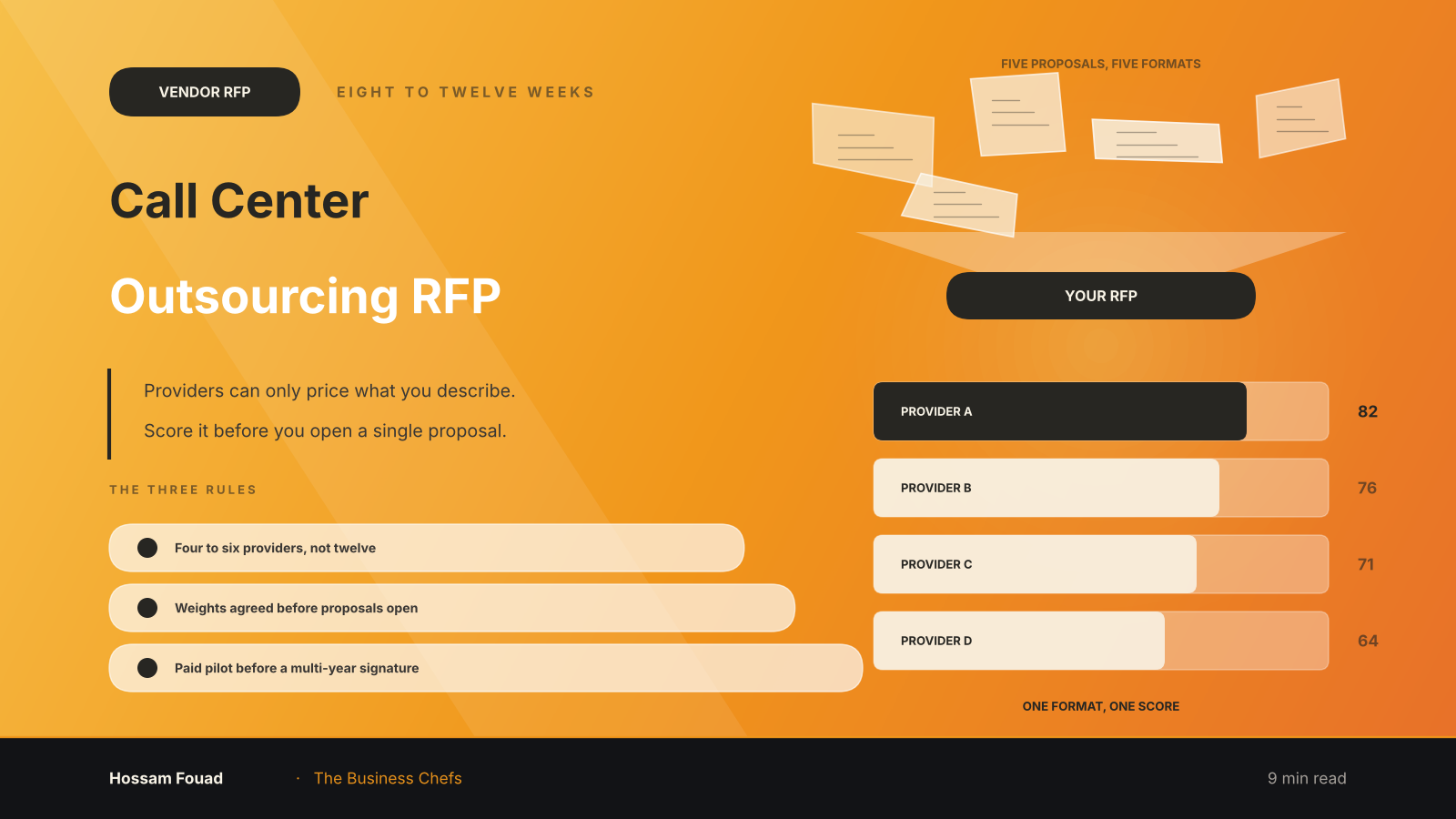
A call center outsourcing RFP (request for proposal) is the document that tells shortlisted providers exactly what you need — channels, volumes, languages, KPIs, compliance rules and the commercial model — and asks them to answer in a format you can compare side by side. A strong RFP gets you realistic promises and comparable prices. A weak one gets you glossy brochures that all sound the same.
RFI, RFP or RFQ: which one do you need?
| Document | Purpose | Use it when |
|---|---|---|
| RFI (request for information) | Learn what the market offers and build a shortlist | You are outsourcing for the first time or entering a new location |
| RFP (request for proposal) | Get detailed solutions and prices for a defined scope | You know what you need and want to compare providers properly |
| RFQ (request for quotation) | Get prices only | The scope is simple, stable and already well defined |
For a first outsourcing program, most companies run a short RFI to narrow the field to four to six providers, then send the RFP only to that shortlist.
Before you write: the four inputs you need
Providers can only be as precise as your data. Gather these first:
- Baseline data: twelve months of contact volume by channel, hour and contact reason, plus current average handle time, first contact resolution and customer satisfaction.
- Objectives: what success looks like, for example a lower cost per resolved contact, longer opening hours or new languages.
- Constraints: data protection, localization rules, industry regulation, budget and go-live date.
- Decision team: who scores, who signs and how much weight each criterion carries.
If your baseline is unreliable, fix that first. An independent contact center assessment gives you the numbers an RFP needs. Issuing an RFP on numbers you cannot defend means every provider prices a different guess, and you will not be able to tell whose guess was closest until you are twelve months into a contract.
What to include in a call center outsourcing RFP
1. Introduction and objectives
Explain who you are, why you are outsourcing and what you want to achieve. Providers write better proposals when they understand the business problem behind the request.
2. Scope of services
Describe channels, languages, processes, opening hours and seasonality. Include a volume table by channel and month so every provider prices the same workload.
3. Performance requirements
List the KPIs you will manage the program on — first contact resolution, customer satisfaction, quality score and service level, with average handle time as a diagnostic rather than a target. As a reference point, SQM Group puts a good first contact resolution rate at 70% to 75% across most channels, 60% to 65% for email, and world class at 80% or higher — a level only about 5% of the centers it benchmarks reach.
Those channel differences matter more in an RFP than anywhere else. A single blended FCR target across all channels can be met by over-performing on the easy channel while the hard one drifts, and you will have signed the contract that allows it. Set the target per channel, state the measurement method next to each one, and say who calculates it.
Our guide to contact center KPIs explains which metrics belong in a contract and the measurement question behind each.
4. People and operations
Ask about hiring profiles, training hours, supervisor ratios, attrition and the delivery location for your program.
5. Technology, data and AI
Cover the contact center platform, CRM integration, reporting access, AI tools in live use and security certifications. Ask exactly where your data will be stored and who can access it.
6. Compliance and risk
Spell out the rules that apply to you: data protection law, industry regulation, localization requirements and business continuity expectations. Treat must-have compliance items as pass or fail gates, not as weighted scores — a provider who fails one does not become acceptable by scoring well elsewhere. In Saudi Arabia, for example, customer service roles inside the Kingdom are fully localized, as we explain in Saudization and BPO.
7. Commercial model
Give providers a fixed pricing template. Ask for prices per hour, per contact and per resolved contact, plus ramp-up costs, minimum commitments, currency and how rates will be indexed. Our call center outsourcing cost guide explains what each pricing model rewards.
Two things to require in that template, because most buyers leave them out. First, make each provider state the first contact resolution assumption behind their cost per resolved contact. Without it the number is unfalsifiable: a low price per resolution may simply assume a resolution rate they have no plan to reach. With it, you can compare like for like, and you have the basis for a contractual commitment.
Second, ask what happens to the price when volume falls. Minimum volume commitments are the quiet trap in outsourcing contracts: if automation removes 20% of your contacts, a minimum commitment means you pay for the volume you just spent money to eliminate. That turns a success into an invoice. We cover the sequencing in how AI is changing contact center outsourcing.
8. Transition plan
Ask for a week-by-week plan covering recruitment, training, knowledge transfer, parallel running and the criteria for going live.
9. References and case studies
Request two or three references you can call, from clients of similar size, industry and languages. Ask for at least one reference from a program that did not go to plan — how a provider describes a difficult account tells you more than three happy ones.
10. Response instructions and timeline
State the deadline, the format, the page limit, the Q&A process and the date finalists will present. State the technical threshold here too, so providers know the standard below which price will not save them.
Ten questions that separate strong providers from weak ones
The questions matter less than knowing what a good answer sounds like. For the five that do the most work, both are below.
1. What was your agent attrition over the last three years on programs like ours? A good answer gives three annual figures, names the worst year and says what changed after it. A weak answer gives one number with no period attached.
2. Show us one program where first contact resolution improved. What exactly changed? A good answer names the intervention — a knowledge base rebuild, a disposition code change, a routing fix — and the size of the move. A weak answer says "continuous improvement".
3. Who will run our account day to day, and can we meet them before we sign? A good answer puts the name forward and offers the meeting. If the person on the pitch is not the person in the contract, you are being sold a different company than the one you will get.
4. How do you calibrate quality scores with clients?
5. Which AI tools are live in client programs today, not on your roadmap? A good answer names the tool, the client type and the contact types it handles. A weak answer describes a partnership with a vendor.
6. If automation cut our contact volume by 20%, how would your pricing respond? A good answer describes a mechanism — a volume band, a renegotiation trigger, a shift to outcome pricing. A weak answer says it would be discussed. Discussion is not a contract term.
7. Where will our data be stored, processed and accessed, including by AI tools?
8. What happens to service levels during your own peak seasons?
9. What does your fallback site look like, and has it ever been used?
10. What would you need from us to reach our targets?
That last one is the most revealing question in the list. A provider who cannot name anything they need from you has either not read the RFP or does not intend to tell you when you have the problem.
How to score the proposals
Agree on weights before proposals arrive. Most published scoring models for outsourcing share a flaw worth naming: they weigh the quality of the commercial model without ever weighting the price. A model like that cannot actually be run, and the first person to notice will be your procurement lead.
The fix is a three-stage structure, which is also how most GCC enterprise and government procurement already works:
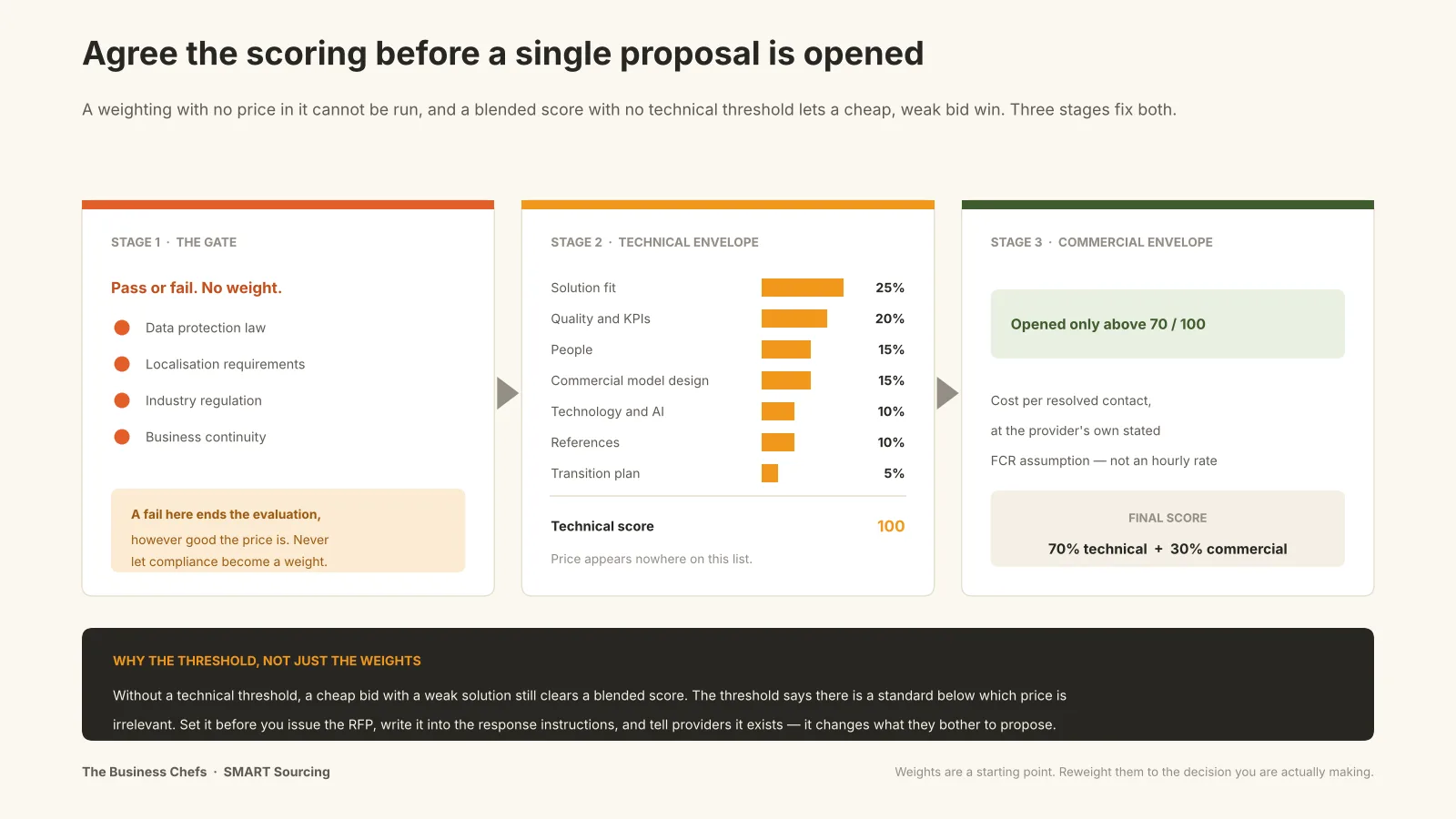
Compliance as a gate, technical scored on its own, commercial opened only above a threshold.
1. The gate. Compliance items are pass or fail, with no weight. Data protection, localization, industry regulation and business continuity. A fail ends the evaluation regardless of price.
2. The technical envelope. Score each criterion from 1 to 5 against the weights below, out of 100. Price appears nowhere in it.
3. The commercial envelope. Opened only for bidders above the technical threshold — 70 out of 100 is a reasonable starting point. Scored on cost per resolved contact at the provider's stated FCR assumption, not on hourly rate.
Then combine. A 70% technical and 30% commercial split works for most customer service programs. Weight commercial higher only when the technical field is genuinely level, which it rarely is.
| Criterion | What good looks like | Weight |
|---|---|---|
| Solution fit | Understands your customers, processes and languages | 25% |
| Quality and KPIs | Proven results on comparable programs | 20% |
| People | Low attrition, strong supervision and training | 15% |
| Commercial model design | Transparent structure that rewards resolution | 15% |
| Technology and AI | Live tools, integrations and data access | 10% |
| References | Comparable clients who will speak openly | 10% |
| Transition plan | Realistic timeline with clear go-live criteria | 5% |
Publish the threshold in the RFP itself. Providers triage the bids they put real effort into, and a buyer who has clearly thought about evaluation gets better proposals than one who has not. Then take two or three finalists into presentations, a site visit or video walk-through, and a pilot.
A realistic RFP timeline
Eight to twelve weeks takes you from first draft to contract award. It does not include a pilot, and this is where most published timelines quietly mislead — a pilot of the kind described below takes 8 to 12 weeks, not four.
| Weeks | Activity |
|---|---|
| 1 to 2 | Gather data, agree objectives, set the weights and the technical threshold, write the RFP |
| 3 | Issue the RFP to the shortlist |
| 3 to 6 | Provider questions, answers and proposal writing |
| 7 to 8 | Technical scoring, finalist presentations and reference calls |
| 9 to 10 | Commercial envelopes opened and scored, combined ranking agreed |
| 11 to 12 | Negotiation and contract award |
Then the pilot. A paid pilot that proves anything runs 8 to 12 weeks, because you need a full ramp plus a stable period after it. You have two honest options:
- Pilot before signature. Total elapsed time becomes 16 to 24 weeks. The cleanest evidence, and the hardest to get budget and patience for.
- Sign with a probation period. Contract award at week 12, with the first 8 to 12 weeks defined as a probationary phase carrying named exit criteria and a short-notice termination right. Faster, and only as good as the exit clause.
What does not work is signing a multi-year contract at week 12 with no pilot and no probation, then discovering real performance in month four. That is the single most expensive mistake in this process and it is almost always caused by a go-live date set before the RFP was written.
If your incumbent is bidding
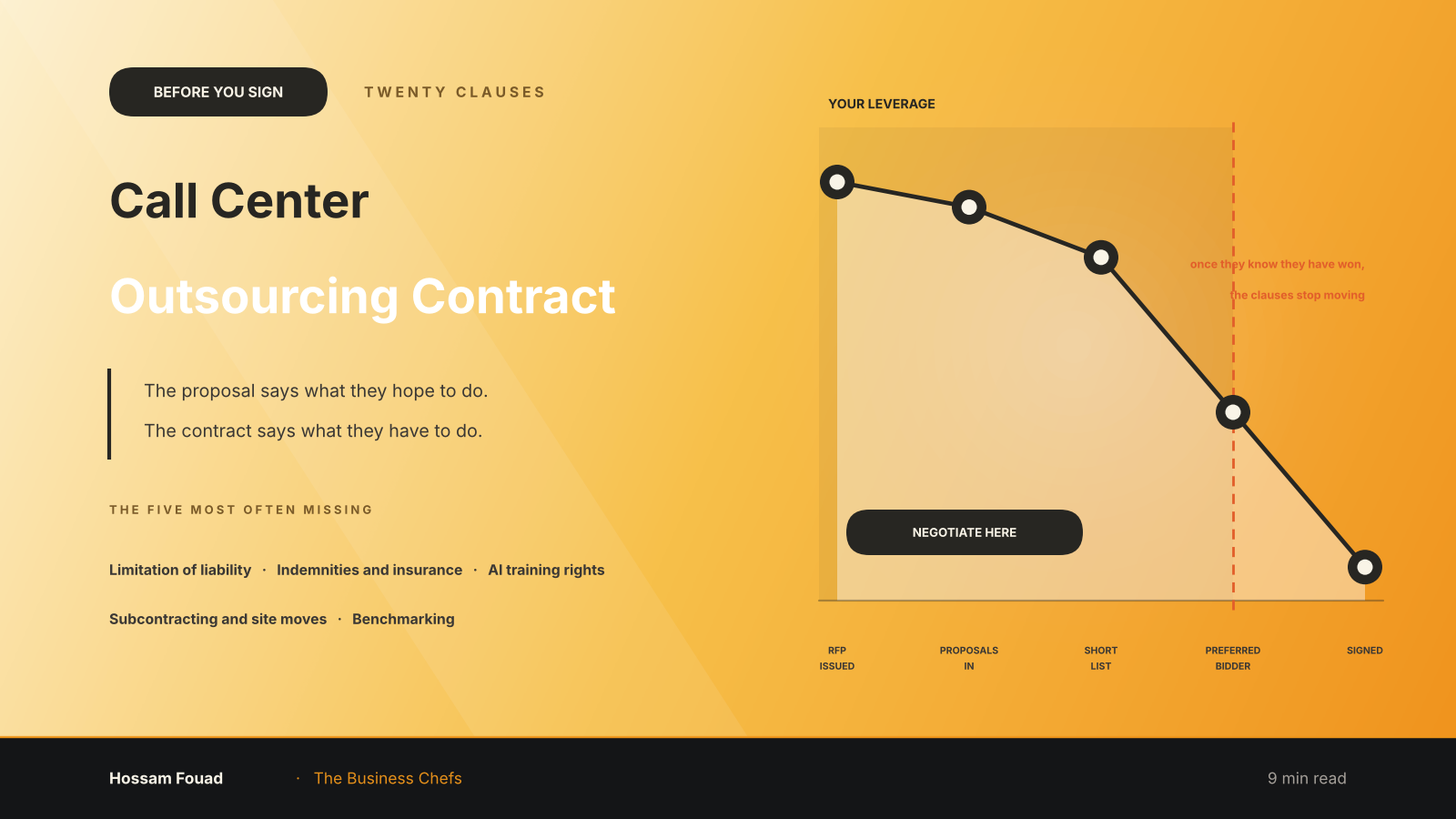
Most re-tenders include the current provider, and most of them are unfair without anyone intending it. The incumbent knows your real volumes, your real quality problems and which of your assumptions are wrong. The challengers are pricing a document.
- Give everyone the same data pack, including the uncomfortable parts. If the incumbent knows your contact-reason mix is 30% status chasing, so should the others.
- Route all questions through one channel and publish every answer to every bidder, unattributed.
- Stop operational conversations with the incumbent that touch the bid and tell them you are doing it. This protects them as much as you.
- Decide in advance what an incumbent has to beat. Switching costs are real, so a small price advantage to a challenger is not a reason to move. Say what the margin is before you see the numbers.
If you cannot run it fairly, say so and negotiate with the incumbent directly instead. A tender used to pressure a renewal is a tax on four providers' bid teams, and the market remembers.
What you owe the providers
Response quality is not purely a function of who you invite. Good providers triage: a bid team that senses a disorganized process assigns the B team. Four things that raise the quality of what you get back:
- A realistic response window. Three weeks minimum for a full proposal. Ten days produce recycled content.
- Answered questions, published to everyone. Late or selective answers push bidders to assume, and assumptions become the caveats that destroy comparability.
- The decision criteria in writing, including the threshold and the weights. Transparency costs you nothing and improves what you receive.
- A real debrief for the losers. Fifteen minutes each. It takes an hour and buys you a better field next time, which in a market this small is worth more than it sounds.
Common RFP mistakes
- Using a generic template that has nothing to do with your customers or processes.
- Leaving out baseline data, so every provider prices a different guess.
- Asking only for an hourly rate, which hides the cost of repeated contacts.
- Asking for cost per resolved contact without the FCR assumption behind it, which looks rigorous and compares nothing.
- Sending it to too many providers. Four to six is enough to create real competition.
- Letting price dominate the scoring — or, more common and harder to spot, leaving price out of the published model entirely and settling it in a side conversation.
- Skipping the pilot and discovering real performance after you have signed.
- Setting the go-live date before writing the RFP, which is what causes most of the above.
Call center outsourcing RFP template (outline)
Use this outline as the skeleton of your document:
1. About us: company overview, customers and reasons for outsourcing.
2. Objectives: the three to five outcomes the program must deliver.
3. Scope: channels, languages, processes, hours and a monthly volume table.
4. Performance: KPIs, targets per channel, measurement method and reporting frequency.
5. People: hiring profile, training, supervision and attrition expectations.
6. Technology and AI: platforms, integrations, AI in use and data access.
7. Compliance: data protection, regulation, localization and continuity, marked as pass or fail.
8. Commercials: a pricing template with per-hour, per-contact and per-resolved-contact options, the FCR assumption behind each, volume bands and indexation.
9. Transition: a week-by-week plan and go-live criteria.
10. References: two or three comparable clients, including one difficult account.
11. Instructions: timeline, format, Q&A process, the technical threshold and the contact person.
For more on supplier selection, the contact center standards body COPC publishes useful guidance — worth reading alongside the fact that COPC also sells certification and vendor management consulting, so read it as informed advocacy rather than neutral research. Our article on how to choose a BPO partner covers the questions to ask beyond the RFP.
The Business Chefs writes and runs RFPs for companies outsourcing customer service for the first time or switching providers, through our vendor selection service. We are therefore a party with an interest in you running one — if the honest answer is that your scope is small enough to handle with a three-provider RFQ, that is what we will tell you on the call.
|
Want an RFP that gets you comparable proposals? Book a free 30-minute discovery call |
Conclusion
A good call center outsourcing RFP does three things: it describes your workload precisely, it asks questions that reveal how providers really operate, and it forces proposals into a format you can compare. Add a scoring model agreed in advance — with a compliance gate, a technical threshold and price in it — and either a pilot or a probation period, and you choose a partner on evidence rather than on the best presentation.
Frequently Asked Questions
What is a call center outsourcing RFP?
It is a request for proposal that describes your customer service requirements, including channels, volumes, languages, KPIs, compliance rules and commercial model, and asks providers to respond in a set format so their proposals can be compared directly.
How long does a call center RFP process take?
Eight to twelve weeks from first draft to contract award. That includes about three weeks for providers to respond and two weeks for scoring and presentations. A pre-signature pilot adds a further 8 to 12 weeks, taking the total to 16 to 24. If that does not fit your go-live date, sign with a probationary period and named exit criteria instead of skipping the test.
How many providers should receive the RFP?
Four to six is usually enough. Fewer limits competition, while more creates evaluation work without improving the outcome. Use a short RFI first if you need to narrow a longer list.
What should I ask about pricing in the RFP?
Ask for prices per hour, per contact and per resolved contact in your own template, plus ramp-up costs, minimum commitments, currency and indexation. Require each provider to state the first contact resolution assumption behind their cost per resolved contact — without it, that figure cannot be compared between bidders or enforced afterwards.
How should price be weighted in the scoring?
Not inside the technical score. Use a pass-or-fail compliance gate, a technical score out of 100, and a commercial envelope opened only for bidders above a technical threshold such as 70 out of 100. A 70% technical and 30% commercial combination suits most customer service programs.
Should I run a pilot after the RFP?
Yes, with your two or three finalists if possible. A paid pilot of 8 to 12 weeks tests the promises in the proposal against real performance. If the timeline will not allow it before signature, build the same test into the contract as a probationary phase with exit criteria.
What if our current provider is bidding?
Give every bidder the same data pack including the unflattering parts, route all questions through one channel and publish the answers to everyone, suspend bid-related operational conversations with the incumbent, and decide in advance what margin a challenger must beat to justify switching costs.
|
About the author Hossam Fouad is the Managing Partner of The Business Chefs, a boutique BPO, customer experience and strategic sourcing consultancy. He advises enterprises in North America, the UK and the GCC on outsourcing strategy, partner selection and contact center performance, working hands-on with operations teams from assessment to execution. Want an RFP that gets you comparable proposals? Book a free 30-minute discovery call with a senior practitioner. No sales pitch, just practical next steps. |