How to Choose a BPO Partner: 10 Questions to Ask Before You Sign
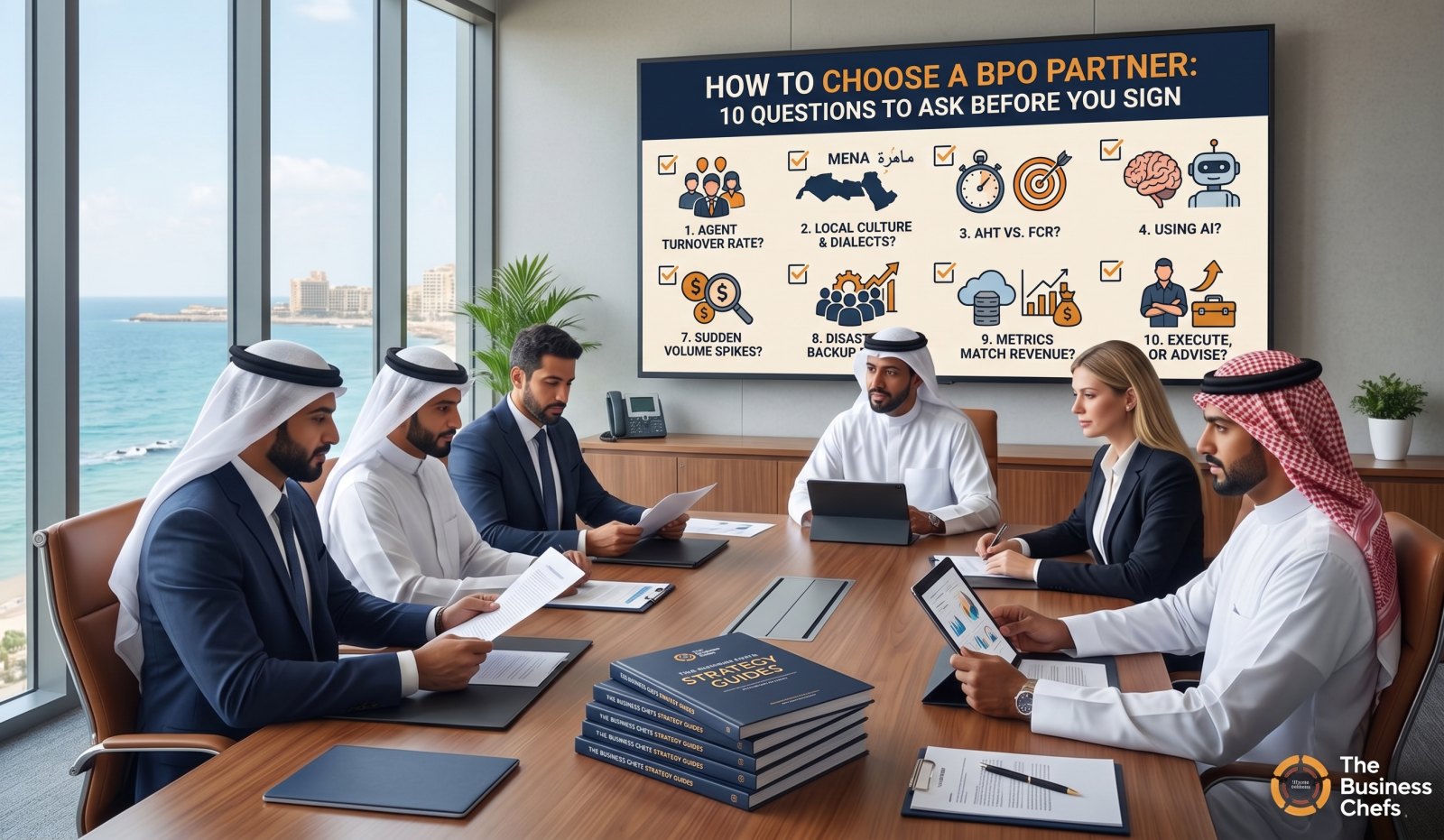
Most companies pick a BPO based on who has the cheapest hourly rate. That’s a mistake that will cost you your customers. A real partner doesn't just fill seats; they fix your broken processes, keep their employees happy, and focus on solving customer problems permanently. Here is what you actually need to ask a vendor before signing a contract.
The vendor selection trap
Every vendor answering your RFP will promise the same things: quality, savings, flexibility, and a dashboard that shows it all in green. On a two-hour pitch call, they are almost impossible to tell apart.
The difference is that outsourcing isn’t procurement. You are handing over the front door of your business. Pick on price and you spend the next two years arguing over SLA credits while customers quietly leave.
The way through is not a longer RFP. It is a shorter list of questions that are hard to answer well unless the operation behind them is genuinely good.
Ask the question, then score the answer
A question only helps if you know what a good answer sounds like. Weak vendors answer in adjectives. Strong ones answer with numbers, names, and examples they can evidence.
Use a simple rule as you go: if an answer contains no figure, no named person, and no specific example, treat it as a no. Score each question out of 3 and compare vendors on the total rather than on how the pitch felt.
Part 1: The people who will serve your customers
1. What is your agents’ attrition rate, and how is it calculated?
If agents leave every few months, your customers spend their time with trainees. Ask for the figures on accounts like yours, not the company average, and ask whether it counts internal promotions as leavers.
- Good answer: A specific annualized number with context, ideally under 35% for voice work, plus what they did when it was worse.
- Red flag: “Industry standard” or “we don’t have that to hand.”
2. Who exactly will run my account, and what else are they running?
The operations manager in the pitch is often not the one you get. Account performance rises and falls on the team leaders, and a lead stretched across five clients cannot coach anyone.
- Good answer: Named leads, their agent-to-leader ratio (roughly 1 to 12–15 for complex work), and how many other accounts they carry.
- Red flag: “We’ll assign that after signature.”
3. How do you handle local dialect and culture?
For the GCC, “our agents speak Arabic” is not an answer. A Cairo-accented agent handling a Saudi customer, or an agent who misjudges formality with an older caller, makes your brand feel foreign.
- Good answer: Specifics on dialect coverage, register and etiquette in training, and QA criteria that score cultural fit, not just script adherence.
- Red flag: Language treated purely as a recruitment checkbox.
Part 2: How they will run the work
4. Do you manage to AHT or to FCR?
A vendor optimizing Average Handle Time is rushing your customers off the phone. One optimizing First Contact Resolution is fixing the problem, so they don’t call back. Both metrics have a place, but only one can be the primary.
- Good answer: FCR and repeat-contact rate as primary, AHT tracked as a capacity input, and a description of how agents are coached when the two conflicts.
- Red flag: AHT targets in the bonus scheme with no resolution measure beside them.
5. How are you using AI, and where do you refuse to use it?
“We use chatbots” is a non-answer. Automation that blocks customers from reaching a human raises effort and costs you goodwill. Used well, it sits behind the agent.
- Good answer: Concrete uses such as agent assist, automated QA across all contacts rather than a sample, and intent prediction, with clear rules on when a customer reaches a human.
- Red flag: Deflection rate presented as the headline benefit.
6. Do you fix processes, or just follow them?
Handing a broken workflow to a vendor gives you the same broken workflow with a margin on top. The best partners tell you which of your own processes are generating the contacts.
- Good answer: A defined discovery or audit phase before go-live, and an example of a client process they pushed back on.
- Red flag: “Send us the SOPs and we’ll follow them exactly.”
7. How do your metrics connect to our revenue?
A vendor can hit every SLA while your customers’ churn. The scorecard must reach past service levels into retention and value.
- Good answer: Willingness to be measured on retention, repeat purchase, or resolution outcomes, and to put a share of fees at risk against them.
- Red flag: A dashboard full of green with no line connecting it to your P&L.
Part 3: Money, risk, and getting out
8. What sits outside the hourly rate?
A low rate usually means the extras are billed separately. Ask for a total cost of ownership view over the full contract term, not a rate card.
- Good answer: A line-by-line breakdown covering transition, training, technology licenses, reporting, management time, and change requests, plus what triggers a re-rate.
- Red flag: A single blended rate and “we’ll handle the details in the SOW.”
9. How do you absorb a sudden spike?
Black Friday, an outage, a product recall. The honest answer involves cross-trained staff and overtime, not magic.
- Good answer: A named past event, how far volume rose, how fast they covered it, and what quality did during the surge.
- Red flag: Unlimited flexibility promised with no mention of the quality cost, or surge cover that means putting untrained new hires straight onto your queue.
10. How is our customer data protected, and what happens if your site goes down?
This is the question most buyers skip and most regret. You need both continuity and compliance, especially with delivery across Egypt and the GCC.
- Good answer: Current certifications such as ISO 27001, PCI DSS where payments are handled, alignment with GDPR and the relevant national data protection law, plus a business continuity plan that has been tested, with the date of the last test.
- Red flag: Certifications “in progress,” or a continuity plan that exists as a document but has never been rehearsed.
Bonus Q: What does leaving look like?
No one wants to discuss exit during courtship, which is exactly why it belongs in the contract rather than in a future dispute.
- Good answer: Clear notice periods, transition-out support at agreed rates, and explicit ownership of your data, recordings, knowledge base, and any process documentation created during the contract.
- Red flag: Long lock-ins, exit fees, or reluctance to confirm that everything built for your account belongs to you.
Reading the answers: red flags and green flags
|
What to look at |
Red flag |
Green flag |
|
Pricing |
Competes to be lowest bidder |
Competes on total cost and outcomes over the term |
|
The team |
Seats filled quickly, constant rehiring |
Selective hiring, defined career paths, named account leads |
|
Technology |
Runs whatever you already have |
Brings tools that make agents faster and QA broader |
|
Candor |
Blame your processes or your customers |
Tell you which of your processes are generating contacts |
|
Evidence |
Adjectives and case studies with no numbers |
Figures, named references, and a client they lost and why |
|
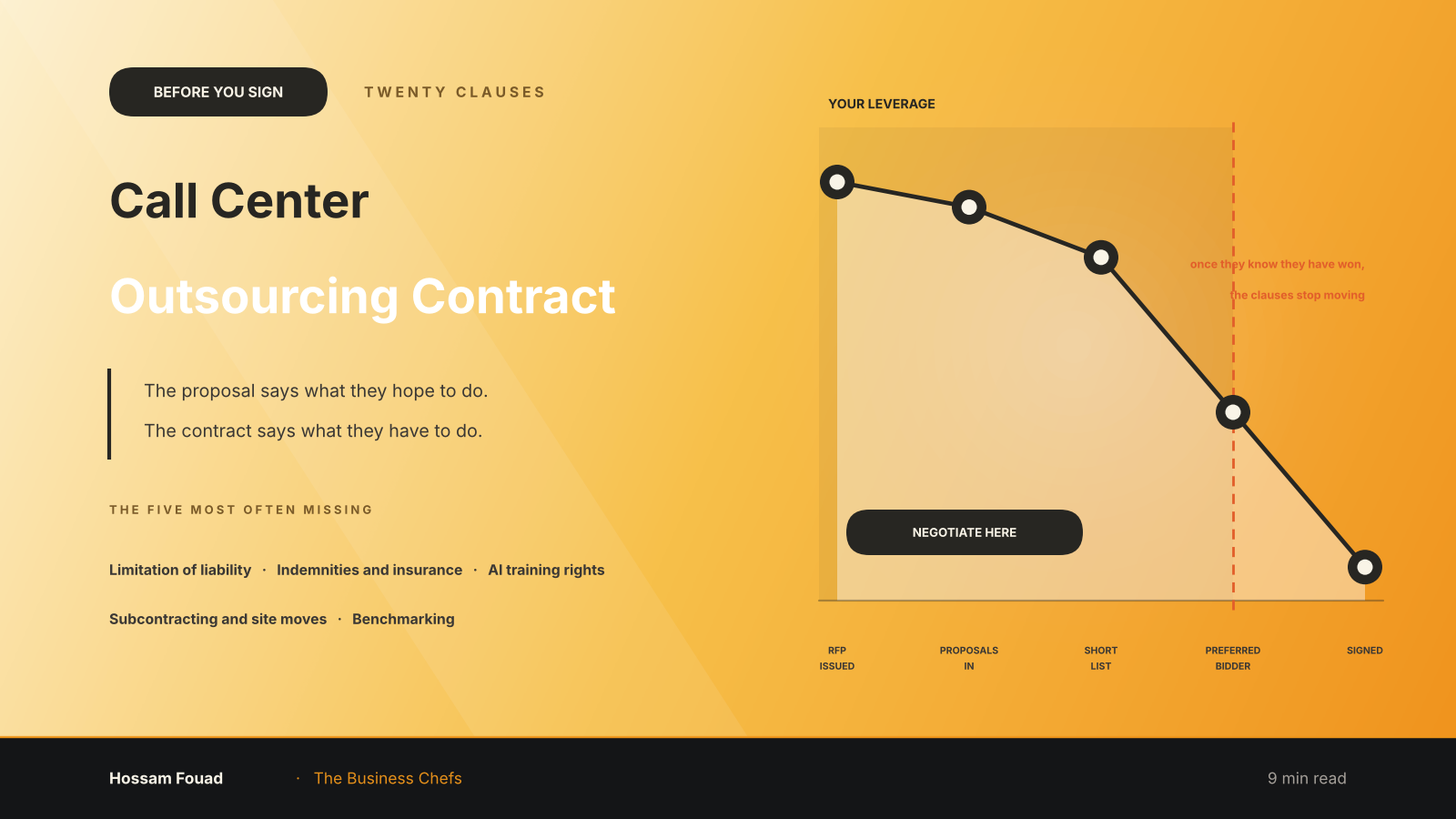
Contract |
Long lock-in, vague exit |
Clear notice, transition-out support, your data stays yours |
Frequently asked questions
What is the single most important metric when choosing a partner?
First Contact Resolution, with repeat-contact rate beside it. High FCR means agents are trained, empowered, and given the authority to finish the job rather than pass it on.
Why does cultural fit matter so much?
Customers can tell when the person on the line doesn’t understand their world. In the GCC this goes beyond language to dialect, formality, and etiquette. Get it right and the team sounds like your brand. Get it wrong and every interaction feels outsourced.
Is outsourcing always cheaper than in-house?
No, and be wary of any vendor who says otherwise. At scale it usually is, because you avoid recruitment, facilities, tooling, and management overhead. It often isn’t for small volumes, highly specialized work, or tightly regulated processes where oversight costs more than the saving. Compare total cost of ownership over three years before deciding.
How long should selection take?
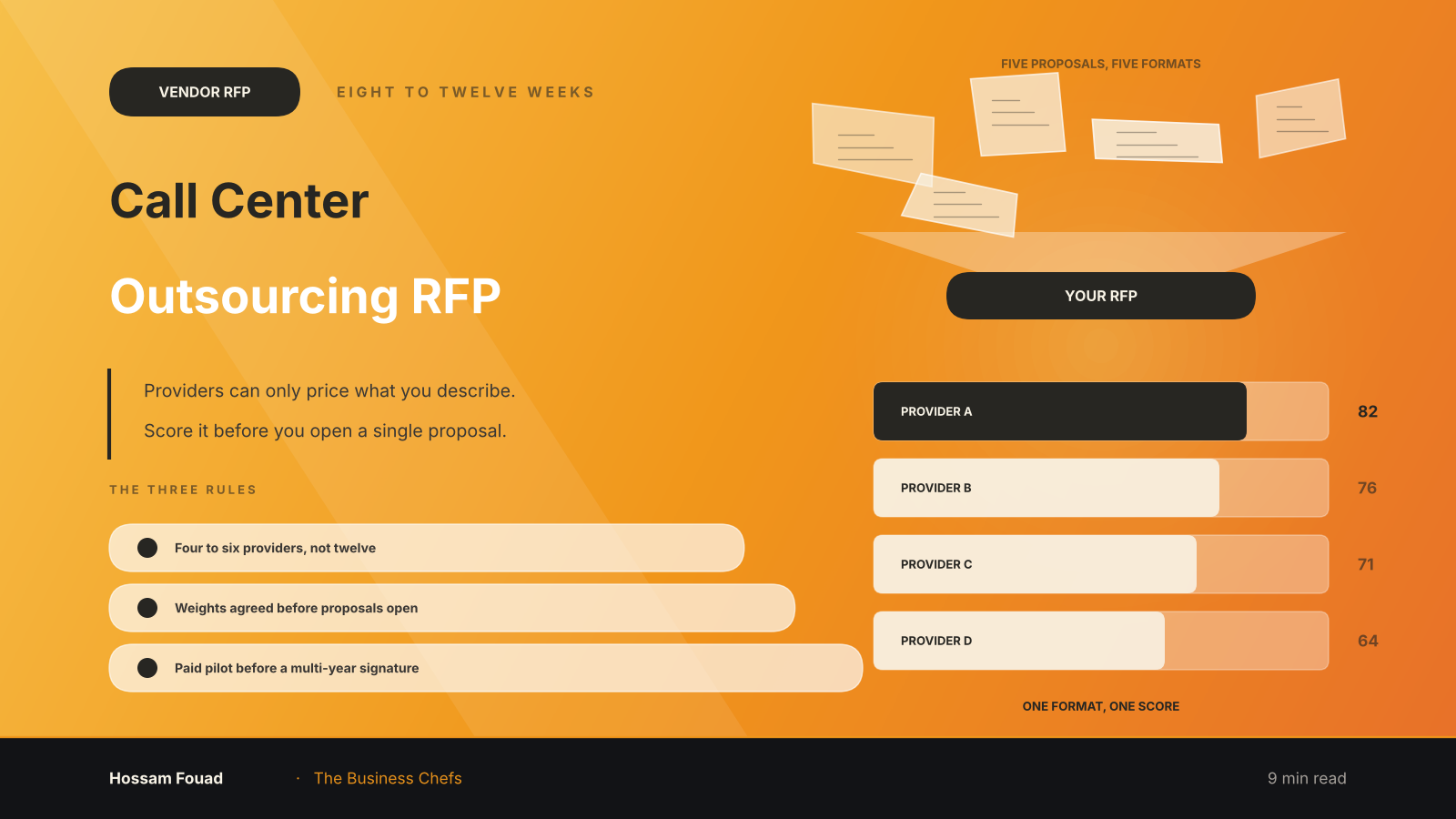
Plan for eight to twelve weeks from RFP to signature for a mid-sized contract, plus a transition period before go-live. Anyone promising to have you live next month is skipping the discovery that makes the rest work.
Before you sign, pressure-test the shortlist
There is one more question worth asking, and it is about us as much as anyone else: does this partner execute, or only advise? Plenty of firms deliver a thick recommendations deck and leave you to run the floor. At The Business Chefs we are practitioners, so ask us the same eleven questions you ask everyone else.
Book a free 30-minute Shortlist Review. Bring the vendors you are considering and we’ll help you:
- Score their answers against what good actually looks like
- Spot the costs that sit outside the rate card
- Decide which two are worth a site visit
No commitment and no pitch deck. If the right answer is a vendor other than us, we’ll tell you.
Book Your Shortlist Review → https://cal.com/thebusinesschefs/30min