How AI Is Changing Contact Center Outsourcing in 2026
AI is rewriting outsourcing contracts, not just workflows. The real sequencing, hidden costs, Arabic dialect pitfalls, and who captures the saving.
|
Key takeaways
|
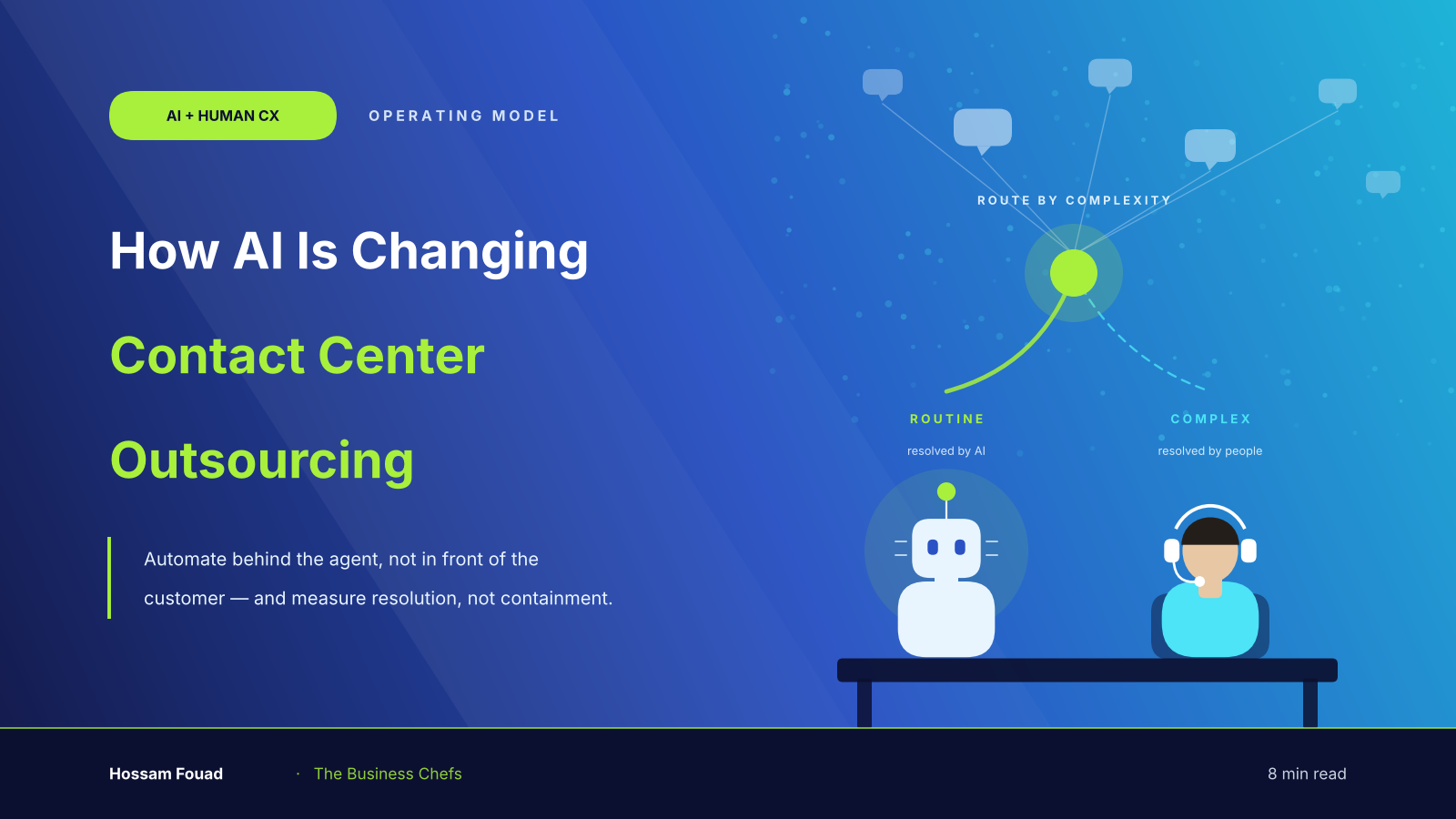
AI is changing contact center outsourcing by automating routine contacts, assisting agents in real time, and turning quality assurance from a small manual sample into full coverage. The commercial model is following; buyers are moving from paying for agent hours to paying for resolved issues. The companies that gain from this will be the ones that pick AI-ready partners, understand what the automation actually costs, and settle who captures the saving before they sign.
What AI can automate in a contact center today
AI already handles a large share of predictable, rules-based work:
- Self-service and virtual agents: answering FAQs, checking order or ticket status, resetting passwords and booking appointments across chat, voice and messaging.
- Intelligent routing: reading intent and sentiment to send each contact to the right queue or agent.
- Agent assist: suggesting answers, surfacing knowledge articles and filling forms while the agent talks.
- Automatic summaries: writing after-call notes and updating the CRM, which cuts wrap-up time.
- Quality assurance: scoring every interaction for compliance, empathy and resolution.
- Forecasting and scheduling: predicting volume and building smarter workforce schedules.
The Agentic AI forecast, and the word people skip
The next wave is agentic AI, which takes actions rather than only generating text. Gartner forecasts that by 2029, agentic AI will autonomously resolve 80% of common customer service issues without human intervention, with a 30% reduction in operational costs, as reported by CX Today.
That figure gets quoted as though it settles the argument. Read it again and the load-bearing word is common. Routine, repeatable, well-documented contacts are exactly what automation is good at, and they are also the contacts your least experienced agents currently handle.
So the 20% that remains is not leftover. It is the complex, the emotional, the regulated and the commercially significant — the work that used to be diluted across a large floor and will now be most of what a smaller floor does. That raises the skill, experience and pay profile you need, rather than lowering it. Any vendor citing this forecast to justify a cheaper, thinner team has read the headline and not the sentence.
What still needs human agents
AI is strong at volume and consistency. People are still better at judgment and trust. Keep humans at the center of:
- Complex problems that cut across systems, policies or departments.
- Emotionally charged moments such as complaints, bereavement, fraud or health issues.
- High-value conversations like retention offers, B2B accounts and complex sales.
- Exceptions and edge cases that fall outside what the AI was trained to handle.
- Culturally sensitive service, including dialect, etiquette and context in markets like the GCC.
The best operations design a clean handoff: AI resolves what it can, then passes full context to a person, so the customer never has to repeat themselves.
Where to deploy it first, and in what order
Most failed AI deployments in customer service fail on sequencing rather than technology. The tools that are easiest to buy are the ones pointed at the customer, and those are the ones that should go live last.
The logic is simple. In Phase 1 the customer never sees the AI, so a mistake costs you an internal correction. In Phase 3 a mistake costs you the customer. Earn your way across.
What AI actually costs
Automation is routinely presented as pure efficiency. It is not free, and the cost lines rarely appear in a vendor deck. Budget for all of these:
- Platform licensing: priced per seat, per conversation or per resolved interaction. Ask which, because per-conversation pricing on a high-deflection deployment scales in a direction you may not expect.
- Integration: CRM, telephony, knowledge base and identity. Usually the largest one-off cost, and usually underestimated.
- Knowledge base build and upkeep: AI is only as accurate as what it reads. This is a permanent function, not a project with an end date.
- Conversation design: somebody has to write the flows, the fallbacks and the escalation rules, and keep rewriting them.
- Arabic tuning and testing: dialect coverage is not a configuration setting. Treat it as a workstream.
- QA of the AI itself: you now have a second workforce to monitor, and it fails differently from the human one.
- Reskilling and change management: the agents who remain need different skills, and someone has to fund that.
Expect the first quarter to cost more, not less. The savings arrive after the knowledge base is accurate and the handoffs work, which is usually month four or later — the same curve we describe in our call center outsourcing cost guide. Anyone promising automation savings in week three is describing a deflection target, not an operating model.
Who captures the saving? The question most RFPs miss
Here is the structural problem nobody raises on the pitch call. A vendor paid per agent hour, per FTE or per contact handled loses revenue when automation removes contacts from your queue. Their AI roadmap, however sincere, runs against their own P&L.
No amount of partnership language removes that. Only the commercial model does. Three ways buyers handle it:
1. Price on resolved contacts or outcomes. The vendor’s margin survives a falling contact volume, so automation stops being a threat to them.
2. Agree with an explicit automation gain-share, with a split that declines over the term as the saving becomes the baseline rather than an achievement.
3. Keep the automation layer on your own contract and let the vendor operate on top of it. You own the tooling and the saving; they provide the people.
Ask which of the three a vendor will accept, and watch what happens to the conversation. The answer tells you whether their AI roadmap is built for your cost base or for their margin.
AI-powered quality assurance and real-time coaching
Traditional quality assurance is a sampling exercise. A QA analyst listens to a handful of calls per agent per month and extrapolates.
SQM Group puts manual evaluation at fewer than 2% of calls, against up to 100% for automated QA. That figure comes from SQM’s own business case for its QA software, so treat the precise number as directional — but the shape of the claim is not controversial, and any supervisor who has run manual calibration will recognize it.
Full coverage changes management rather than just measurement. Supervisors see every compliance risk, coaching opportunity and process failure, not the few calls an analyst happened to pick. Real-time coaching goes further, prompting agents’ mid-conversation with the next best action or a reminder to confirm resolution.
This is one of the fastest routes to higher first contact resolution, which our guide to contact center KPIs explains is the metric most closely tied to both satisfaction and cost. It is also, not coincidentally, a Phase 1 deployment: the customer never sees it.
Why Arabic breaks generic AI tools
"Our platform supports Arabic" is not a specification. For a GCC operation it is the beginning of a conversation, and these are the places deployments actually fail:
- Dialect versus MSA. Vendors benchmark speech recognition on Modern Standard Arabic, which almost nobody speaks to a contact center. Word error rates on Gulf, Egyptian and Levantine dialects are materially worse. Ask for the figure on the dialect your customers actually use.
- Code-switching. Gulf callers switch between Arabic and English inside a single sentence, often mid-clause. Many pipelines treat an utterance as one language and degrade sharply when it is not.
- Entity capture. Numbers, dates, amounts and names spoken in dialect are the most common failure point, and they are precisely what a transactional self-service flow depends on.
- Register and formality. A model that cannot handle حضرتك and its equivalents sounds wrong to an older caller in a way that no containment metric will show you.
- Accent coverage within a dialect. Sa’idi, Khaleeji and Levantine are not interchangeable in training data, and a model tuned on one will not generalize to the others.
Test with recordings from your own queue, not the vendor’s demo set. A demo is built from clean audio and cooperative speakers; your queue is neither.
Data protection shapes this too. Saudi Arabia’s Personal Data Protection Law has been fully enforceable since September 2024, which constrains where AI tools may process customer data and whose models may see it.
The impact on headcount, roles and skills
Fewer agents will handle simple, repetitive contacts. That does not mean the contact centre disappears; it means the work changes shape. The remaining interactions are harder, so agents need stronger problem-solving, empathy and product knowledge — and they cost more, which is the part cost models tend to miss.
New roles are growing, conversation designers, AI trainers, knowledge managers, quality analysts and automation specialists. Outsourcing hubs are adapting already. Ahmed El Zaher, CEO of Egypt’s IT Industry Development Agency, recently argued that AI will take simple call center jobs while opening higher-value roles, noting that providers such as Concentrix are building AI solutions from Egypt for international clients.
For a buyer, the practical question is whether your partner is reskilling its people or quietly cutting seats and keeping the difference.
How to evaluate whether your BPO partner is AI-ready
Use these in your RFP or your next business review:
4. What AI tools are live in client programs today, not on the roadmap?
5. What share of contacts is resolved by automation, and how is "resolved" defined and measured?
6. How do virtual agents hand off to humans, and does full context transfer with the customer?
7. What is your speech recognition word error rate on the specific dialects we need, measured on real customer audio?
8. Where is our data processed, which models see it, and how do you comply with PDPL and the other regimes that apply to us?
9. How do you reskill agents as automation grows, and what happened to agent pay on programs where you have already done it?
10. Will you accept outcome-based pricing or an automation gain-share, so that removing contacts does not cost you revenue?
Vague answers are the answer. For the full vendor checklist, see how to choose a BPO partner in Saudi Arabia.
The risk of over-automating: when AI hurts CX
Automation done badly is expensive. Watch for:
- Dead-end bots that trap customers with no clear route to a person.
- Deflection disguised as resolution, where contact volume drops but problems are not solved and customers return less patient than before.
- Brand damage from wrong, robotic or culturally tone-deaf answers.
- Data and compliance risk when AI tools process personal data without proper safeguards.
Measure automation by resolution and satisfaction. Containment is a vendor’s metric, not yours.
And the shift nobody has priced yet
Customer behavior is moving faster than most service strategies. Gartner expects that by 2028, 70% of customer service journeys will begin and be resolved in conversational, third-party assistants built into mobile devices.
Read what that implies. Your service operation may increasingly be talking to your customer’s AI assistant rather than to your customer. That changes what "good service" means: the thing being satisfied is an agent acting on someone’s behalf, which will ask structured questions, retry rather than escalate, and not be charmed by an empathetic tone.
Nobody has a settled playbook for this yet, including us. But a partner who has not thought about it is a partner planning for the contact center of 2022.
How GCC companies are adopting AI
GCC operations face the same opportunity with local constraints: dialect variety, code-switching, high service expectations and data protection rules that limit where processing can happen.
The approach that works is staged, and it is the roadmap above. Start with agent assist, summaries and automated QA, which carry no customer risk and build the evidence base. Expand into self-service only once the knowledge base and the Arabic models are proven on real interactions from your own queue.
The Business Chefs’ approach to AI and human CX
We design operations where AI and people each do what they do best:
- Diagnose first: map contact reasons and identify what is genuinely automatable.
- Fix the process: remove avoidable contacts before automating them. Automating a bad process makes it faster, not better.
- Automate the routine: AI for simple, high-volume queries and for agent support.
- Elevate the human: reskill agents for complex, high-value and sensitive work, and pay accordingly.
- Measure outcomes: resolution, satisfaction and cost per resolved contact.
Explore our services or read how AI fits the economics in our call center outsourcing cost guide.
Conclusion
AI is not replacing contact center outsourcing; it is rewriting the terms. Routine work is moving to automation, quality assurance is moving to full coverage, and human agents are moving to the conversations that carry the most value and the most risk.
Choose partners who can prove AI results in live programs today, who can quote error rates on your dialects rather than on Modern Standard Arabic, who protect your data, who are reskilling their people, and whose pricing survives the volume reduction their own roadmap promises.
Frequently asked questions
Will AI replace call center agents?
It will replace much of the routine, repetitive work, not the need for people. Gartner’s forecast is that agentic AI resolves 80% of common issues by 2029 — and the harder 20% that remains becomes most of what a smaller floor handles, which raises the skill and pay profile rather than lowering it.
What can AI automate in a contact center?
Self-service for common questions, intelligent routing, real-time agent assistance, automatic summaries, quality scoring of every interaction, and forecasting and scheduling. Agentic AI is starting to complete tasks end to end on the customer’s behalf.
Does AI actually reduce cost?
Eventually, and not immediately. Licensing, integration, knowledge base upkeep, conversation design, Arabic tuning and QA of the AI all carry cost, and the first quarter usually costs more. Savings arrive once the knowledge base is accurate and the handoffs work.
How does AI improve quality assurance?
Automated QA reviews every interaction instead of a small manual sample, which surfaces compliance risks and coaching opportunities a sampling approach misses entirely. It is also the lowest-risk place to start, because the customer never sees it.
How do I know if a BPO provider is AI-ready?
Ask for tools live in client programs today, measured automation results with "resolved" defined, how bots hand off to humans, word error rates on your actual dialects, data protection practices, agent reskilling plans, and whether they will accept pricing that survives falling volume.
Why do generic AI tools struggle with Arabic?
Because vendors benchmark on Modern Standard Arabic while customers speak dialect, because Gulf callers code-switch mid-sentence, and because numbers, dates and names in dialect are the hardest things to capture reliably — and exactly what self-service flows depend on. Test on your own call recordings, not a demo.
What are the risks of AI in customer service?
Dead-end bots, deflection that does not solve problems, inaccurate or culturally inappropriate answers, and data protection breaches. Measure AI by resolution and satisfaction, and always leave a one-step route to a person.
|
Planning AI in your contact center? Book a free 30-minute call with a senior practitioner. No sales pitch, just practical next steps. Talk to a practitioner |
|
About the author Hossam Fouad is the Managing Partner of The Business Chefs, a boutique BPO, customer experience and strategic sourcing consultancy. He advises enterprises in North America, the UK and the GCC on outsourcing strategy, partner selection and contact center performance, working hands-on with operations teams from assessment to execution. |