How to Choose a BPO Partner in Saudi Arabia (2026 Guide)
A 7-step guide to choosing a BPO partner in Saudi Arabia with Saudization and PDPL as pass/fail gates, paid pilots, scorecard and red flags before you sign.

|
Key takeaways
|
To choose a BPO partner in Saudi Arabia, define the outcomes you need, then screen every vendor against two non-negotiable requirements: Saudization and PDPL compliance. Score the survivors on industry evidence, quality record, technology, people, commercial model and transition plan. Test cultural and communication fit, run a paid pilot against agreed KPIs, and negotiate pricing tied to results. This guide walks through each step, the red flags to watch for, and a two-stage scorecard you can use in your next RFP.
Why choosing the right BPO partner matters more than cost
Outsourcing is still growing, but the reasons behind it have changed. In Deloitte's 2024 Global Outsourcing Survey of more than 500 executives, 80% said they plan to maintain or increase investment in third-party outsourcing, and skilled talent and agility now sit alongside cost reduction as key drivers.
That shift matters in Saudi Arabia. A low hourly rate means little if agents cannot resolve issues, if attrition forces constant retraining, or if a compliance gap stops the operation. The real price of a BPO partner is the cost per resolved contact plus the risk you carry.
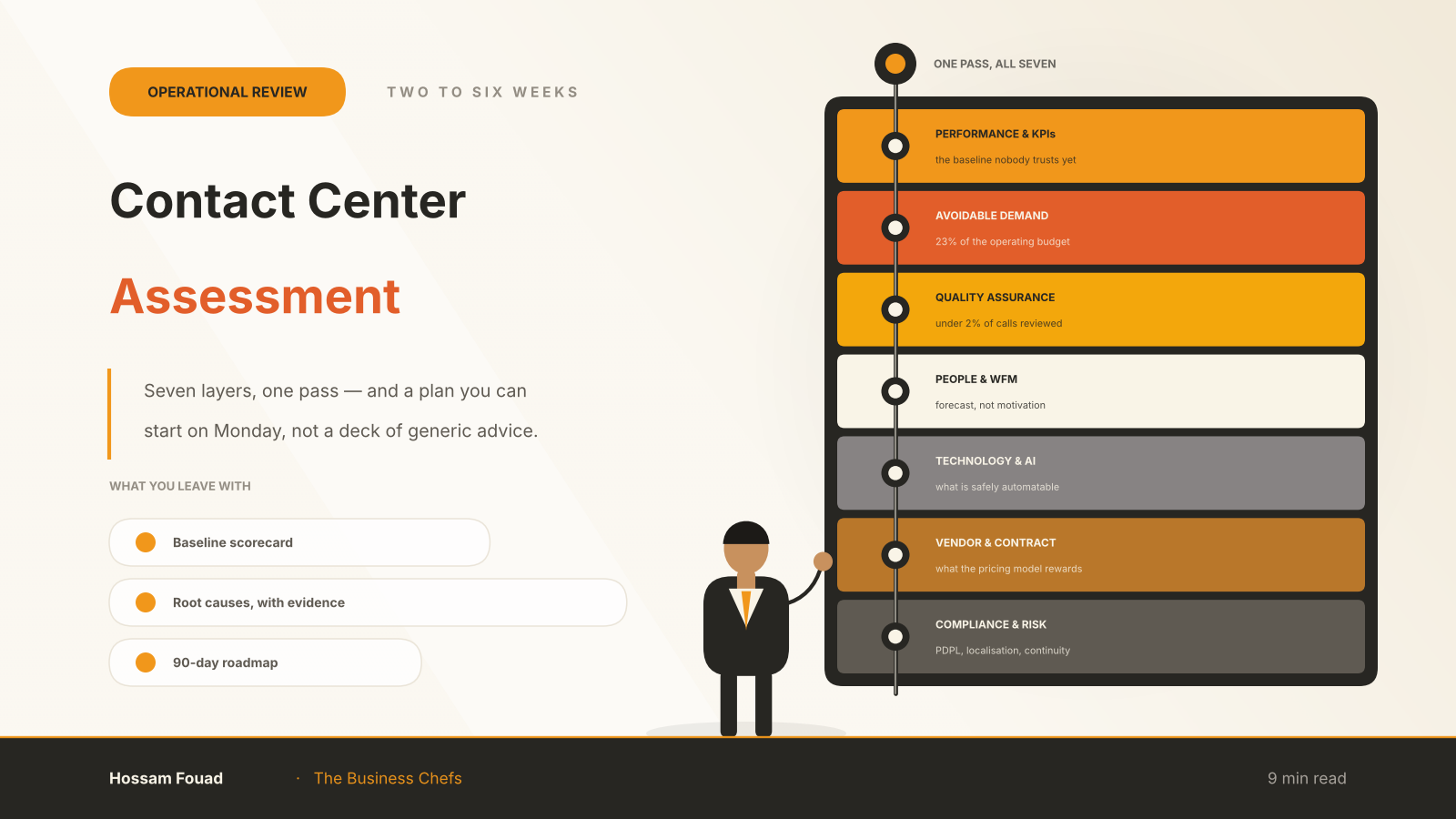
Research from SQM Group shows that every 1% improvement in first call resolution (FCR) cuts contact center operating costs by about 1% and lifts customer satisfaction by about 1%. The same research found that repeat calls account for roughly 23% of the average contact center’s operating budget. Choosing the partner that resolves more is a financial decision, not just a customer experience one.
Step 1: Define your outsourcing objectives before you shortlist
Most failed outsourcing deals fail at the start, because the buyer never wrote down what success looks like. Before you contact a single vendor, document:
- Scope: which processes, channels (voice, chat, email, social media), languages and hours of coverage.
- Baseline: current volumes, FCR, CSAT, average handle time (AHT), cost per contact and attrition.
- Target outcomes: for example, FCR from 65% to 75% within six months, or a 20% lower cost per resolved contact.
- Constraints: budget, go-live date, regulatory requirements, data residency and brand voice.
- Delivery model: which parts of the operation must be delivered inside the Kingdom by Saudi nationals, and which may sit elsewhere. Step 3 explains why that split, rather than a blanket onshore-or-offshore choice, is the decision that actually applies here.
This document becomes the backbone of your RFP and the yardstick for every vendor conversation that follows.
Step 2: Evaluate industry expertise and delivery track record
A provider that runs telecom collections will not automatically excel at banking onboarding or healthcare appointment lines. Ask every shortlisted vendor:
- What share of their current clients operates in your industry, and for how long?
- Which programs of similar size and complexity have they launched in the last 24 months?
- Can they share two or three references you can call, plus case studies with real numbers?
- What FCR, CSAT and attrition results did they achieve on comparable programs?
Weight evidence over presentations. A vendor that cannot produce references or measurable outcomes is asking you to pay for their learning curve.
Step 3: Screen for Saudization and PDPL compliance
This is the step where Saudi Arabia differs most from every other outsourcing market, and it is the one most buyers treat as paperwork. It is not. Both requirements below are pass/fail. A vendor that cannot satisfy them does not belong on your scorecard at all.
Saudization
In 2021, the Ministry of Human Resources and Social Development (HRSD) restricted remote customer service jobs to Saudi nationals, covering both direct contracts and outsourcing agreements across phone, email, chat and social media. Since December 2022, the ministry has been enforcing 100% localization of customer service jobs, including establishments that outsource customer service to another party, and including leadership and supervisory positions.
For a buyer, that means you should:
- Ask for the vendor’s Nitaqat status and exactly how they will staff your program with Saudi nationals at every level, supervisors included.
- Check their recruitment pipeline, training capacity and Saudi national attrition, not just today’s headcount.
- Confirm how they will stay compliant as your volumes grow or the rules change.
Data protection
Saudi Arabia’s Personal Data Protection Law took effect on 14 September 2023 and became fully enforceable on 14 September 2024. It is administered by the Saudi Data and Artificial Intelligence Authority (SDAIA). Transfers of personal data outside the Kingdom require appropriate safeguards, such as approved standard contractual clauses, and in some cases a risk assessment. If any part of the service will be delivered or hosted outside Saudi Arabia, the vendor must explain exactly where data is stored, who can access it and which transfer mechanism applies.
What does this mean for your delivery model
These two rules are often read as closing the door on offshore delivery entirely. They do not, but they do change the question. Localization governs customer service jobs inside the Kingdom, so the decision is not onshore versus offshore across the whole operation. It is a split, and it usually falls into three buckets:
- Must be in-Kingdom and Saudi-staffed: customer-facing service roles for your Saudi operation across phone, email, chat and social media, together with the team leaders and supervisors above them.
- Can usually sit elsewhere, subject to PDPL: non-customer-facing back office, finance and accounting operations, IT and engineering support that is not customer service, and support for customers in other markets.
- Needs legal input before it reaches an RFP: any service delivered to Saudi customers from outside the Kingdom, and any arrangement in which personal data leaves Saudi Arabia.
Treat the second bucket as the only straightforward offshore conversation for a Saudi program, and settle the third with counsel early rather than during contract review. If you are weighing locations for the work that can move, see our guide to nearshore vs offshore outsourcing for GCC companies.
For a deeper look at the localization rules, read our article on Saudization and BPO. This section is general guidance, not legal advice, so confirm current requirements with HRSD, SDAIA and your legal counsel.
Step 4: Assess cultural-fit and communication quality
Step 2 tests whether the vendor can run a program like yours. This step tests whether they can sound like your brand to a Saudi customer, which is a different question and the one most RFPs skip.
- Gulf Arabic, not "Arabic": fluency in the register Saudi customers expect, including how formality shifts with age and context, plus strong English for expatriate and international customers.
- Brand alignment: whether the vendor can adapt tone, scripts and escalation rules to your brand voice rather than applying a house standard.
- Agent authority: what an agent can resolve without approval. Most escalations in premium segments are permission failures, not knowledge failures.
- Management culture: how supervisors coach agents, and how quickly problems reach you.
- Governance rhythm: weekly operations reviews, monthly business reviews and a clear escalation matrix.
Ask to listen to call recordings from existing programs, with customer data masked, and request a live walk-through of the operations floor, in person or by video.
The attrition problem nobody prices in
Full localization plus a competitive labor market for Saudi nationals makes attrition the central operational risk of a Saudi program, not a secondary one. Contact center work competes for the same candidates as retail, banking and government employment, and a vendor that won your contract on price has very little room to pay above market to keep people.
The cost compounds quietly. Every departure carries recruitment and training and then buys you several weeks of below-baseline FCR while the replacement ramps. A vendor running high turnover is not occasionally short-staffed. They are permanently staffing a learning curve, and you are paying for it in repeat contacts.
What to ask:
- Saudi national attrition specifically, over the last three years. Not blended attrition, and not last quarter.
- Average agent tenure on comparable programs, which is harder to flatter than a turnover percentage.
- What they pay relative to market, and whether the rate they quoted you supports it.
- Their internal progression path, since advancement, is one of the few retention levers available in a fully localized workforce.
- How many of the agents who start your program they expect to still be there at month twelve.
The verified benchmark for BPO attrition in Saudi Arabia is 30–45% annually, with some programs exceeding 50–60%, based on global BPO attrition research and GCC mobility data. BPO Agent Turnover and Service Quality in 2026 | BPO Insight Hub | BPO Insight Hub - Employee Turnover Rate UAE & KSA: Benchmarks for 2026 — PraiseLoop
Step 5: Review technology stack and AI readiness
The best partners combine skilled people with technology that makes those people more effective. Ask about:
- The contact center platform (CCaaS), CRM integrations and reporting tools they use.
- AI capabilities such as virtual agents, real-time agent assist, automatic call summaries and AI-driven quality assurance.
- Arabic support in their AI tools, including how they handle Gulf dialects specifically.
- Security certifications, access controls, and how AI tools process your customer data under PDPL.
Gartner predicts that by 2029, agentic AI will autonomously resolve 80% of common customer service issues without human intervention, leading to a 30% reduction in operational costs. Read that carefully before drawing the obvious conclusion. The word doing the work is "common."
If automation absorbs the routine contacts, what reaches a human is the complex, the emotional and the commercially significant. That raises the skill required of the agents who remain rather than lowering it. A vendor using this forecast to justify a cheaper, thinner team has misread it. The right questions are how their AI roadmap changes the agent profile they will hire for your program, and what happens to quality on the contacts automation does not take.
We cover this in detail in how AI is changing contact center outsourcing.
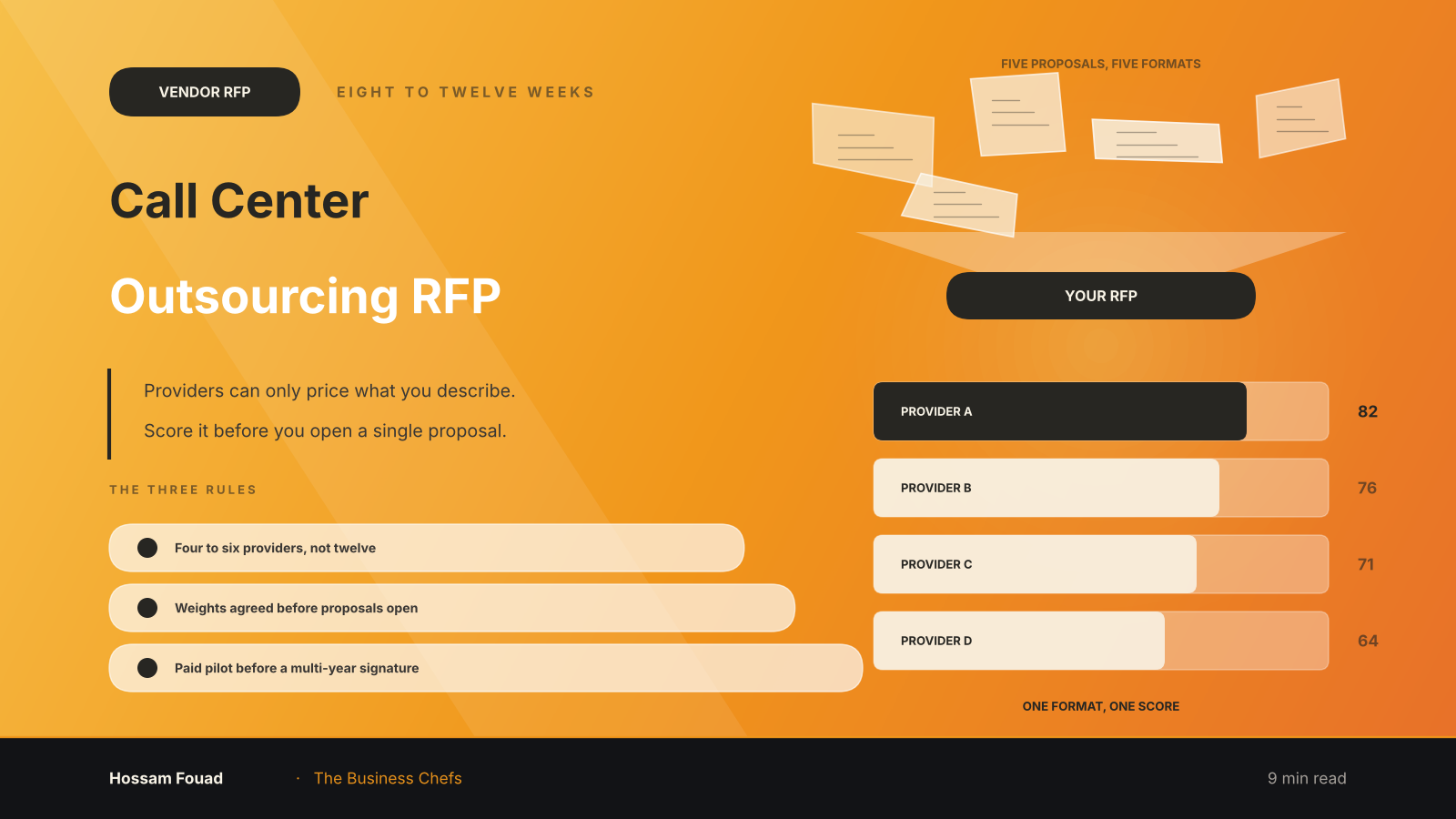
Step 6: Run a paid pilot with clear KPIs
A pilot turns promises into data. Structure it like this:
1. Scope: a representative slice of volume, for example 10% to 20% of contacts, for 8 to 12 weeks.
2. KPIs: FCR, CSAT, AHT, quality score, schedule adherence and cost per resolved contact.
3. Targets: agreed in writing before day one, using your current baseline as the benchmark.
4. Transition costs: who pays for recruitment, training and knowledge transfer during the pilot, and whether any of it is credited back if you proceed. This is where pilot economics usually go wrong.
5. Governance: weekly reviews and joint quality calibration sessions.
6. Exit criteria: what happens if targets are missed, and how scale-up works if they are met.
Pay for the pilot. Free pilots attract a vendor’s sales team, not its best operations people. As a reference point, SQM Group considers an FCR rate of 70% to 75% good for voice, with 80% or above regarded as world-class. For the full metric set, see our guide to contact center KPIs that matter in 2026.
Step 7: Negotiate outcome-based pricing, not just hourly rates
Hourly or per-FTE pricing rewards the vendor for time spent, not for problems solved. Where volumes are predictable, consider:
- Per-resolved-contact pricing, which aligns your cost with outcomes.
- Gain-share or bonus and penalty bands tied to FCR, CSAT and quality.
- Glide paths that reduce unit costs as the program matures.
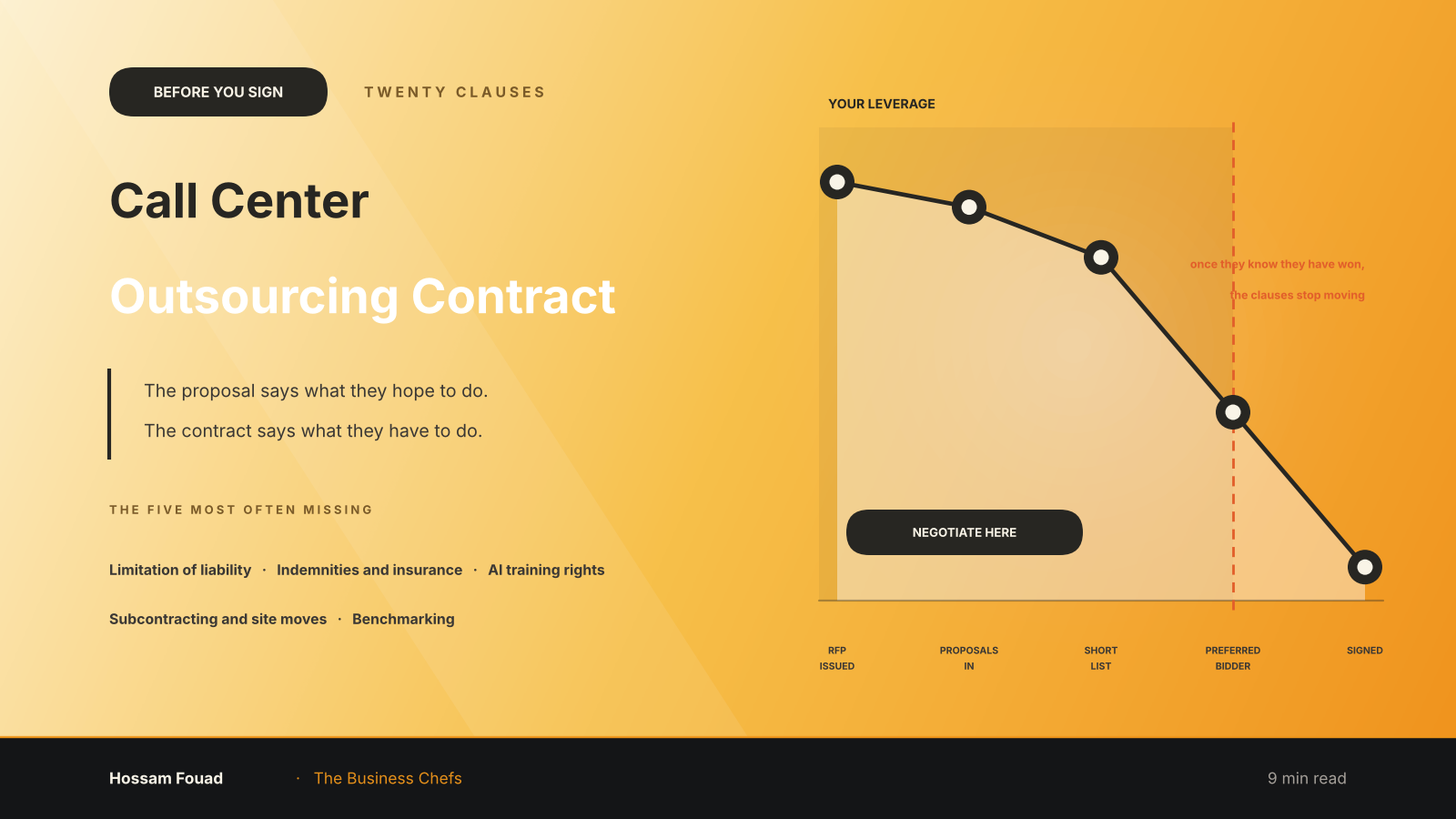
- Clear exit clauses, transition assistance and data return obligations.
One caution specific to Saudi Arabia: outcome-based pricing only works if the rate underneath it still supports paying Saudi agents a competitive wage. A clever commercial structure built on an unsustainable base rate buys you attrition instead of performance.
To understand market rates before you negotiate, read about our call center outsourcing cost breakdown for 2026.
Red flags to watch for when selecting a BPO vendor
Walk away, or at least slow down, if a vendor:
- Cannot share references or case studies with measurable results.
- Quotes blended attrition rather than Saudi national attrition or avoids the question entirely.
- Treats Saudization as a staffing detail rather than a condition of operating.
- Has no structured 30, 60 and 90-day onboarding and transition plan.
- Offers only hourly pricing and resists any outcome-linked terms.
- Is vague about where your data is stored and who can access it.
- Promises that AI will cut costs dramatically without showing how quality is protected.
The selection framework: a gate, then a scorecard
Compliance and capability are different kinds of question, and mixing them produces a misleading result. If Saudization and PDPL sit inside a weighted table, a vendor can score well overall while failing a legal requirement. Screen first, then score what survives.
Stage 1: The compliance gate (pass / fail)
|
Requirement |
What to verify |
Outcome |
|
Saudization |
Nitaqat status; Saudi nationals at every level including supervisory; recruitment pipeline and training capacity |
Pass / Fail |
|
Data protection (PDPL) |
Data location, access controls, transfer mechanism, breach notification process |
Pass / Fail |
A vendor that fails either requirement leaves the process. These are conditions of operating, not criteria to be traded against a strong score elsewhere.
Stage 2: The weighted scorecard
Score each criterion from 1 to 5, then multiply by its weight. Weights are renormalised to 100% now that the two compliance items have moved into the gate.
|
Criterion |
What to verify |
Weight |
|
Industry expertise |
Comparable clients, callable references, case studies with numbers |
30% |
|
Quality and KPIs |
Historic FCR, CSAT and AHT; quality assurance approach |
21% |
|
Technology and AI |
Platform, integrations, Gulf Arabic AI support, security certifications |
14% |
|
People and culture |
Saudi national attrition, tenure, coaching model, language quality |
14% |
|
Commercial model |
Outcome-based options, cost transparency, exit terms |
14% |
|
Transition plan |
30, 60 and 90-day plan, risk management, knowledge transfer |
7% |
If you want an independent view, The Business Chefs runs vendor selection and BPO assessments for companies in Saudi Arabia, the GCC, North America and the UK through our SMART Sourcing approach.
Conclusion
Choosing a BPO partner in Saudi Arabia comes down to evidence and fit, in that order. Screen hard on Saudization and PDPL, because those are conditions of operating rather than preferences. Then score what survives on proven results in your industry, the right culture and technology, and a commercial model that pays for outcomes. Prove it with a paid pilot before you commit to a term.
Price matters, but the cheapest vendor is rarely the lowest-cost partner once repeat contacts, attrition and compliance risk are counted.
Frequently asked questions
What is the first step in choosing a BPO partner?
Defining your objectives: scope, baseline metrics, target outcomes, constraints and the split between work that must be delivered in-Kingdom and work that may sit elsewhere. Without this, vendors cannot propose accurately and you cannot compare them fairly. The objectives document becomes the core of your RFP and your pilot targets.
Do BPO agents serving Saudi customers have to be Saudi nationals?
For customer service jobs inside Saudi Arabia, yes. HRSD has enforced 100% localization of customer service roles since December 2022, including outsourced and supervisory positions.
Can any part of a Saudi program be delivered offshore?
Work that is not customer service — back office, finance and accounting operations, internal IT support — can usually sit elsewhere, provided the PDPL transfer requirements are met. Customer-facing service delivered to Saudi customers from outside the Kingdom raises both localization and data transfer questions, so settle it with legal counsel before it reaches an RFP rather than after shortlisting.
How long should a BPO pilot last?
Most pilots run 8 to 12 weeks. That is long enough for agents to get past the learning curve and for FCR, CSAT and AHT trends to stabilize, and short enough to keep momentum. Agree targets, transition cost treatment and exit criteria in writing before the pilot starts.
What KPIs should I use to evaluate a BPO vendor?
First contact resolution (FCR), customer satisfaction (CSAT), average handle time (AHT), quality scores, Saudi national attrition and cost per resolved contact. FCR is especially useful because it connects customer satisfaction with operating costs.
Should I choose the cheapest BPO provider?
Not automatically. A low hourly rate can hide more repeat contacts, escalations and attrition, which raise your total cost. In Saudi Arabia it carries a second risk: a rate that cannot support competitive pay for Saudi agents buys you turnover. Compare vendors on cost per resolved contact and total cost of ownership and use a paid pilot to validate their numbers.
|
Need help shortlisting BPO vendors? Book a free 30-minute discovery call with a senior practitioner. No sales pitch, just practical next steps. Book a call |
|
About the author Hossam Fouad is the Managing Partner of The Business Chefs, a boutique BPO, customer experience and strategic sourcing consultancy. He advises enterprises in North America, the UK and the GCC on outsourcing strategy, partner selection and contact center performance, working hands-on with operations teams from assessment to execution. |