Nearshore vs Offshore Outsourcing for GCC Companies (2026)
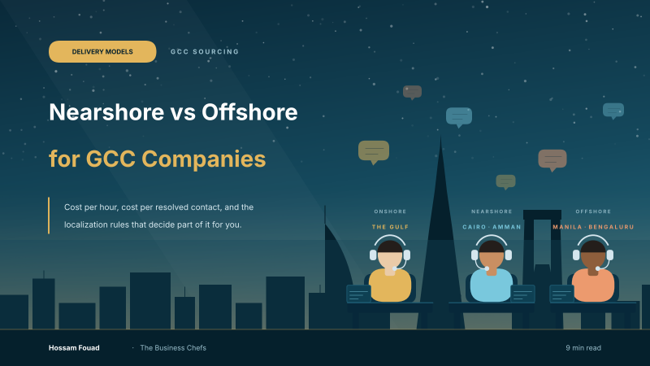
Nearshore or offshore for GCC? Start with your contact mix, not the map. Compare cost, time zones, dialect, Saudization and when hybrid delivery actually pays.
|
Key takeaways
|
Nearshore outsourcing suits GCC companies that need Arabic-language service, close time zones and tight collaboration. Offshore suits high-volume, English-language and back-office work where cost per hour is the main driver. Most mature GCC programs end up hybrid: regulated, customer-facing Saudi work stays onshore, Arabic support for other markets goes nearshore, and global English-language or back-office work goes offshore. The useful question is not which model wins, but which of your contacts belongs where?
What near-shore and off-shore actually mean
Nearshore delivery sits in a nearby country, usually within a couple of hours of your time zone, with enough cultural and language overlap that a customer does not notice the handover. For a company in Riyadh, Dubai or Doha, that typically means Egypt, Jordan, Morocco, Turkey and parts of Eastern Europe.
Offshore delivery sits further away, often on another continent, and trades proximity for scale and a lower cost base. For GCC companies the classic offshore destinations are India and the Philippines, with Latin America relevant mainly for those serving customers in the Americas.
Neither term describes quality. They describe distance, and distance is only a proxy for the things that actually matter whether the agents match your customers, and whether your managers can reach theirs during the working day.
Offshore delivery is proven at scale. The Philippine IT-BPM industry alone generated more than $40 billion in revenue in 2025 and employed about 1.9 million people, according to its industry association, IBPAP.
Start with your contact mix, not the map
The usual framing of this decision is Arabic versus English, and that framing quietly assumes a customer base that most GCC companies do not have.
In the UAE and Qatar in particular, a large share of customers are expatriates. They contact you in English, Hindi, Urdu, Tagalog, Malayalam or Arabic depending on who they are. For many consumer brands in those markets, Arabic-language voice is a significant but minority share of total contact volume.
That changes the conclusion. If most of your contacts arrive in English or South Asian languages, offshore is not the cheap compromise for overflow work. It is the correct primary fit for the bulk of your volume, and nearshore Arabic becomes the specialist tier sitting alongside it. Get this backwards and you will pay a fit premium on contacts that never needed one.
So before comparing countries, produce three numbers:
1. Language split. What share of contacts arrive in each language, by channel.
2. Channel split. Which contacts are voice, where accent and register carry weight, and which are chat, email or back office, where they carry far less.
3. Complexity split. Which contacts are high-emotion, high-value or regulated, and which are routine.
Most companies have never produced this breakdown. It takes a few days and it settles most of the argument that follows.
Cost: hourly rate versus cost per resolved contact
Published price benchmarks almost all come from North American buyers. A 2026 pricing guide from Retell AI puts outsourced agent rates at roughly the following, with cost-per-contact ranges from Callzent's 2026 outsourced customer service breakdown:
|
Delivery model |
Typical hourly rate per agent |
Typical cost per contact |
|
Onshore — United States |
$28 to $42 |
$10 to $16 |
|
Nearshore — Latin America |
$12 to $24 |
$7 to $12 |
|
Eastern Europe |
$12 to $22 |
Varies by language mix |
|
Offshore — India, Philippines |
$5 to $16 |
$4 to $8 |
The number that decides the question is cost per resolved contact. Retell’s guide notes that if around 15% of offshore calls need a second interaction or an internal escalation, the effective resolution cost starts to approach onshore levels. Language gaps, time-zone distance and cultural mismatch all raise repeat contacts. We break down the full calculation in our call center outsourcing cost guide for 2026.
Time zones: what overlap actually buys you
Time-zone distance is usually discussed as a staffing problem. It is not. Agents can be put on shifts to cover any hours you need. What cannot easily be shifted is everyone above them: the supervisors who coach, the quality team who calibrate, the operations manager who has to answer when something breaks at 11am your time.
Jordan and Turkey share the Riyadh working day completely. Egypt loses an hour in winter and none in summer. India still shares most of a working day. The Philippines shares four hours, all of them in your morning, which means an afternoon escalation waits until tomorrow. Latin America shares almost nothing with the Gulf, which is why it belongs in a GCC conversation only for companies serving the Americas.
A large gap is not automatically a disadvantage. It is what makes genuine follow-the-sun coverage possible. It is only a problem when nobody has planned for it.
Language and dialect: beyond "speaks Arabic"
Arabic is not one accent. Customers in Saudi Arabia, the UAE and Kuwait hear the difference between Gulf, Egyptian, Levantine and Maghrebi registers immediately, and expectations around formality and hospitality are high.
That does not rule out nearshore Arabic delivery. Egyptian and Jordanian agents serve Gulf customers successfully every day. It does mean the specification has to go further than the language name:
- Dialect and etiquette built into onboarding, not bolted on later.
- Explicit guidance on tone, greetings, formality and sensitive topics.
- Quality monitoring that scores cultural fit, not only script compliance.
- A named view of which dialects the account will actually be staffed for, confirmed by listening to recorded calls before signing.
For English-language and multilingual support, offshore hubs such as the Philippines and India bring deeper and more experienced talent pools than anything available nearshore.
Localization rules differ across the GCC
This is where the commercial comparison stops being the only input. Each GCC state regulates national employment differently, and the mechanisms are not variations on a theme — they are structurally different instruments.
Saudi Arabia is the strictest case for this sector. The Ministry of Human Resources and Social Development has been enforcing 100% localization of customer service jobs since December 2022, including outsourced customer service and supervisory roles. Customer service delivered from inside the Kingdom must be staffed by Saudi nationals. Serving Saudi customers from outside the Kingdom raises a second question: Saudi Arabia’s Personal Data Protection Law has been fully enforceable since 14 September 2024, and transfers of personal data abroad require approved safeguards. Sector regulators can add their own rules.
The UAE uses percentage targets rather than a blanket rule. Private companies with 50 or more employees must raise the share of Emiratis in skilled roles by 2% a year, measured in two half-yearly steps, with penalties and classification downgrades for firms that miss the deadline. Companies with 20 to 49 employees in a defined list of sectors carry a smaller obligation of their own. For a contact centre operation that sits either side of those thresholds, the headcount you place in the UAE is a compliance variable, not just a cost one.
|
Saudi Arabia |
United Arab Emirates |
|
|
Instrument |
Sector-specific full localization |
Percentage targets by company size |
|
Customer service roles |
100% Saudi nationals, supervisors included |
No sector-specific rule; counts toward the skilled-role target |
|
Applies to outsourcing |
Yes, explicitly |
Applies to the employing entity |
|
Effect on delivery model |
Saudi-facing service stays in-Kingdom |
Influences where headcount sits, not whether work can move |
Oman, Qatar, Kuwait and Bahrain each run their own nationalization regimes with different thresholds and enforcement. Confirm the current position with counsel before committing to a model in any of them. Our article on Saudization and BPO covers the Saudi detail, and how to choose a BPO partner in Saudi Arabia covers the vendor side.
The risks the business case usually leaves out
Location decisions are typically modelled on rate and quality. Three other factors move the answer over a three-year term.
- Currency and wage inflation. A cost advantage quoted today is not fixed. Currency movement and local wage inflation can erode a differential over the life of a contract, and Egypt in particular has seen significant currency movement in recent years. Ask how rates are indexed and what triggers a re-rate.
- Concentration and continuity. A single delivery country is a single point of failure: power, connectivity, regional disruption, or a local event that takes a site offline. Ask what the fallback site is, in which country, and whether it has ever actually been used.
- Talent competition in crowded hubs. The popular nearshore cities are crowded. Where every BPO recruits from the same pool, wages rise and attrition follows. Ask for attrition over three years, not last quarter, and for average agent tenure on comparable programs.
Hybrid delivery: when it works, and when it does not
A hybrid model assigns each type of work to the location that does it best. A typical GCC setup looks like this:
- Onshore (in the Kingdom): Saudi-facing customer service, complaints and regulated processes.
- Nearshore (Egypt, Jordan): Arabic support for other markets, back-office processing, quality assurance and digital channels where the rules allow.
- Offshore (Philippines, India): English and South Asian language support, overnight coverage and high-volume back-office work.
Hybrid spreads country risk gives you genuine 24/7 coverage and lets you match cost to complexity. It also costs something real, and the article that sells it to you without saying so is selling.
What hybrid actually costs you
- One KPI set, one quality framework and one calibration standard across every site, or the experience fragments by channel.
- A single named owner with authority across all locations. Two vendors each reporting their own green dashboard is not governance.
- Integration work: shared CRM, shared knowledge base, consistent routing and a single view of the customer.
- More of your own management time, permanently, not just during transition.
As a rough threshold, hybrid rarely pays below about 50 to 75 seats in total. Under that, the governance overhead consumes the arbitrage, and a single well-chosen location run properly beats three locations run thinly.
Nearshore locations for GCC companies
Egypt is the region’s largest hub. According to Egypt's IT Industry Development Agency (ITIDA), digital export revenues doubled from $2.4 billion in 2022 to $4.8 billion in 2025, with new agreements expected to create more than 70,000 jobs over three years. Egypt offers large Arabic and multilingual pools and a minimal time gap with the Gulf. Its scale is also its risk: the popular districts are competitive employers’ markets.
Jordan offers educated, Arabic-speaking talent with a Levantine accent that Gulf customers generally find easy to follow, at smaller scale than Egypt and often at a slightly higher rate.
Morocco is a major BPO destination, but mainly for French and European-language work. Moroccan Darija differs substantially from Gulf Arabic, so Morocco is a strong choice for francophone and back-office delivery and a weaker one for Gulf Arabic voice.
Turkey shares the Riyadh time zone and adds Turkish, European-language and technical support capacity.
Eastern Europe, including Poland and Romania, suits companies that need European languages for international customers or a European delivery base.
Offshore locations for GCC companies
The Philippines leads for English-language voice, with a strong service culture and a very large, experienced workforce. Its weakness for a Gulf buyer is the time gap, which leaves only the morning for live management.
India is the deepest market for IT-enabled services, back office and English-language support, and its time zone is close enough to the Gulf for most of a working day to overlap. It is also the natural pool for Hindi, Urdu, Malayalam and Tamil support, which matters more for a GCC expatriate customer base than the usual framing suggests.
Pakistan and Sri Lanka are worth a look for the same reason, at smaller scale, where South Asian language coverage is a significant share of volume.
Latin America, including Mexico and Colombia, makes sense for GCC companies serving customers in the Americas, and almost never otherwise — the working day barely overlaps with the Gulf.
Decision framework: matching work to place
|
If your priority is... |
Lean toward |
Why |
|
Saudi-facing customer service |
Onshore in the Kingdom |
Localization rules and data residency |
|
Arabic support for other GCC markets |
Nearshore (Egypt, Jordan) |
Language, culture and time-zone fit |
|
English or South Asian language volume |
Offshore (Philippines, India) |
Depth of talent and cost per contact |
|
Lowest hourly cost at high volume |
Offshore |
Scale and labor cost |
|
Complex, high-value interactions |
Onshore or nearshore |
Easier supervision and higher resolution |
|
Back office and data processing |
Nearshore or offshore |
Cost, where data rules allow |
|
24/7 coverage, 75+ seats |
Hybrid |
Follow-the-sun across time zones |
|
24/7 coverage, under 50 seats |
One location, shift-based |
Governance overhead exceeds the arbitrage |
If you are weighing locations right now, our SMART Sourcing approach matches the right work to the right place and the right talent.
Conclusion
There is no universal winner in the nearshore versus offshore debate. Offshore wins on hourly cost, scale and depth of English and South Asian language talent. Nearshore wins on Arabic, culture and the ability to run the account inside your own working day. Regulation decides what stays onshore, and your contact mix decides most of the rest.
For most GCC companies of real size, the answer is a deliberate hybrid built on cost per resolved contact rather than cost per hour. For smaller operations, the answer is usually one location chosen well.
Frequently asked questions
What is the difference between nearshore and offshore outsourcing?
Nearshore uses a provider in a nearby country with a small time difference and close cultural ties. Offshore uses a distant country, usually to access lower labor costs and larger talent pools. For GCC companies, Egypt and Jordan are typical nearshore options; the Philippines and India are typical offshore ones.
Is nearshore always more expensive than offshore?
Per hour, usually. Per resolved contact, not always. Better language fit and closer collaboration can raise first contact resolution and reduce escalations, which lowers total cost. Compare on cost per resolved contact, not on hourly rates.
Our customers mostly contact us in English. Does nearshore still apply?
Less than the usual advice suggests. If the bulk of your volume arrives in English or South Asian languages, offshore is the right primary fit for that volume, and nearshore Arabic becomes a specialist tier alongside it rather than the default. Produce your language split before deciding.
Which countries count as nearshore for GCC companies?
Mainly Egypt, Jordan, Morocco and Turkey, with Poland and Romania for European languages. Egypt is the largest hub, with digital exports that doubled between 2022 and 2025 according to ITIDA. Morocco is strongest for French-language work rather than Gulf Arabic voice.
Can a Saudi company outsource customer service to another country?
Customer service jobs inside Saudi Arabia must be filled by Saudi nationals, including outsourced roles. Serving Saudi customers from abroad raises separate PDPL data transfer requirements and possible sector rules, so many companies keep Saudi-facing service onshore and send non-customer-facing work nearshore or offshore. Take legal advice before committing.
What is hybrid outsourcing, and do we need it?
Hybrid combines onshore, nearshore and offshore delivery, assigning each process to the location that handles it best. It improves resilience and coverage but needs one KPI set, one quality framework and one owner across all sites. Below roughly 50 to 75 seats the governance cost usually outweighs the benefit.
|
Not sure which model fits your operation? Book a free 30-minute discovery call with a senior practitioner. No sales pitch, just practical next steps. Get an independent view |
|
About the author Hossam Fouad is the Managing Partner of The Business Chefs, a boutique BPO, customer experience and strategic sourcing consultancy. He advises enterprises in North America, the UK and the GCC on outsourcing strategy, partner selection and contact center performance, working hands-on with operations teams from assessment to execution. |