What Is a BPO Consultant and When Do You Need One?
|
Key takeaways
|
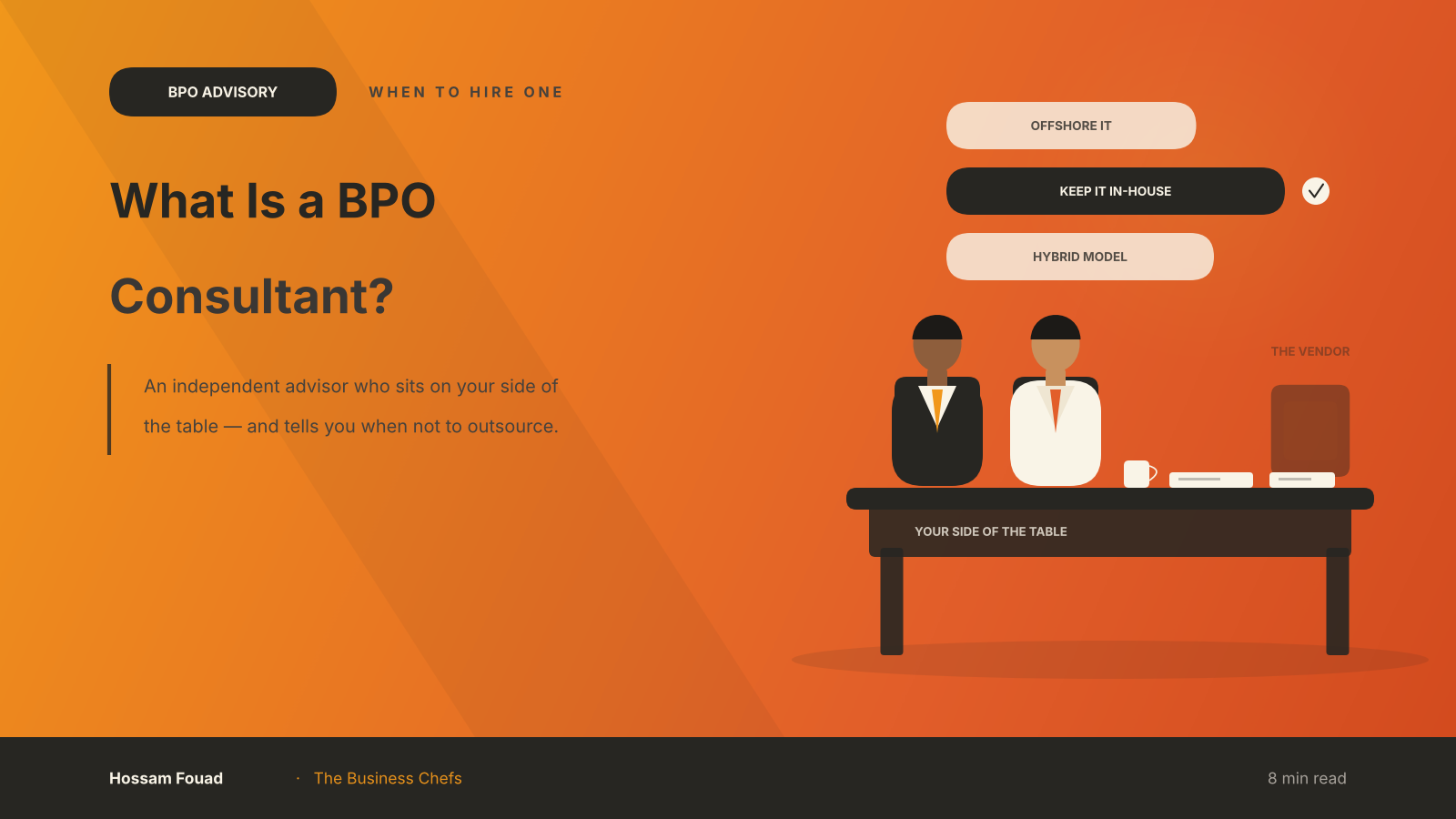
A BPO consultant is an independent outsourcing advisor who helps a company decide which processes to outsource, which delivery model and location to use, and which provider to choose, then manages contracting, transition and ongoing performance. They sit on the buyer’s side of the table. Their value is expertise and objectivity: most companies outsource a function only a few times in their history, while a good consultant has watched dozens of deals succeed and fail, and knows which early decisions are the expensive ones.
What does a BPO consultant actually do?
Business process outsourcing means contracting a defined business function — customer service, finance and accounting, HR administration, claims processing — to a third-party provider who runs it for you under a commercial agreement. A BPO consultant helps you do that well. Typical responsibilities:
- Assessment. Mapping current processes, costs, volumes and performance to set a baseline. Without this, every saving you claim later is an estimate.
- Strategy. Deciding what to outsource, what to keep, and which delivery model fits — onshore, nearshore, offshore or hybrid.
- Business case. Quantifying expected savings, quality gains, risks and total cost of ownership, including the governance cost you will carry forever.
- Location analysis. Comparing countries on talent, cost, language, time zone and regulation, often using benchmarks such as Kearney’s Global Services Location Index.
- Vendor selection. Writing the RFP, shortlisting providers, running due diligence and designing a pilot that actually tests something.
- Contracting. Structuring outcome-based pricing, service levels, exit terms and data protection clauses.
- Transition. Planning and overseeing knowledge transfer, parallel running and go-live.
- Governance and optimization. Setting up KPIs, business reviews and a continuous improvement rhythm — then handing it to someone internal who will still be there in two years.
BPO consultant vs BPO provider: what is the difference?
|
BPO consultant |
BPO provider |
|
|
Who they work for |
The buyer |
Their own business and many clients |
|
What they deliver |
Advice, strategy, selection and oversight |
Day-to-day operations such as customer service and back office |
|
How they earn |
Consulting fees |
Per-hour, per-FTE or per-transaction fees |
|
Main value |
Objectivity and expertise |
Scale, people and infrastructure |
|
Their incentive |
A larger, longer engagement — which is not the same as your outcome |
Volume and margin |
|
Who carries delivery risk |
Nobody. They advise and leave |
They do, to the limit of the contract |
A provider will always recommend its own locations and services. A consultant should recommend whatever fits you best, including keeping the work in-house — but notice the incentive row above, because most articles on this subject quietly write "your outcome" there and move on.
The honest version is this: a consultant’s commercial interest is a bigger programme and a longer engagement. "Do nothing" ends the project. "Outsource three functions across two countries" extends it. That structural pull does not make advice worthless; any more than a surgeon’s fee makes surgery unnecessary. It does mean you should test it, which is what the questions further down are for.
Independence is a spectrum, not a badge
"Vendor-neutral" is the easiest claim in this industry to make and the hardest to verify. There are at least four business models calling themselves independent advisory, and they are not equally independent:
- Buyer-paid only. All fees come from you. The cleanest model, and the one you should expect to pay a real rate for.
- Referral or introduction fees. The advisor is paid by the provider when you sign. Common, rarely volunteered, and it narrows the shortlist to firms that pay.
- Vendor-paid success fees. A percentage of first-year contract value, paid by the winning provider. This is placement, not advice.
- Advisory arms of delivery firms. The advice is genuine; the recommendation to use the parent company is not a coincidence.
Research and analyst firms sit in a fifth category: they rank providers while selling research subscriptions and briefings to those same providers. Their data can still be useful. Treat their rankings as one input, not a verdict.
The practical test is not "are you independent?” everyone says yes. It is "show me your last five engagements and tell me who paid you in each one."
When your company needs a BPO consultant
Outsourcing is a large and growing market. Grand View Research values the global BPO market at about $328 billion in 2025 and projects it to reach $695.8 billion by 2033, a compound annual growth rate of 9.9%. More options mean more opportunity, and more ways to get it wrong. These are the moments when outside help pays for itself.
You are outsourcing for the first time
First-time buyers have no benchmarks for pricing, performance or contract terms, and no scar tissue. A consultant helps you avoid the expensive beginner mistakes: service levels built on speed alone, hourly-only pricing with no outcome link, no benchmarking clause, and no exit plan.
Your current BPO vendor is underperforming
Rising complaints, falling resolution rates or creeping costs need an objective diagnosis. An independent audit establishes whether the problem sits with the vendor, the contract, your own processes or all three — and it is very often all three. Buyers who skip the diagnosis tend to re-tender, win a lower price, and reproduce the same problem with a new logo.
You are scaling operations across multiple countries
Expanding into new markets raises questions about language coverage, time zones, data protection and localization requirements. In Saudi Arabia, for example, customer service roles are subject to full localization, as we set out in Saudization and BPO. A consultant designs a multi-location model that works market by market rather than applying one template everywhere.
You need to renegotiate or transition vendors
Switching providers is the riskiest thing a sourcing team does, because the customer never agreed to be part of your transition. A consultant runs the market process, negotiates the terms, and plans a handover that protects service during the overlap — which is where most of the damage happens.
When you should not hire a BPO consultant
This section is unusual in an article written by a consultancy, which is exactly why it belongs here. There are situations where the fee buys you very little:
- The scope is small and single-site. Twenty seats in one language with one obvious provider does not need a seven-phase program. Run a tight RFP yourself and spend the money on a better contract review.
- You already know the answer and want validation. If the decision is made, you are buying cover for it. That is a legitimate purchase, but call it what it is, and do not pay strategy rates for it.
- You have a mature sourcing function. If you have a working vendor management office, standard contract templates and recent market pricing, you have most of what a consultant brings. Buy a specific gap — a location study, a benchmark — not the whole engagement.
- Nobody internal can own the outcome. If there is no named person who will still be accountable after the consultant leaves, the engagement will produce a good recommendation and no change. Fix the ownership problem first.
- The real problem is internal. If your own process is broken, undocumented and unmeasured, outsourcing it exports the mess at a markup. Fix or at least map it first, which is cheaper than a sourcing program.
A consultant who cannot tell you when not to hire them has already answered the independence question.
What to expect from a BPO consulting engagement
Most engagements follow the same seven phases, scaled to the size of the program. You can buy the whole journey or a single phase — a vendor audit, an RFP, a location study — and for many buyers a single phase is the right purchase.
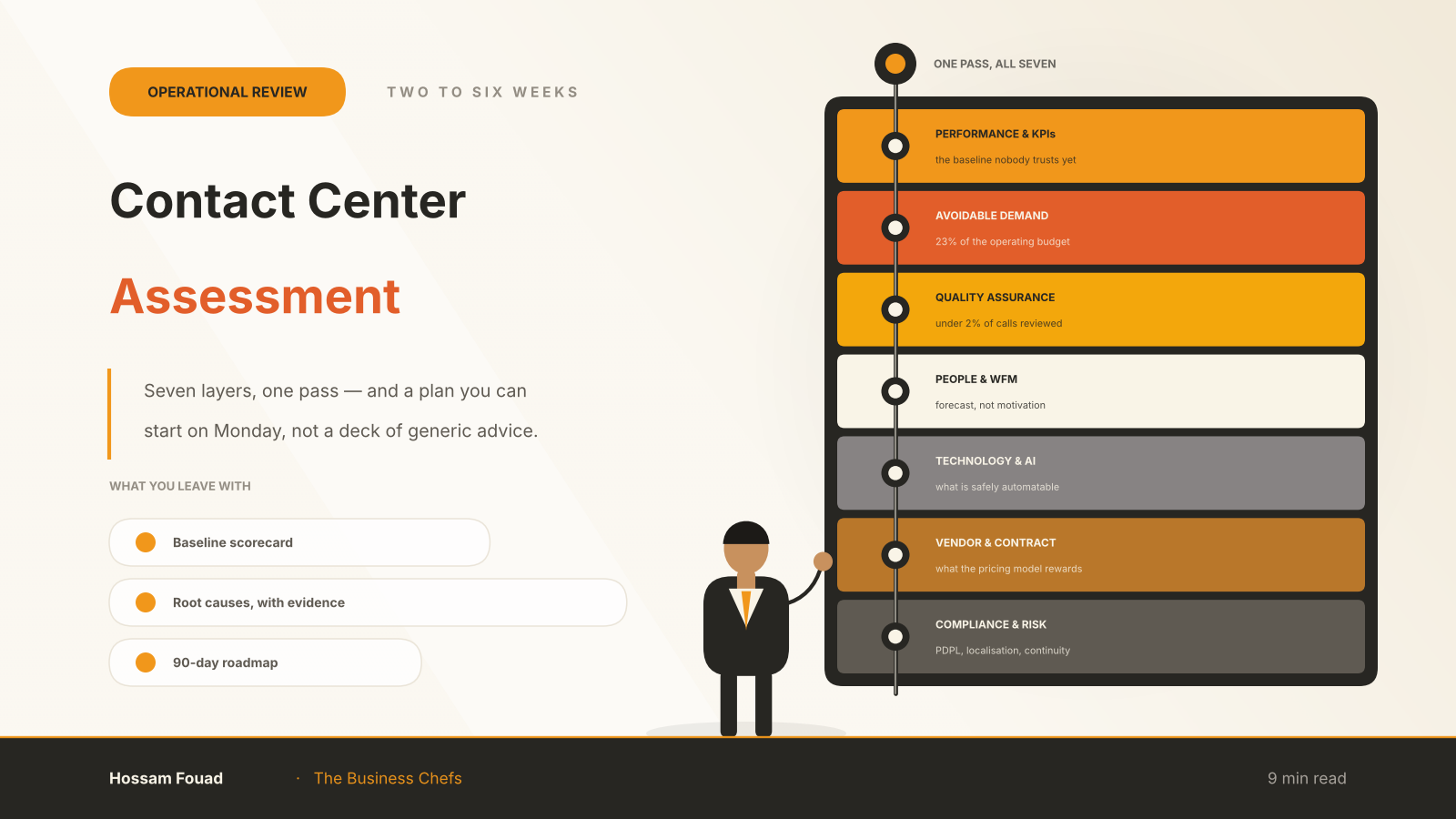
1. Discovery and baseline. Interviews, data analysis and process mapping. If your baseline data is poor, this phase gets longer and everything after it gets less reliable.
2. Strategy and business case. Scope, delivery model, location options and the financial case, including the cost of governing the arrangement.
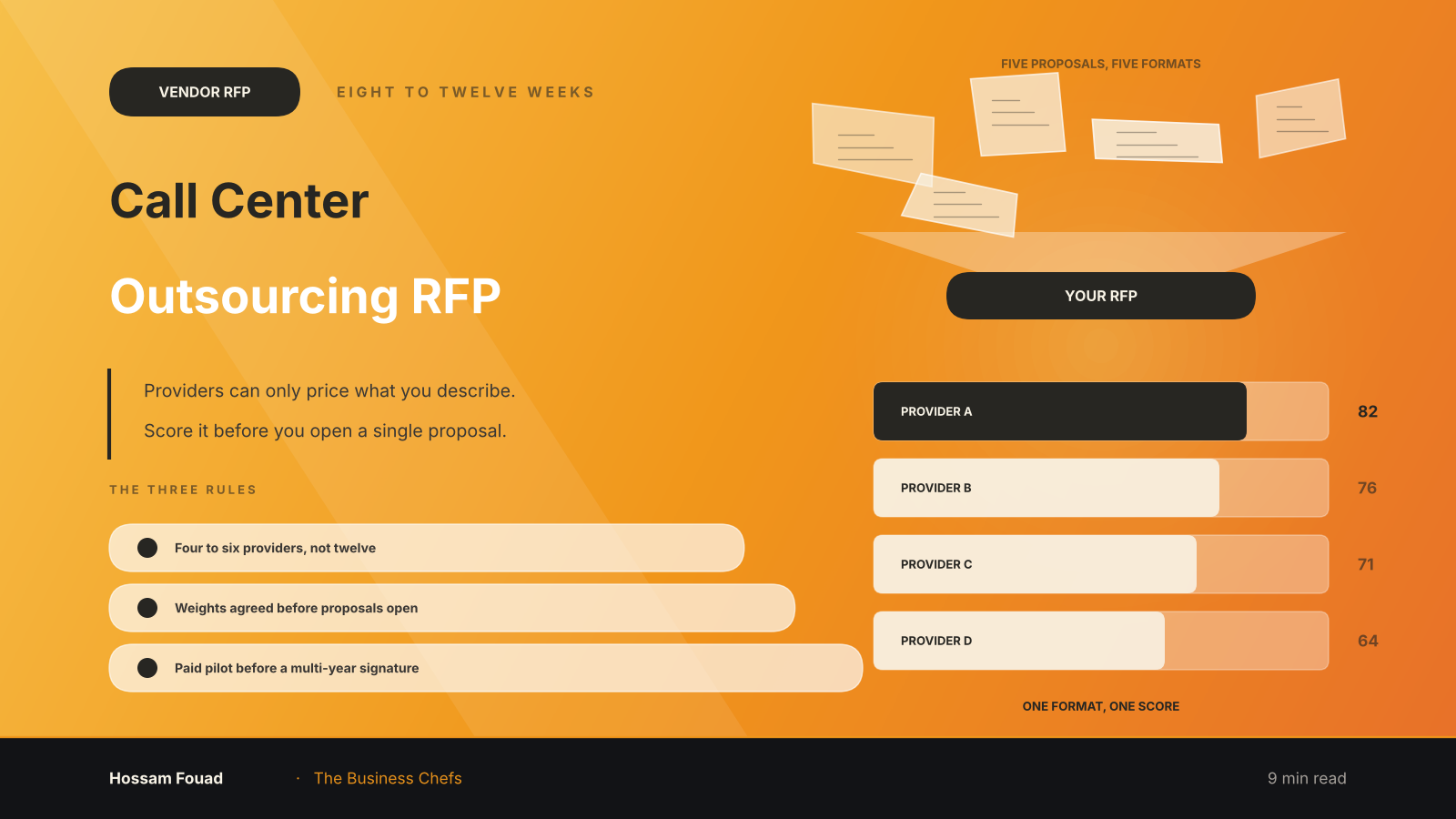
3. Market scan and RFP. A structured request for proposal sent to a qualified shortlist, not to everyone with a website.
4. Selection and pilot. Scoring, due diligence, site visits and a paid pilot against agreed KPIs. The pilot is the first honest signal you will get.
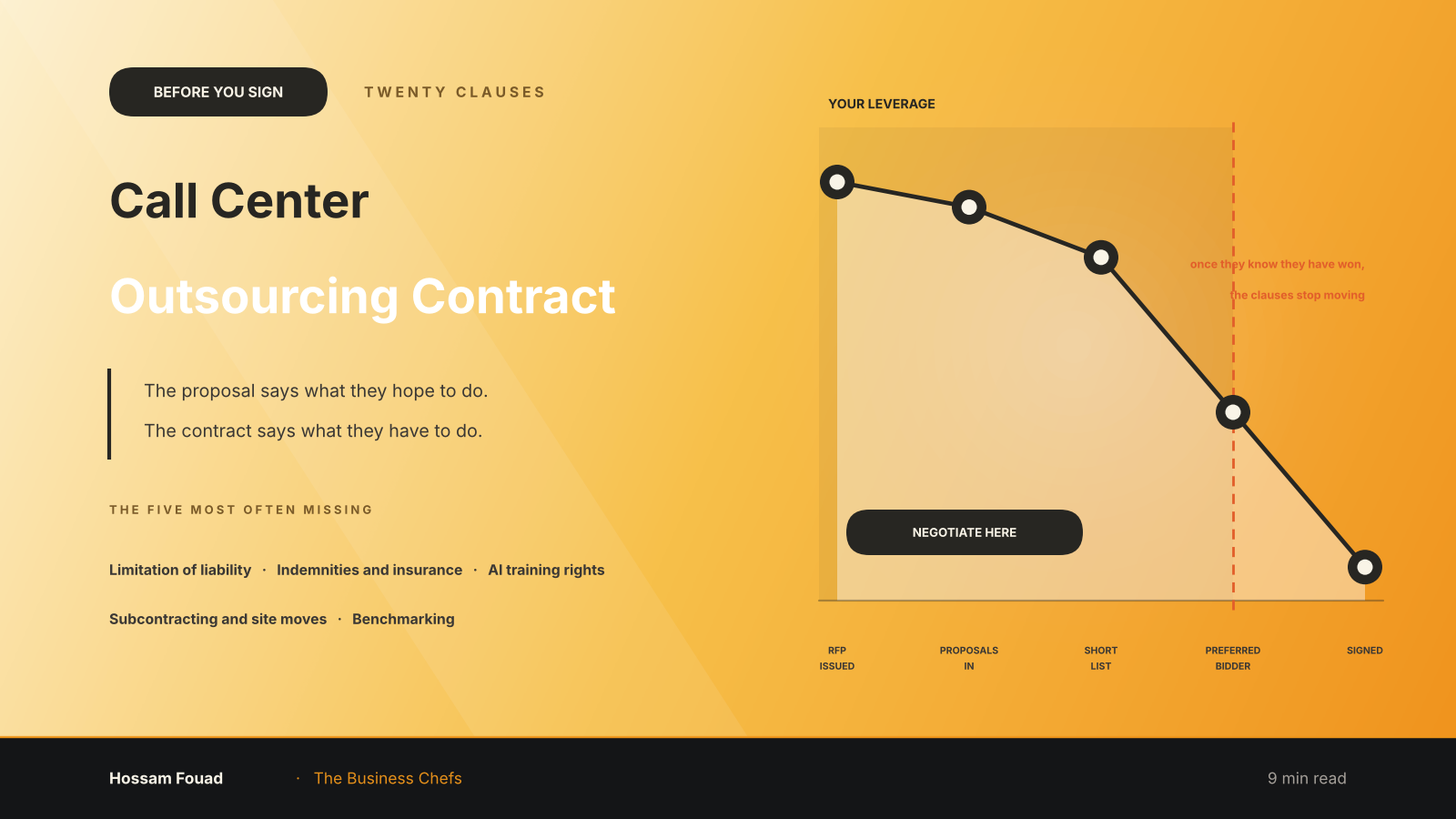
5. Contracting. Outcome-based pricing, service levels, data protection, benchmarking and exit terms. Your legal team leaders; the consultant supplies the commercial and operational detail.
6. Transition. Knowledge transfer, training, parallel running and go-live. The vendor leads this; your job is assurance.
7. Governance. KPI dashboards, business reviews and optimization. This one never ends, and it has to be owned internally.
Deloitte found that 70% of executives say their vendor management function is not fully mature, which is the single best argument for taking phase seven seriously. A well-negotiated contract that nobody enforces is a document, not a control.
Our guide on how to choose a BPO partner in Saudi Arabia shows what a strong selection process looks like end to end, and the contact centre KPI guide covers what to put on the governance dashboard.
How much does BPO consulting cost?
Costs vary widely with scope, complexity and seniority, so be wary of anyone quoting a price before understanding your situation. That is true — and it is also the answer every consultant gives, so here is more structure than that.
What actually drives the fee: the number of processes and sites in scope, how clean your baseline data is, how many countries you are comparing, whether you need a pilot designed and run, and how senior the people doing the work are. The last one is the biggest multiplier and the least visible on a proposal.
The four pricing models, and what each is good and bad at:
- Fixed fee per phase. A set price for an assessment or an RFP. Easiest to budget and the best way to start with a firm you have not used before. Watch the scope definition, because that is where fixed-fee disputes live.
- Retainer. Ongoing governance and advisory support. Good for the long tail after go-live, which is the phase buyers most often leave uncovered. Set a review date or it becomes an annuity.
- Day rates. Flexible and right for short, bounded work. Poor for large programs, because nobody is accountable for finishing.
- Outcome-linked fees. Part of the fee depends on savings or performance targets. Attractive, and it carries its own bias: a consultant paid on savings has a reason to recommend the cheapest provider and the biggest change, which is not always the right answer. If you use it, link it to outcomes you care about — resolution quality, transition stability — not to headline savings alone.
Judge cost against the size of the decision, not against a day rate. A sourcing program sets the cost and quality of a function for three to five years, so the right comparison is the fee against the contract value it governs. A consultant who moves you to a partner with materially better first contact resolution can save more than the fee in the first year — our call center outsourcing cost guide shows how quickly resolution quality changes the total bill. One caveat worth stating plainly: that argument is made by consultants about their own fees, so ask for the arithmetic rather than the assertion.
Questions to ask before hiring a BPO consultant
1. Who paid you on your last five engagements? Not "are you independent" — everyone says yes. Ask about referral fees, vendor-paid success fees and whether the firm has a delivery arm.
2. Have you run operations yourself, or only advised on them? Ask what they were accountable for, with what headcount, and what went wrong.
3. Which industries and countries do you know first-hand? First-hand means they have been on the floor, not read the index.
4. Can you share references from clients with similar programs — including one that did not go to plan?
5. How do you measure your own success? Insist on outcomes, not deliverables. A slide pack is not an outcome.
6. Who will actually do the work? Senior practitioners or junior analysts. Get the names in the contract, not just in the pitch.
7. What would make you tell us not to outsource this? The answer tells you whether you are buying advice or a process.
Why demand for independent advice is rising
In Deloitte’s 2024 Global Outsourcing Survey, 80% of executives said they plan to maintain or increase third-party outsourcing investment. That headline is the one everyone quotes. Two other findings from the same survey are more useful to a buyer:
- 70% had selectively insourced work previously held by a third party over the preceding five years. Outsourcing decisions get reversed often, and reversal is expensive.
- Only 25% reported lower vendor service costs or better service quality. Three quarters of buyers are not getting the two things outsourcing is sold on.
Read together, those numbers say the problem is not whether to outsource — the market has decided that — but that most buyers are not getting what they paid for. That is the actual case for independent advice, and it is a stronger one than the growth figure.
The Business Chefs is a boutique BPO and CX consultancy. Our senior practitioners have run operations, not just advised on them, and our SMART Sourcing approach covers strategy, vendor selection, BPO assessments and transition for companies in North America, the UK and the GCC.
|
Thinking about outsourcing, or fixing a vendor that is not delivering? Book a free discovery call |
Conclusion
A BPO consultant is your independent guide through one of the most consequential operational decisions a company makes. Bring one in when you outsource for the first time, when a vendor underperforms, when you expand across countries, or when you switch providers. Do not bring one in to validate a decision you have already made, or to compensate for the absence of an internal owner.
Choose someone independent in a way you can verify, experienced in operations rather than only in advising on them, and accountable for outcomes rather than deliverables. On a decision that sets the cost and quality of a function for the next three to five years, that engagement should pay for itself several times over — and if it cannot, you should not be buying it.
Frequently Asked Questions
What does a BPO consultant do?
A BPO consultant assesses your current operations, decides what to outsource and where, builds the business case, runs vendor selection and contracting, oversees the transition and sets up governance. They work on the buyer’s side and do not run the operations themselves.
What is the difference between a BPO consultant and a BPO provider?
A BPO provider runs outsourced operations, such as customer service, and earns fees for that work. A BPO consultant advises the buyer on strategy, vendor selection and performance. Because they do not sell operations, consultants can give vendor-neutral advice — provided they are not taking fees from providers, which is worth asking about directly.
When should a company hire a BPO consultant?
The most common triggers are outsourcing for the first time, an underperforming vendor, expansion into new countries, and a planned vendor switch or renegotiation. In each case independent expertise reduces risk and usually improves contract terms.
When should a company not hire a BPO consultant?
When the scope is small and single-site, when the decision has already been made and you only want validation, when you already have a mature vendor management function, or when there is no internal owner who will be accountable after the engagement ends.
How much does BPO consulting cost?
It depends on scope, complexity and seniority. Common models are fixed fees per phase, retainers, day rates and outcome-linked fees. Judge the cost against the value of better vendor choices, stronger contracts and lower total cost of ownership — and ask for the arithmetic behind any savings claim.
Can a BPO consultant audit my current outsourcing vendor?
Yes. A vendor audit reviews performance data, quality, contract terms, governance and costs to identify what is working, what is not, and whether the issue lies with the vendor, the contract or your internal processes. It usually ends with a prioritized improvement plan.
|
About the author Hossam Fouad is the Managing Partner of The Business Chefs, a boutique BPO, customer experience and strategic sourcing consultancy. He advises enterprises in North America, the UK and the GCC on outsourcing strategy, partner selection and contact centre performance, working hands-on with operations teams from assessment to execution. Planning to outsource or fix an underperforming contact centre? Book a free 30-minute discovery call with a senior practitioner. No sales pitch, just practical next steps. |