Nearshore vs Offshore BPO: Which Model Fits Your Business?
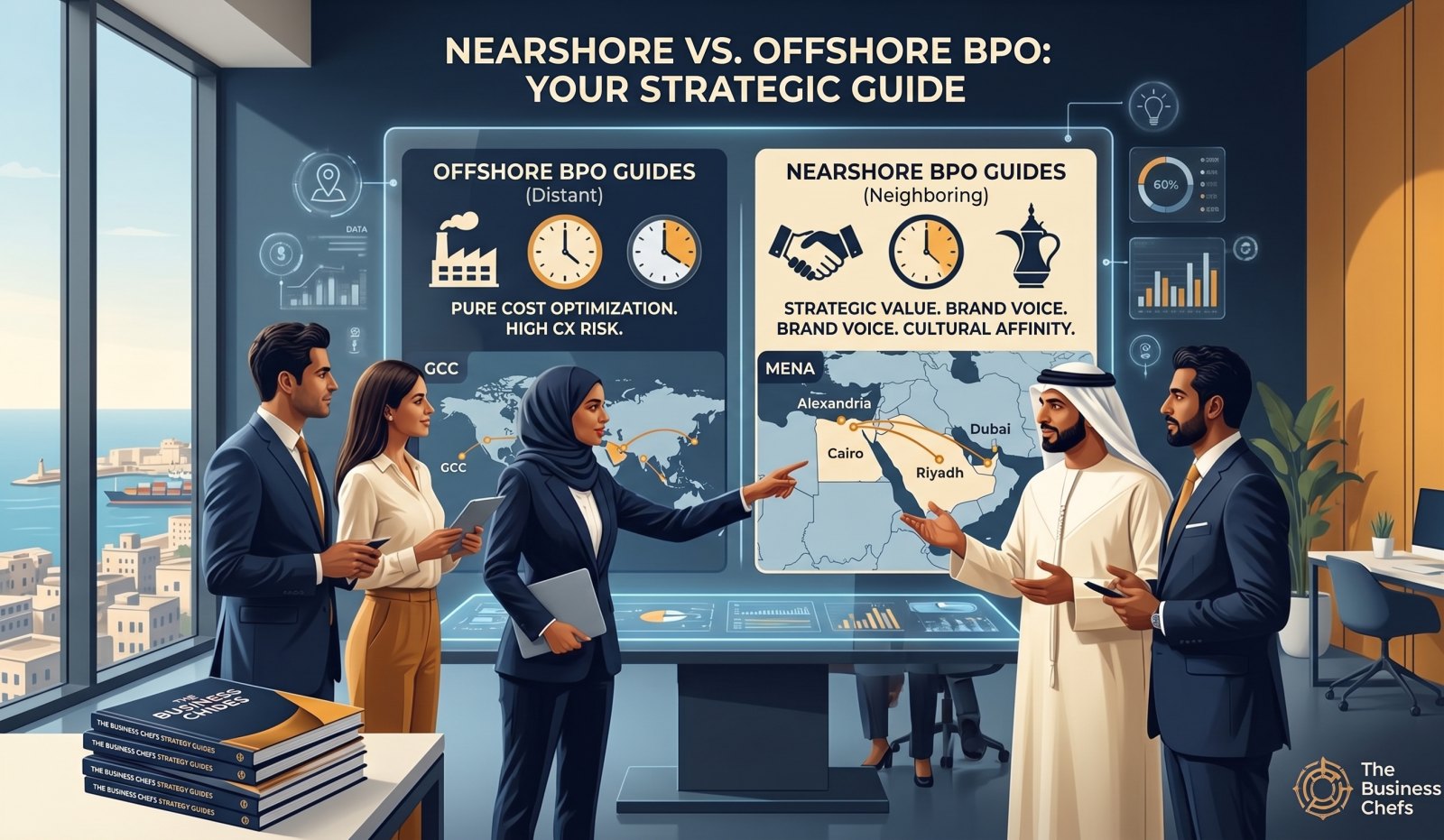
Offshore outsourcing saves you the most money but usually hurts your customer experience because of language and cultural barriers. Nearshore costs slightly more but keeps your brand voice intact because the agents actually understand your customers' culture. The right choice depends on whether you are optimizing for pure cost or long-term customer loyalty.
The geography of customer support
The instinct when a support budget lands on a CEO’s desk is to look for the lowest hourly rate, wherever in the world it sits. That instinct built the offshore industry, and for a lot of work it was right.
What it misses is that a contact center is not a factory. The output is a conversation. A customer in Riyadh who has to repeat themselves three times has had a bad experience regardless of what the seat cost, and they will call back, which means you pay for the interaction twice.
So, the offshore versus nearshore debate is really a question about fit. Get that right and cost follows. Get it backwards and the rate card becomes the most expensive thing in the operation.
Start with your customers, not the map
Miles are a poor proxy for fit. Manila is far from California and serves American consumers well, because the match that matters are language, accent familiarity and working hours, not distance. Cairo is close to Dubai and serves Gulf customers well for the same reason.
For GCC brands there is a complication the usual debate ignores. Your customer base is not homogeneous. In the UAE and Qatar, a large share of customers are expatriates, and they contact you in English, Hindi, Urdu, Tagalog, Malayalam or Arabic depending on who they are.
That single fact reshapes the decision. A nearshore Arabic team is the right answer for Gulf national customers and for anything requiring dialect and register. It is the wrong answer, on its own, for a customer base where most contacts arrive in English or South Asian languages. Many GCC operations need both, which is a sourcing design question rather than a choice between two countries.
So before comparing locations, answer three questions about your own contact volume:
1. What languages do customers actually contact you in, and in what proportion?
2. Which contacts are voice, where accent and register carry weight, and which are chat, email or back office, where they carry much less?
3. Which contacts are high-emotion, high-value or complex, and which are routine?
Offshore: cheapest capacity, narrowest fit
For a GCC business, offshore usually means India, the Philippines, Sri Lanka or Southeast Asia.
Where it works well. Back-office processing, data entry, finance and accounting operations, IT service desk, and English or South Asian language chat and email support. For the expatriate portion of a Gulf customer base, an offshore team can be a better match than a nearshore Arabic one. The talent pools are deep, the scale is available quickly, and the cost per seat is the lowest of the three options.
Where it struggles. Arabic voice support, anything requiring Gulf dialect or register, and complex conversations where an accent mismatch turns a two-minute call into a five-minute one with an escalation at the end. Time zones add friction too: an India or Philippines team serving Gulf hours works a shifted schedule, which tends to show up in attrition rather than in the proposal.
The honest framing is that offshore is not lower quality. It is a different fit. Put it against the wrong work and it looks like a quality problem.
Nearshore: the fit premium
For the Gulf, nearshore means Egypt, Jordan, Morocco or Tunisia, and increasingly Egypt in particular for Arabic voice at scale.
Where it works well. Arabic voice support, VIP and high-value care, complex problem-solving, and anything where the customer should feel the agent understands their world. An agent in Cairo reads a Gulf caller’s expectations, formality and humor in a way an agent without that background cannot be trained into quickly. Working hours overlap almost completely, so escalations reach a supervisor the same morning rather than the next one.
What does it cost? More per seat than deep offshore, less than in-market delivery in the GCC. The premium buys fit, and it is only worth paying on work where fit changes the outcome.
What to check. Dialect coverage is not uniform. A Cairo team handles Gulf Arabic well, but Levantine, Sa’idi and Khaleeji registers are not interchangeable, and Moroccan Arabic is a different proposition again for Gulf customers. Ask which dialects the account will actually be staffed for and listen to recorded calls before signing.
The two options this debate usually leaves out
In-market delivery. Some work has to sit inside the GCC: government-facing services, certain regulated financial and healthcare processes, and any contact type where data residency rules or a client mandate requires it. It is the most expensive option per seat and sometimes the only permitted one. Nationalization programs such as Emiratization and Saudization also make in-market hiring a strategic commitment rather than purely a cost line.
Blended delivery. This is where most mature operations end up, and it is the answer the either-or framing hides. Arabic voice and VIP care nearshore. English and South Asian language chat, email and back office offshore. The regulated or government-facing slice in-market. One partner coordinating all three, or two partners with clear boundaries between them.
Blending has a real cost: more governance, more integration work, and a risk of inconsistent experiences across channels if nobody owns the standard. It is worth it when the contact mix is genuinely varied. It is overhead you do not need if you run one language and one contact type.
The three models side by side
|
In-market (GCC) |
Nearshore (Egypt, Jordan) |
Offshore (India, Philippines) |
|
|
Relative cost per seat |
Highest |
Middle |
Lowest |
|
Arabic voice and dialect |
Strongest |
Strong |
Limited |
|
English and South Asian languages |
Available, expensive |
Available |
Deepest pools |
|
Working hours |
Identical |
Near-identical |
Shifted, needs night shifts |
|
Scale available quickly |
Constrained |
Good |
Greatest |
|
Data residency |
Simplest |
Needs contractual and technical controls |
Needs contractual and technical controls |
|
Best used for |
Regulated and government-facing work |
Arabic voice, VIP care, complex resolution |
Back office, IT service desk, English and South Asian language chat |
Cost is shown in relative terms deliberately. Absolute rates move with currency, wage inflation and scope, so the only comparison worth making is against your own quotes, built as total cost of ownership rather than hourly rate.
Deciding by work type, not by country
Run each contact type through the same three filters and the location answers itself.
|
Contact type |
Language and channel |
Where it usually belongs |
|
Gulf national customers, voice |
Arabic, dialect and register matter |
Nearshore |
|
VIP, complaints, retention calls |
Any language, high emotion |
Nearshore, or in-market for the top tier |
|
Expatriate customers, voice |
English, Hindi, Urdu, Tagalog |
Offshore |
|
Chat and email, general |
Mixed |
Offshore, with Arabic chat nearshore |
|
Back office, finance, IT service desk |
No customer contact |
Offshore |
|
Regulated or government-facing |
Any |
In-market |
The pattern is consistent: fit premium where the conversation is hard, lowest viable cost where it is not. A single-location decision forces you to overpay for one of those or underserve the other.
The risks nobody puts in the business case
Location decisions are usually modelled on rate and quality alone. Four other things move the answer.
- Currency and wage inflation. The cost advantage quoted today is not fixed. Currency movement and local wage inflation can erode a differential over a three-year term, so ask how rates are indexed and what triggers a re-rate.
- Data residency and privacy law. Saudi and UAE data protection rules, sectoral regulation, and your own client contracts may constrain where customer data can be processed. Settle this before shortlisting, not during legal review.
- Concentration and continuity. A single delivery country is a single point of failure: power, connectivity, political disruption, or a local event that takes a site offline. Ask what the fallback site is and whether it has ever been used.
- Talent competition. Popular nearshore hubs get crowded. In a city where every BPO is hiring from the same pool, wages rise and attrition follows. Ask what the vendor’s attrition looked like over the past three years, not last quarter.
Frequently asked questions
What is the real difference between nearshore and offshore?
Proximity in language, culture and working hours rather than in kilometers. Nearshore for a Gulf brand means somewhere that shares the language and the business day. Offshore usually means a deeper talent pool, a lower rate, and a shifted schedule.
Why does Egypt come up so often for GCC companies?
A large, educated, multilingual workforce, Arabic that Gulf customers understand, and working hours that overlap almost entirely. It is a strong fit for Arabic voice work in particular. It is not automatically the answer for an English-language or back-office requirement.
Does nearshore improve CSAT?
It can, where the previous problem was language or cultural mismatch. If contacts are rising because of a broken returns policy or a confusing app, moving the team closer will not fix it. Diagnose the contact drivers before you move the seats.
Can I use more than one location?
Yes, and most operations of any size eventually do. Put the work where it fits and accept the governance overhead that comes with coordinating two or three sites.
How much cheaper is offshore than nearshore?
It varies enough with scope, language and seniority that any published figure is close to meaningless. Compare real quotes for your own volume mix and build the comparison on total cost of ownership including rework and attrition.
Work out your contact mix first
The location decision is straightforward once you know what your contacts actually consist of. Most companies have never broken them down by language, channel and complexity together.
Book a free 30-minute Sourcing Fit Review. In one session we’ll help you:
- Break your contact volume down by language, channel and complexity
- Map each segment to the delivery model that fits it
- Identify which contacts you should be preventing rather than relocating
No commitment and no pitch deck. If your current location is the right one, we’ll tell you.
Book Your Sourcing Fit Review → https://cal.com/thebusinesschefs/30min