Best Countries for Call Center Outsourcing in 2026
|
Key takeaways
|
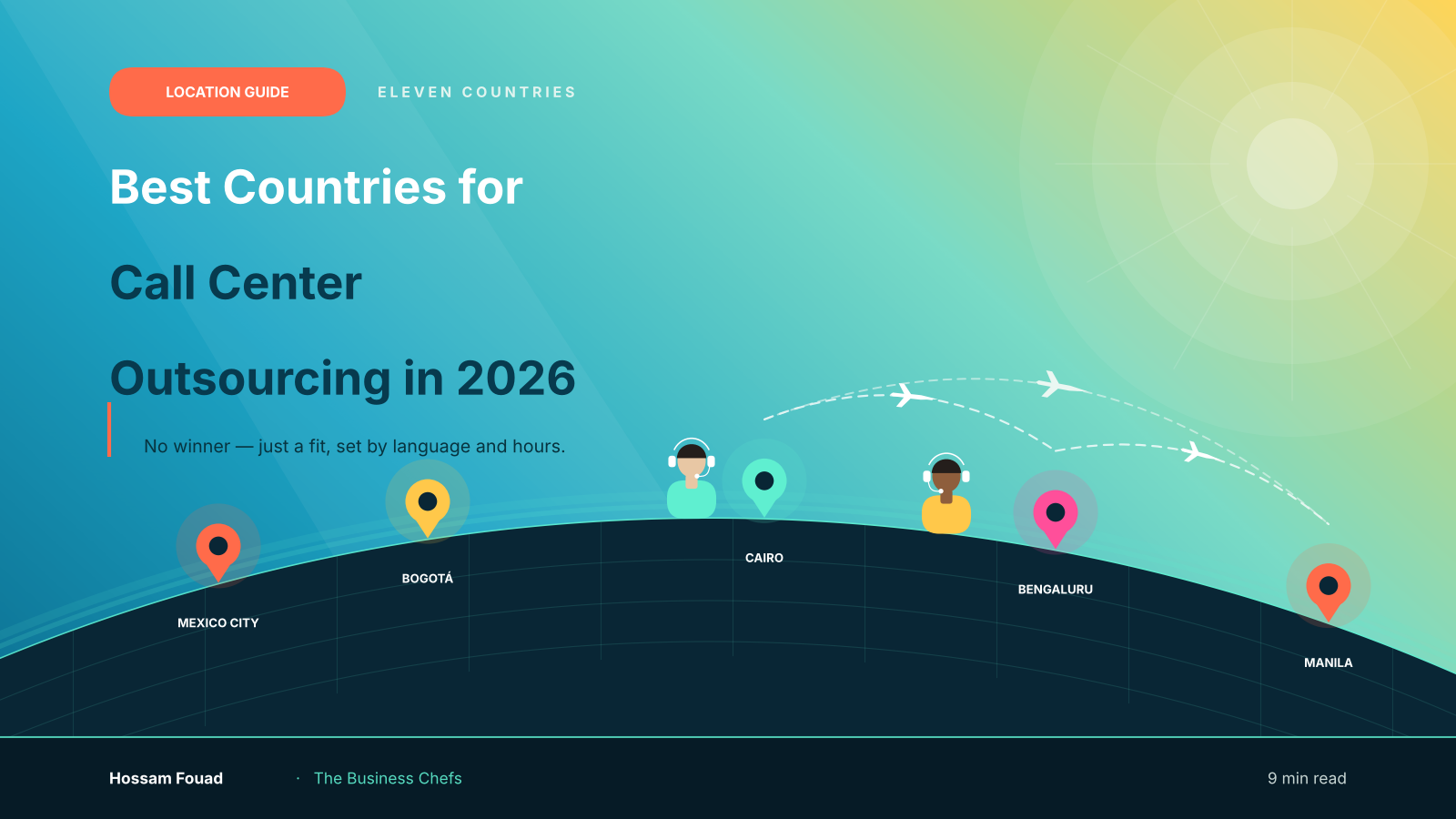
The best countries for call center outsourcing in 2026 are the Philippines and India for large-scale English-language support; Mexico, Colombia and the Dominican Republic for nearshore service to North America; Egypt, Jordan and Turkey for Arabic and Middle East coverage; Poland and Romania for multilingual European support; Morocco and Tunisia for French; and South Africa and Kenya as fast-growing English-speaking options. There is no single winner. The right choice depends on who your customers are, when they call, what language they speak, and what your regulator permits.
Why companies are looking beyond India in 2026
India remains the global leader. In Kearney's Global Services Location Index, which ranks locations on cost, skills and business environment, India placed first and China second, with Malaysia among the leading group. That edition was published in July 2023 and is the most recent available, so treat it as a structural signal rather than a current snapshot.
So why are buyers looking elsewhere? The reasons are strategic rather than a verdict on India:
- Concentration risk: running all customer operations from one country exposes you to one set of disruptions.
- Language and culture: Spanish-speaking customers in the Americas, Arabic-speaking customers in the Gulf and multilingual customers in Europe are usually better served from elsewhere.
- Time zones: real-time supervision is easier when your partner works your hours.
- Changing priorities: in Deloitte's Global Outsourcing Survey, skilled talent and agility now sit alongside cost reduction as primary drivers.
Most mature buyers now run multi-country portfolios, keeping India for what it does best and adding locations that close specific gaps.
Start from where you are
Most location guides, including the first version of this one, are organized by region of supply. Buyers do not read that way. They arrive with a location, a customer base and a queue, and they want to know which column is theirs.
| The Work | GCC Buyer | UK & Europe Buyer | North America Buyer |
| Local-language voice |
Egypt, Jordan (Arabic) |
Poland, Romania Egypt |
Mexico, Colombia Dominican Rep. |
| English voice at scale | Philippines, India | Philippines, South Africa | Philippines |
| Multilingual European |
Turkey, Poland Romania |
Poland, Romania |
Poland, Romania |
| Backoffice, F&A, IT Desk | India, Egypt | India, Poland | India, Mexico |
| Premium & VIP care | Jordan or in-market | South Africa or in-market | Mexico or in-market |
| Regulated or data-restricted |
In-market - Saudi work in Kingdom, Saudi Staff |
In-Market or within EU |
In-market |
|
THREE THINGS THE MAP WILL NOT TELL YOU Scale - Jordan & the Philippines are not interchangeable. Attrition - the crowded hubs churn hardest. Currency - a three year rate is a three years bet |
Find your column, read it down, and treat the rest of this article as the detail behind your own two or three cells.
Nearshore destinations for North American companies
Latin American nearshore centers typically run $12 to $24 per agent hour, according to Retell AI's 2026 cost guide — a vendor-published figure, so directional rather than audited — and they work in or near U.S. time zones.
Mexico
Proximity to the United States, a large bilingual workforce, and Central and Pacific time zones. Suits Spanish and English support, complex service, and programs that need frequent on-site visits.
Colombia
Stays on UTC−5 all year, matching U.S. Eastern in winter and Central in summer, with a neutral Spanish accent and a growing English-speaking pool. Suits bilingual service, sales and collections.
Dominican Republic
Caribbean delivery at UTC−4, bilingual agents and a short flight from major U.S. cities. Suits small and mid-sized English and Spanish programs.
Nearshore destinations for GCC and European companies
Egypt
The largest outsourcing hub in the Middle East and Africa. According to ITIDA, Egypt's IT Industry Development Agency, digital export revenues doubled from $2.4 billion in 2022 to $4.8 billion in 2025, with 55 new agreements — including Accenture, Capgemini, Deloitte and Teleperformance — expected to create more than 70,000 jobs over three years. More recent figures reported by Enterprise put outsourcing exports at $5.2 billion in fiscal 2025/26, with about 195,000 Egyptians working in the exporting industry.
Egypt offers Arabic, English, French, German and other European languages with a minimal time gap to the Gulf and Europe. Its scale is also its main risk: the popular districts are a competitive employers’ market, and that shows up in attrition and wage pressure rather than in the rate card.
Jordan
UTC+3, highly educated Arabic and English speakers, and a Levantine dialect widely understood across the Gulf. Suits premium Arabic service at smaller scale than Egypt — which is the point to check before you commit volume.
Turkey
UTC+3, bridging Europe and the Middle East, with Turkish, Arabic and European language capability. Suits multilingual European and regional programs.
Morocco and Tunisia
Both are substantial BPO markets, strongest for French and other European languages and for back-office work. Moroccan Darija differs considerably from Gulf Arabic, so neither is a natural first choice for Gulf-facing Arabic voice — a distinction worth making explicitly, because they are often grouped with Egypt and Jordan as though interchangeable.
Poland and Romania
Mature European hubs for multilingual service, technical support and shared services. They suit companies serving several European markets from one site. Retell estimates Eastern European rates at $12 to $22 per agent hour.
Offshore destinations
Philippines
The benchmark for English-language voice. Its IT-BPM industry generated more than $40 billion in revenue in 2025 and employed about 1.9 million workers, according to the industry association IBPAP. Suits high-volume customer service, healthcare and financial services support. The constraint for a Gulf or European buyer is the time gap, which leaves only part of a working day for live supervision.
India
The deepest market for IT-enabled services, back office and English-language support, and the natural pool for Hindi, Urdu, Malayalam and Tamil — which matters more for a GCC expatriate customer base than most location guides acknowledge. Its time zone overlaps most of a Gulf working day.
Pakistan and Sri Lanka
Smaller than India but worth a look for the same South Asian language coverage, particularly where that is a meaningful share of your contact volume rather than an edge case.
South Africa
Native-level English, an accent UK and Australian customers find easy, and UTC+2 alignment with Europe. It sits a tier above Kenya on cost for the same language, and the reason is what you are buying: accent neutrality for Western markets, higher average education, and a more established delivery industry. Check power and connectivity contingency.
Kenya
UTC+3, a young English-speaking workforce and a fast-growing digital services sector. Suits cost-sensitive English-language service and back-office work. A newer market, so scale and depth of experienced supervision are the questions to ask.
Country comparison
Cost tiers are indicative and relative, including a high tier so that onshore has a place on the scale. Scale is shown qualitatively, because published workforce figures exist for only a few of these markets.
|
Country |
UTC |
Key languages |
Cost tier |
Scale |
Best for |
|
Philippines |
+8 |
English |
Low |
Very large |
High-volume English voice |
|
India |
+5:30 |
English, Hindi, S. Asian |
Low |
Very large |
IT-enabled services, back office |
|
Egypt |
+2 (+3 summer) |
Arabic, English, French, German |
Low |
Large |
Arabic and multilingual EMEA |
|
Kenya |
+3 |
English, Swahili |
Low |
Emerging |
Cost-sensitive English support |
|
Pakistan, Sri Lanka |
+5, +5:30 |
English, Urdu, S. Asian |
Low |
Medium |
South Asian language coverage |
|
Morocco, Tunisia |
+1 |
French, Arabic, English |
Low–Medium |
Large |
French and European languages |
|
South Africa |
+2 |
English, Afrikaans |
Medium |
Medium |
Premium English for UK and Europe |
|
Mexico |
−6 to −7 |
Spanish, English |
Medium |
Large |
Bilingual U.S. support |
|
Colombia |
−5 |
Spanish, English |
Medium |
Medium |
Bilingual sales and service |
|
Dominican Republic |
−4 |
Spanish, English |
Medium |
Small |
Small and mid-sized U.S. programs |
|
Jordan |
+3 |
Arabic, English |
Medium |
Small |
Premium Arabic service |
|
Turkey |
+3 |
Turkish, Arabic, European |
Medium |
Medium |
Multilingual regional programs |
|
Poland, Romania |
+1 to +3 seasonal |
Polish, Romanian, European |
Medium |
Medium |
Multilingual European support |
|
In-market (GCC, US, UK) |
local |
local |
High |
Limited |
Regulated and data-restricted work |
Cost tiers depend on languages, channels, complexity and volume, so validate everyone with real quotes. For actual rate ranges and why the hourly figure misleads, read our call center outsourcing cost breakdown for 2026.
*Used the two sourced figures (Philippines 1.9m, Egypt ~195,000) and the rest is qualitative
What a comparison table cannot show you
Time zone, language and cost are the easy columns. Three harder factors decide whether a location works over a contract term, and none of them appear in a tier label.
Scale
Jordan and the Philippines are not interchangeable, and a table that lists them as peers invites exactly that mistake. Ask how many agents a provider can field in your languages, how fast, and what happened the last time a client doubled volume. A country that is perfect at 40 seats can be the wrong answer at 400.
Attrition
The crowded hubs churn hardest. Where every provider in a city recruit from the same pool, wages rise and tenure fall, and you pay for it in repeat contacts rather than in the rate. This is the factor most location guides omit entirely, including the previous version of this one. Ask for attrition over three years rather than last quarter, and for average agent tenure on comparable programs.
Currency and cost drift
The rate advantage quoted today is not fixed. Currency movement and local wage inflation can erode a differential well inside a three-year term, and Egypt in particular has seen significant currency movement in recent years. Ask which currency the contract is denominated in, how rates are indexed, and what triggers a re-rate.
And one that can remove a country entirely
Regulation does not adjust your comparison; it deletes rows. Saudi Arabia requires customer service jobs inside the Kingdom to be held by Saudi nationals, and data protection rules can prevent personal data leaving a jurisdiction at all. Settle this before you shortlist, not after. Our article on Saudization and BPO covers the details, including the carve-outs that are easy to miss.
Matching your needs to the right country
Five questions narrow the list quickly:
1. Who are your customers? Their language and dialect come first, and the answer is often more mixed than you expect — in much of the GCC a large share of contacts arrive in English or South Asian languages.
2. When do they contact you? Match working hours for the management overlap or design follow-the-sun deliberately.
3. How complex is the work? Complex, high-value interactions justify a higher-cost location with stronger resolution.
4. What rules apply? Localization and data protection can remove options outright.
5. How much risk can you carry? Two or three countries reduce exposure, at the price of real governance overhead — rarely worth it below roughly 50 to 75 seats in total.
Then compare on cost per resolved contact rather than hourly rate. Our nearshore vs offshore guide explains why and sets out how a hybrid portfolio actually gets governed.
The Business Chefs works with a global delivery network across Latin America, Europe, Africa, the Middle East and Asia-Pacific. Our SMART Sourcing approach helps companies choose the right location and partner for each type of work.
Conclusion
In 2026 the best outsourcing country is the one that fits your customers, your hours and your rules. The Philippines and India lead on scale, Latin America on proximity to North America, Egypt and Jordan on Arabic, Morocco and Tunisia on French, Eastern Europe on multilingual coverage, and South Africa and Kenya on English at different price points.
Build the portfolio around fit and resolution quality. Then do the part most buyers skip, ask about scale, attrition and currency, because those are what turn a good location on paper into a good one in year three.
Frequently asked questions
Which country is best for call center outsourcing in 2026?
There is no single best country. The Philippines leads for English-language voice at scale, India for IT-enabled and back-office services, Mexico and Colombia for nearshore support to North America, and Egypt for Arabic and multilingual EMEA. Choose on language, time zone, complexity and regulation.
What are the best alternatives to India?
The Philippines for English voice, Egypt for Arabic and European languages, Mexico and Colombia for bilingual U.S. support, Poland and Romania for European languages, Morocco and Tunisia for French, and South Africa and Kenya for English. Most companies use them alongside India rather than instead of it.
Is Egypt a good country for call center outsourcing?
Yes, particularly for Arabic and multilingual support. Digital exports doubled from $2.4 billion in 2022 to $4.8 billion in 2025 according to ITIDA, with outsourcing exports reported at $5.2 billion in fiscal 2025/26 and about 195,000 people in the exporting industry. The trade-off is a competitive labor market in the popular districts, so ask about attrition.
What is the best nearshore location for U.S. companies?
Mexico, Colombia and the Dominican Republic. All three offer bilingual Spanish and English talent, overlapping time zones and short travel, at roughly $12 to $24 per agent hour on vendor-published 2026 figures.
Which country has the lowest attrition?
No country has uniformly low attrition — it is a function of how crowded the local market is rather than of the country itself. A smaller city in a large market often retains better than the capital. Ask each provider for three years of attrition data on comparable programs and compare those, not countries.
How do I choose an outsourcing country?
Start with your customers’ language, your operating hours and the complexity of the work. Check localization and data protection rules, which can remove options entirely. Then compare on cost per resolved contact, ask about scale, attrition and currency, and consider spreading work across two or three countries if you are large enough to govern it.
|
Choosing a location for your next contact center? Book a free 30-minute call with a senior practitioner. No sales pitch, just practical next steps. Get an independent recommendation |
|
About the author Hossam Fouad is the Managing Partner of The Business Chefs, a boutique BPO, customer experience and strategic sourcing consultancy. He advises enterprises in North America, the UK and the GCC on outsourcing strategy, partner selection and contact center performance, working hands-on with operations teams from assessment to execution. |